• The move to the new server is done. There are some software and database maintenance updates in process. This has us passing the hat around to help out. We appreciate any donations. Seriously, even a dollar helps. The payment page may be found here - https://www.audiokarma.org/support.html

Kenwood Ka-8300 Intermittent Left Channel

vmedia

Active Member
Hello,
I have a (new to me) KA-8300 which is in nice shape, but has an intermittent left channel problem that seems to be common with this model, but I have not been able to find any solid solutions that fit with my situation.
After thoroughly cleaned all pots and switches (multiple times) and replacing the the speaker relay, what continues is the following:
1 - Upon cold turn on the left channel is distorted (maybe 75% of the time, typically after being off overnight)
2 - When the channel is distorted, spinning the volume knob to extreme levels eventually clears up the problem.

I have tried switching the separate/couple switch using LtoR / RtoL cabeling and the problem switches to the right side, proving (to me) that the problem lies before output amp boards.

I audio traced the pre-amp board and discovered clean signal at pin 13 (left input) but leaves pin 27 distorted (Left output from per board) - thinking this may be bad transistors at Qd5 and Qd7 - I replaced with KSA992 (Qd5) and KSC1845 (Qd7). Also replaced C15 as it looked a bit suspect. No change.

Any thoughts would be appreciated. As this is an intermittent issue, it's tough to measure voltages, but I'm thinking if I have a list of priorities, I can quickly check areas before the distortion goes away (it typically clear up on its own after 10 minutes or so).

Any help would be most appreciated.
 
Register to hide this ad
You are fortunate to have one of these with intact output modules.

Since the switches have apparently been cleaned multiple times, that might remove the prime suspects. Board connectors, solder joints, and even foil traces may require a thorough inspection for marginal connections.

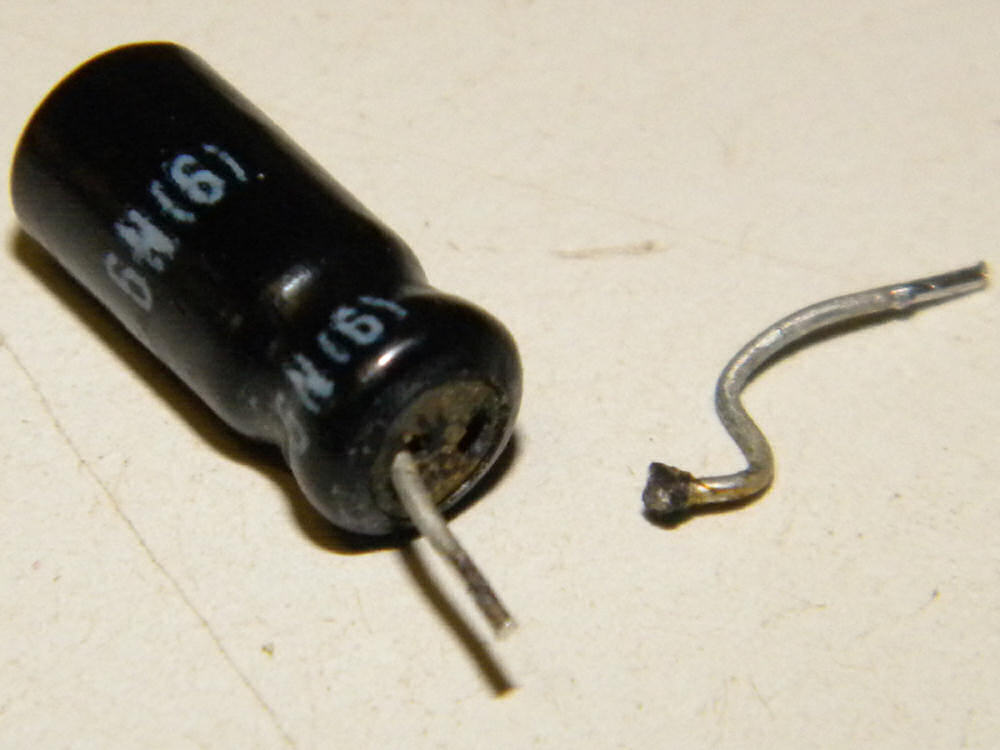
It's also possible that a device in the path has an internal connection problem. I recently discovered an electrolytic with an internally failed connection - It let go well up into the package:

SX-750C111.jpg
 
Thank you for your replies.
The speaker relay has been replaced.
I’m planning on measuring voltages next time I am able to recreate the issue.
Any suggestions on where/what to measure?
 
Thanks! I was inspecting earlier today and in fact did suspect Qd9 (2sc1345) as the leads look moldy - I traced the signal and it is clean to base and emitter leads (outer) but dirty/distorted at collector (center) - I am planning on replacing with 2sc145.
I'll report back soon.
 
Every one of the six 2SC1345s in it needs to be replaced anyway. It is on the Top Eleven list of suspects. Also replace all four of the 2SA750s in the unit.
 
Q9 appears to have been the culprit!
Now, I'm seeing that the left channel is slightly hotter/louder than the right. I did swap out c15 on the left side - otherwise both right and left have matching transistors.
Thoughts on what could be causing the imbalance?
 
Thanks rjsalvi.
I was charging my old iphone for this very purpose when I saw your response. Great advice, and I was able to check tonight with a 1K tone into amp direct. The meters and output were spot on. So, this tells me that the imbalance is in the pre-stage. I have cleaned all switches and pots multiple times, so this is likely not the culprit. As I mentioned previously, I have not recapped the entire pre-board as I'm always inclined to fix a problem before blindly replacing parts. I think I need to fire up the oscilloscope and check levels going in/out of the first pre-amp board as my next step. Wondering if there are other signal test points that I can also check to help zero in further?
 
I'd start at the pre out and see if really is the preamp side. if so, pins 27/36 of the tone board. still bad? 17/18 of the same tone board. this should help narrow down the problem.

looks like a lot of switches before the tone board.

Don't forget your scope and a signal generator are your friend (and Robert).

Re-reading your original post, I don't see pin 13 as an input. here is what my schematic looks like (pulled from hifiengine)
8300-pre.jpg
 
Last edited:
Hello - sorry it's been a while, travel and a Sansui Eight that showed up unexpectedly.
So, I replaced all transistors on the pre board and thought I had solved the problem, but, today when listening to the tuner, the left side started to distort again. This time, no amount of fiddling with the volume or balance pots got it to go away. I hooked up a tone generator and fired up the O-scope and confirmed that the signal on pin 13 (this comes from balance pot) is clean, pin 27 is bad. I was not able to get to pin 17 because, along the way I got careless and shorted something close to pin 13 and it cleared up immediately ! I've had this happen once before and have a suspicion this can point to a cap that's on its way out? I'm also wondering if that finicky power supply board can cause something like this? Currently voltages look good, but the distortion is not happening right now. I did touch up the questionable solder joints on Power Supply, but certainly could have missed something. Also, does signal come in to this board from presence board or out to that board?
As always, thanks for your help.
 
Last edited:
The symptoms you describe and your "short" experiment seems to scream "bad connection" in the circuit. Touching up the solder joints was a good first step. A close inspection of any connectors, board traces, and even components might be helpful.

I mention components because of Post #3.
 
I've pulled both power supply and pre boards today. Touched up solder joints on both and cleaned as best I could.
Right now all is well.
What's unusual, is that sometimes it starts with distortion, other times it happens after warming up - but not always. It wen 3-4 days with no distortion at all, granted, not on 24hrs a day.
I also touched up the left side solder connections on volume pot since I was in there.
Will report back once I've given it a good test run.
BTW rjsalvi, I'm also in San Diego.
 
Two words - "Heat Gun" - or even a hair dryer or carefully positioned hot soldering iron to warm components as a check for thermal problems. There are a handful of transistors reputed to have a tendency to lose internal connections to the substrate, and all bets are off if that happens. 2SC1344 and 2SC1451 come to mind as prime examples, among potentially many more.

This was a recent example of a similar problem:

http://audiokarma.org/forums/index....case-is-attached-solved.855790/#post-12405409
 
I believe I have solved the problem, at least, the distortion has yet to return after hours of testing.
Cd25 (.47 cap) seems to have been the culprit.
I found this as I was spraying freeze spray (inspired by the "heat gun" suggestion) even though I had already done this previously. I had been checking transistors before, and this time was spraying "areas" of the pre board just to see if anything changed when the amp was hot. After I had just given Icd1 a good squirt a drop of freeze spray fell directly on Cd25 and the distortion immediately stopped and the volume cranked up to full. Scared the daylights out of me, but clearly was the result I was searching for. I've replaced Cd25/26 with a .47 WIMA cap.
So far, so good.
To further investigate, I hooked up the old caps to my cap tester and measured how they reacted to heat applied by a hair dryer. They both increased in capacitance, but one definitely reacted more than the other, at one point increasing to .6uf (it also appeared to "bounce around" a few times, but I can not be sure this was from the heat and not the leads losing a solid connection)
What was throwing me was the fact that sometimes the distortion occurred right as I turned the unit on - after a night of sitting in a very cold (high 30 degrees Fahrenheit garage) - then would disappear once warmed up - other times the exact opposite (no distortion when cold, only to crop up when hot)
My question is if this is typical of old tantalum caps? Inconsistent changes due to hot or cold? I've always thought these are rare to go bad, but have possibly learned an important lesson.
As always, your thoughts are most appreciated.
 
Back
Top Bottom