• Please note that Audiokarma will be offline briefly for updates early on Monday morning, September 28th.

Kenwood KR-6600 relay shutting on and off repeatedly, and pops and crackling with volume at 0

benjaminlee

New Member
I recently purchased a Kenwood Kr-6600 from a man on facebook who said his relative used it for a while, then it sat in a barn for a while.

When I powered it on for the first time there was no sound at low volumes, and a faint sound close to max volume. I have since worked the dials and switches quite a bit, and sound does come through now, though the right channel is a bit weaker than the left.

Not long after I powered it on for the first time, the relay started to disengage after the amp was on for a few moments. After that, the relay wouldn’t engage when the amp was powered on. A day or so later, the amp will turn on, relay will engage, radio seems to play fine, but after about a minute of being powered on the relay will disengage, sometimes toggling back and forth quickly.

The only other notable issue, is when I tried to send a signal through the aux input, the relay would disengage and stay that way. I was able to use the tape play input to get sound, though after a few minutes of that, the relay shut off again.

I figured going into this that it wouldn’t be fully functioning, at least not until it gets a good cleaning, but I’m not sure cleaning is all it needs. Unfortunately I don’t have a guitar center anywhere near me, or any store that carries deoxit, so I ordered a can of d5 and f5 which will be here Friday.

It may be that I am just describing what occurs when pots/switches are really dirty, but I figure I can’t know that until the deoxit comes. The input selector is really tough to move, so that may be the culprit, though even with the volume at 0 I still hear pops and crackles. I’ve been reading countless related repair forums, but this is my first vintage amp and I could really benefit from some more direct guidance. Hoping someone sees this and is able to help in some way, thanks for reading!

Edit: Just tried playing through aux input, seemed to work fine for about 5 minutes, then relay started to flip off and on repeatedly.
 
Last edited:
Register to hide this ad
thanks for the detailed description of the problem. What are your skills in repairing electronics; can you solder/desolder? Can you read a schematic? Can you use a multimeter?

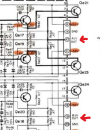
The first suspect is probably a bad capacitor on Cr3, Cr4, or Ck7. If you replace those and it’s still doing the same thing, it’s likely one of the transistors on Power Supply Unit A.
 
thanks for the detailed description of the problem. What are your skills in repairing electronics; can you solder/desolder? Can you read a schematic? Can you use a multimeter?

The first suspect is probably a bad capacitor on Cr3, Cr4, or Ck7. If you replace those and it’s still doing the same thing, it’s likely one of the transistors on Power Supply Unit A.
Hi! Thank you for responding so quickly. My skills in repairing electronics certainly may need some improvement. I have yet to solder or desolder much of anything in my life, though it does seem like something I would be able to pick up. I will say, I have been looking through the amp and the service manual since I purchased it, and I feel myself becoming more familiar with everything and starting to understand the schematics.

In my position, I suppose at this point I should consider whether to attempt the fix, and possibly create more issues, or find someone with the knowledge and expertise to fix the issue quickly and correctly. I would need to learn from video example, but I likely could learn to do it.

I was only able to see cr1, cr3, cr4, and cr5, but that’s mainly due to the transformer being in the way and the board’s position. From my very limited knowledge they do not appear bad, but I have yet to test them. I will get my multimeter some new batteries and get to testing things. I assume you’d be able to tell me what numbers to look for?

And as for repairs, I’m guessing you need to remove the board you’re working on, so all the wires twisted around the little metal toothpick like connectors on the edges of the boards need to be unwound and rewound, correct?

I suppose, more importantly, you’ll be able to tell me if it is worth learning these valuable skills (possibly saving myself a lot of time and money throughout my life), or if I should attempt to find someone who already has these skills. Apologies for the long response, I have many thoughts and questions and no one else to share them with.

Edit: I asked my roommate if he would be able to help with the actual soldering/desoldering as he is in school for physics and electrical engineering, he said he can help but doesn’t know much about audio circuits. So I would at least have someone who has experience soldering, I just can’t bother him much as he’s already a busy person.
 
Last edited:
I know when I was in school and one of my SWTP tigers failed, I really didn't know how to fix it and had one of my EE teachers help me.

I wouldn't expect your roommate to be much help unless he has fixed a lot of gear. Plus you really don't want to make it worse.

I think a better solution is to post your location and see if someone on AK will offer to help. If you are in my area, I can look at it.

Clean the switches and pots and report back.
 
And as for repairs, I’m guessing you need to remove the board you’re working on, so all the wires twisted around the little metal toothpick like connectors on the edges of the boards need to be unwound and rewound, correct?
There should be sufficient clearance to work on the boards without removing them. Stand the receiver up on its end and work from the top and bottom.

You should really avoid removing the wire wrap connections, if at all possible.

If your physics friend can replace a few components, that’s probably helpful. However, troubleshooting these can be quite time-consuming, which could put a lot of stress on any friendship. I agree with @rickl, see if there is an AK member nearby who could help out.
 
Thank you both for your advice, it has been helpful. I have been thinking about it quite a bit and was starting to come to the same conclusion, without the required skills this just may be too difficult for a starter project. And I’d rather not bother my roommate much, he’s very busy already.

I am in Boone, NC, and going off what I’ve seen listed on marketplace locally I would assume there are very few people here even interested in vintage audio, let alone anyone that could repair it. But I may be wrong, at least I hope I am.

Does the issue sound like it could be remedied with just a thorough cleaning? The part the bothers me most is how I’ve been able to get some nice sound out of it, only for the relay to click. I suppose I’ll have the answer on Friday.
 
Here is my opinion.

1. The scratchiness can be fixed with cleaning. All the knobs and maybe the relay, too. Deoxit should do the trick.

2. If it is a bad cap or transistor, the fix is pretty cheap and quick. It requires soldering skills and a little patience.

3. The parts are under $2. Shipping will cost more.

I’d give it a try, with a little assistance. What do you have to lose?
 
If the simple fix does not work and more troubleshooting is needed, you will still be in the same position.
 
Here is my opinion.

1. The scratchiness can be fixed with cleaning. All the knobs and maybe the relay, too. Deoxit should do the trick.

2. If it is a bad cap or transistor, the fix is pretty cheap and quick. It requires soldering skills and a little patience.

3. The parts are under $2. Shipping will cost more.

I’d give it a try, with a little assistance. What do you have to lose?
Not having to remove the boards and the wires makes this seem considerably less difficult, I guess I’d just need to get a soldering iron. Is it worth spending a little more to get something with decent quality? Or will a cheap one work fine?

And you're right, if it turns out not to be a simple fix I would be in the same position I am now. There’s a vintage stereo technician in Asheville I believe, about 2 hours away, so I do have that option.

Should I wait until I’m able to clean everything to order replacement parts? Seems like the best option in case my issue was just dirty pots/switches. I mean, the input selector is so dirty it takes actual muscle to move.
 
If you are in no hurry, yes, you should do this incrementally. Clean it, then fix it.

A cheap soldering iron should work just fine for this. I got a temp controlled iron on line for $12 or so and it is just fine. It’s nowhere near as nice as a good soldering station for long term use, but it will do the job.

If you need some assistance, check with your roommate or some other technogeek on campus. There must be someone who will sling a little solder for a few beers.
 
not that this is much help but I fixed a KR-6600 for a friend that recently moved to Asheville. I thought it was pretty nice.

the invoice said i recapped power supply 'A' and diff pairs (to lower DC offset). I'd focus on the caps on the protection (power supply 'C') to see if the relay stuttering is fixed.

Don't forget one of the caps might be a bi-polar (Cr3, 47uF). You can also measure the output to see if one of the channels are causing the problem (and the protection circuit is working) or if the protection circuit is the problem. See pins 10 and 19 on the amp board. post what you measure. it should be 0v but anything less than 100mV should not trip the protection. I don't have a kr-6600 snap some pics if you have questions. maybe your EE roommate can help. please be careful. put some electrical tape on the DVM probes so only the tip is exposed.

1730942329348.png
 
the first thing i'd do is measure the amp at 10 and 19 and talk about next steps.
 
the first thing i'd do is measure the amp at 10 and 19 and talk about next steps.
I believe I disconnected the amp board at one point as I remembered seeing that given as a suggestion elsewhere on ak, yet the problem persisted. I assume that means it isn’t part of the issue? I will still test 10 and 19 and get back to you.
 
Got all pots and switches cleaned today, even the ones hidden behind the preamp board. I hadn’t powered it on for a few days, so the first few minutes of it being on I was able to get sound, though the relay would still toggle on and off occasionally. After having it on for a bit, the relay won’t engage at all now.

I disconnected the amp board again to be sure, yet the issue still persisted. I measured 10 and 19, 10 read around 26mV while 19 was around 20mV. From what I’ve seen on similar forums those are pretty good numbers, and since nothing changed with the amp board disconnected I’m guessing it’s nothing on that board?

What else should I test? Or should I just order a soldering iron and replace the caps on the “power supply c” board? If that is the next step, I may need some guidance on where to source the parts from.
 
Ordered a soldering iron and some rosin flux. There’s some solder near me, do I need a specific type of solder for this job? And what is the best source to be getting capacitors and such from?
 
Ordered the capacitors off of mouser, got a few seemingly different caps of the same value just to be sure I’ll have what I need. Still may need help with that part, if either of you are still following the thread. Been a while since I’ve heard anything!

But I’m very appreciative of the information you’ve provided me so far, I plan to replace the capacitors mentioned earlier in the thread. Cr3, cr4, and ck7. Cr4 seems to have a slight budge on the bottom, but I’m yet to be confident with identifying bad caps. Hopefully I’m able to get those switched out without causing more problems, and hopefully that solves it. If not, I may have to rely on this thread, but I suppose I’ll know soon enough.

Parts arrive tomorrow and soldering iron arrives Friday. Hoping one of you see this soon!
 
Last edited:
Hello everyone,
After many years I took my Kenwood kr-6600 to clean the dust.
I removed the top cover and side panels, blew out with compressed air and cleaned all the inside with a soft brush.

Accidentally reached pins 1 and 2 on the POWER SUPPLY board (X00-1770-10) with metal tweezers and caused a short circuit because the receiver was live.
I noticed that resistor Rk1 (56 ohms) became very hot. He burned out.

Changed it, and when I turn on the receiver again, resistor Rk1 burns out. I probably caused a short circuit on one of the components.

I need to ask for your help to find the short circuit why the resistor Rk1 burns.

Thank you in advance
 
Hello everyone,
After many years I took my Kenwood kr-6600 to clean the dust.
I removed the top cover and side panels, blew out with compressed air and cleaned all the inside with a soft brush.

Accidentally reached pins 1 and 2 on the POWER SUPPLY board (X00-1770-10) with metal tweezers and caused a short circuit because the receiver was live.
I noticed that resistor Rk1 (56 ohms) became very hot. He burned out.

Changed it, and when I turn on the receiver again, resistor Rk1 burns out. I probably caused a short circuit on one of the components.

I need to ask for your help to find the short circuit why the resistor Rk1 burns.

Thank you in advance
Just like the other thread you posted on, it's best to start your own thread.

Now you have two threads asking about your unique problem while these other guys are trying to get help with their unique problem.
 
Sending another message to try and revive this thread, going to get a DBT put together but otherwise I should have everything I need to physically repair the amplifier. Just going to need some technical assistance. Since my last post I have replaced Cr3, cr4, and ck7, but to no avail. I have not plugged the amp in for quite a while, the last time it was plugged in the relay would not engage.
 
Back
Top Bottom