• The move to the new server is done. There are some software and database maintenance updates in process. This has us passing the hat around to help out. We appreciate any donations. Seriously, even a dollar helps. The payment page may be found here - https://www.audiokarma.org/support.html

Kenwood KR-7600 Power Amp transistors

4ever7

AK Subscriber
Subscriber
Just reaching out to the larger Kenwood community to see what people have done lately.....I'm in the process of restoring a Kenwood KR-7600 and am trying to find a replacement for various transistors on the Power Amp (X07-1450-11) board. When searching the forums, a lot of the recommendations in the past posts are now obsolete. Im looking at the following specifically:

Qe1-4: 2SA872E
Qe17-18: 2SC1913 (Q)
Qe19-20: 2SA913 (Q)

See attached for what I believe would be good substitutes (feel free to criticize)

Kenwood.KR7600-Power.Amp-Transistors.png

Also, a question on the frequency value...in some of my substitution transistors, there is a significant difference. For the Power Amp board, would this give me issues?

Any guidance or feedback is greatly appreciated
 
Register to hide this ad
For the 2SC1913, use a KSC 2073TU. These were substituted in a KR-8050 that I have.

As for substitutes, ok to have a transistor that can sink more current, that is pretty typical. As for switching frequency, especially pre drivers or outputs, match what the originals are. If you don't, it will work, but you may introduce artifacts or distortion. And, you may have to get creative to do this. Example:
The Kenwood 8050 I have had blown outputs and took the usual suspects with it. The Sanken outputs are no longer available and NOS is impossible to find. Knock offs are plentiful but they wont last and will blow up making more of a mess. I searched for a substitute but could only find T0-3P instead of TO3. The outputs spec is 20mhz switching. Further investigation, I found a thread here on AK, where this type of substitution was successful. So, I obtained the parts and it worked. I had to fabricate the new outputs to fit in the T03 space. I made a jig, and then soldered gold pins to the base and emitter of the T0-3P. Instead of mica insulators, I cut thermal material to fit the T0-3P.

Output substitutes:
2SC2607 = NJW3281G
2SA1116 = NJW1302G
 
@rschweitzer: thanks for your feedback, greatly appreciated. I'll definitely look into the transistors you recommended

Another question on the frequency (hopefully this is an area of expertise for you)...when looking at the original values of the driver transistors (Qe17-20) and output transistor (Qe21-24), there is an order of magnitude difference of 8-10 times. Is it optimal to keep the same values or the same ratio when restoring?
 
@rschweitzer: did some more digging after your reply and found the following for output transistors (Qe21-24), seems to be a better fit

kenwood.KR-7600-alternate.transistor.substitution.png

MJ15015G replaces 2SC1116
MJ15016G replaces 2SA747
 
Use MJ21193G and MJ21194G outputs from Mouser or Digikey

Use 2SC4883A and 2SA1859A drivers from B + D Enterprises

If the amp is working with the original parts I see no need to change them unless you just want to
 
@gort69:
this is just my anecdotal observation, but when I change out the transistors in the amplifier stage (mainly output and driver) I find it's more of a tighter bass response while still maintaining that "warm" vintage sound for the most part....again, just my observation (is it just in my head? who knows)

Also, since I'm going through the trouble of re-cap, changing out certain transistors and diodes is just a little more effort and time (in my humble opinion)
 
@rschweitzer: did some more digging after your reply and found the following for output transistors (Qe21-24), seems to be a better fit

View attachment 2624986

MJ15015G replaces 2SC1116
MJ15016G replaces 2SA747


The 2SA1116 operates at 20mhz. The Motorola equivalent operates at 6mhz. It fits, but switching is slower. That is why I modified to use the T0-3P transistors. I did not try the Motorolas. Maybe they would have worked? I elected to go with functionally equivalent.
 
The 2SA1116 operates at 20mhz. The Motorola equivalent operates at 6mhz. It fits, but switching is slower. That is why I modified to use the T0-3P transistors. I did not try the Motorolas. Maybe they would have worked? I elected to go with functionally equivalent.
It's a 2SC1116, not A1116 - different animals. Ft 5 Mhz. Mj21193 and 21194 work very well here.
 
It's a 2SC1116, not A1116 - different animals. Ft 5 Mhz. Mj21193 and 21194 work very well here.
Ah... I see that now. I was citing as an example the drivers that I used in the 8050. The 7600 naturally uses different drivers.
 
Hello to all posters here - I am facing a similar issue with my KR-7600 but it seems this thread is discussing the Qe17-18 more than the Qe 19-20. I have replaced one of the A913 transistors and swapped it with what I believe is a counterfeit (ebay) transistor which blew up the second I soldered it in and turned on the unit. I had no idea that there were fakes out there but I was glad to find out the issue is most likely bunk transistors rather than some other issue with the receiver.

I looked up the MJE15033G transistor that was listed in the OP's initial replacement table and found that it has a much lower transition frequency (30mHz) than the original A913 (120mHz). As Im a novice (at best) with hifi electronics I asked ChatGPT or not this would be a sufficient replacement and it mentioned concerns around the ability of a transistor with a far lower transition frequency to be suitable for HiFi applications. This information is a bit above my pay grade so I'm checking with th experts here to see if this is a real concern or if I can go ahead with that transistor (MJE15033G) or if there's a better replacement.

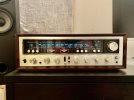
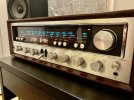
I've included pictures of the receiver which has been sitting untouched in my father in laws basement for over 25 years along with the original Cerwin Vega 211's that he purchased from Crazy Eddies in NYC. It's in near perfect condition and would love to bring her back to former glory. Thank you!
 

Attachments

  • IMG_0274.jpeg
    IMG_0274.jpeg
    107.7 KB · Views: 4
  • IMG_0277.jpeg
    IMG_0277.jpeg
    111.5 KB · Views: 4
The general advice here is that devices bought at auction are likely counterfeit.
Is a common result of these counterfeit transistors is burning up immediately upon powering the device?

use something in the TO-3P line,
Also you mentioned "use something in the TO-3P line, though installing them gets a little fiddly." Can you elaborate? Do you have a specific TO-3P transistor model in mind that might be available via digikey or mouser?
 
Is a common result of these counterfeit transistors is burning up immediately upon powering the device?
That’s one result. Working until pushed, working poorly, not fit for circuit, N-type for P-type (and vice versa). Counterfeiters just take any device of the same shape and rebrand it to something of 50x or 100x value.

Here is a link to an article by Rod Elliott which discusses this in some depth. Rod is well respected in the audio community and his site has a wealth of information. Well worth spending some time there.

Also you mentioned "use something in the TO-3P line, though installing them gets a little fiddly." Can you elaborate? Do you have a specific TO-3P transistor model in mind that might be available via digikey or mouser?
TO-3P is the plastic cased replacement for the TO-3 and have the same pin spacing. There are precious few replacement TO-3 models available. MJ21193G and MJ21194G are the go-to for metal cases, but there is a much wider range of devices available as TO-3P. But you must have confidence in your ability to select a good replacement based on transistor performance data. If you are not confident, stick with the available TO-3s.

TO-3P are not drop-in replacements. You will need to figure out how to mount it for your specific device. It’s not hard, but takes some thinking and messing around.

Search “TO-3P conversion” on AK and you will find threads that describe the process.
 
Back
Top Bottom