I have an old Kenwood integrated amplifier, KA 405, around 50 wpc I think. It's a solid match for the Model Fives, plenty of clean power and a looker, too, with pretty VU meters and that classic 70s appearance.
awesome...thank you!


I have an old Kenwood integrated amplifier, KA 405, around 50 wpc I think. It's a solid match for the Model Fives, plenty of clean power and a looker, too, with pretty VU meters and that classic 70s appearance.
Stacking is fun!
You'll probably need to dope the surrounds on those Fives, too. But, by all means, stack away!
I tried 2 pair of Fives some years back. It was a bit much for my small room, but in a bigger space they would have been great: https://audiokarma.org/forums/index.php?threads/stacked-klh-fives-just-for-giggles.802930/
There are lots of other "secret stackers" out there. You'll know us by our discreet lapel pins.

Grnrra
Generally, how does one “place” two sets of speakers to run simultaneously?


Yes, good point. The 17’s can/would essentially muddle with what makes the fives great. Any vintage receivers you like to use to drive the fives?

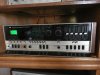

I’d love some vintage driver recommendations, if you have any. Thanks!
Tubes, but that's JMHO.
The best way to run multiple pairs of speakers is with each pair having their own amp. Either use a preamp feeding two amps or a receiver/integrated amp feeding a second amp/integrated amp. If the speakers have different sensitivities, use two integrated amps so you can adjust the volume of each appropriately.
I have one system set up with the receiver pre-outs going to the inputs of my amp. The receiver powers one set of speakers and the amp powers the other. One speaker pair is slightly more sensitive than the other, so that speaker pair overpowers the other slightly. This is my garage system, so I don't care. I just want lots of sound to fill the garage and the driveway and part of the street in front of the house. Good thing I don't have many close neighbors.
All of these. The 5 is a very forgiving speaker. Feed it 30 plus watts and it's good to go. Sub 20 watt's, not so much.
View attachment 1885065
This little 80 watt JVC vr-5660 is my preference with all the speakers. No house sound, no this or that, no warm tub sound, no stripped clean sterile sound. It's all about getting it done. If I didn't have all the others I wouldn't know that. Maybe all the other old receivers are faulty, I don't think so.
View attachment 1885075

As far as high wattage vintage receivers, you can't go wrong with the big boy pioneers sx-1010,1050, 1250 etc but they're pricey! The other thing to think about would be placing a 4 ohm load and cranking up the db's on an unrestored vintage unit could very well be a formula for major issues. If you go down the road of vintage, restoration of the electronics is important. I was using an older yamaha rx-v 2092 surround receiver that was rated down to 2 ohms that was just a beast (50lbs). I could run 2 sets of front mains, a set of front effects, center, and rears. The 23's and 5's for fronts, Model 22's for front effects, Model 17's for the center, and the model 6's for the rears. Concert dvds were phenomenal! The large Yamaha surround receivers (non HDMI) can be picked up for a song compared to their original $1500+ original stickers. They equal many of the older vintage receivers musically at a fraction of the going vintage market rates. In my old age their remotes are also a plus!Haha
haha, that’s how I’m looking to use the “stacked” pair. I have an old barn and hope to use them for a big party when this pandemic ends. Thanks fir your help. I hope to find 23’s one day. That’s for the heads up on ohm loads. Can you give me some high wattage vintage receiver recommendations? Thanks a lot!

Stacking is fun!
You'll probably need to dope the surrounds on those Fives, too. But, by all means, stack away!
I tried 2 pair of Fives some years back. It was a bit much for my small room, but in a bigger space they would have been great: https://audiokarma.org/forums/index.php?threads/stacked-klh-fives-just-for-giggles.802930/
There are lots of other "secret stackers" out there. You'll know us by our discreet lapel pins.

All of these. The 5 is a very forgiving speaker. Feed it 30 plus watts and it's good to go. Sub 20 watt's, not so much.
View attachment 1885065
This little 80 watt JVC vr-5660 is my preference with all the speakers. No house sound, no this or that, no warm tub sound, no stripped clean sterile sound. It's all about getting it done. If I didn't have all the others I wouldn't know that. Maybe all the other old receivers are faulty, I don't think so.
View attachment 1885075
holy crap was that awesome.
i did a lot of work on my newly acquired 5’s; changed caps, resealed surrounds, even refinished a bit.
I connect them and it turns out both have dead tweeters. Any advice you can give me on what to look out for on switching them out? The 5’s sound amazing even without the working tweeters (that bass!). The first thing I always play on new speakers is 5:15 by The Who. Who needs a tweeter to listen to John Entwistle?
Thanks for you help as always!

Have you checked them with a meter?I connect them and it turns out both have dead tweeters.
Have you checked them with a meter?
My analog Triplett has x1and x10 settings. If you have those, set it to x1 ohm. Disconnect the tweeter and hook the meter leads to + and - to get your reading. I think mine were somewhere between 3 and 4 ohms. IMO it would be unusual for both tweeters to be dead, although I'm no expert. I do what the experts her tell me to do.I tried but I don’t know which ohm setting to put it on - 20k 200k 20m or 200m. Please let me know...this meter element I one I haven’t figured out yet. Thank you!
I tried but I don’t know which ohm setting to put it on - 20k 200k 20m or 200m. Please let me know...this meter element I one I haven’t figured out yet. Thank you!
My analog Triplett has x1and x10 settings. If you have those, set it to x1 ohm. Disconnect the tweeter and hook the meter leads to + and - to get your reading. I think mine were somewhere between 3 and 4 ohms. IMO it would be unusual for both tweeters to be dead, although I'm no expert. I do what the experts her tell me to do.
Consider this a perfect learning opportunity.
Connect the leads to the driver and switch between the different ohm options. You cannot damage the driver doing that. You will see that the reading varies for each ohm setting. Where the scale is very high (megohms), it will look like the driver is a dead short (zero ohms on the scale). As you get to the lower ranges, you will see that there is some resistance. The meter scale that shows around 3 to 6 ohms is the one you should be using.
If the voice coil is open, then you will see an open circuit reading on every scale position. This is the same as having the meter leads not connected to anything.

