• The move to the new server is done. There are some software and database maintenance updates in process. This has us passing the hat around to help out. We appreciate any donations. Seriously, even a dollar helps. The payment page may be found here - https://www.audiokarma.org/support.html

Klh model 6 coils

CptTomato

New Member
Hello everyone

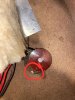
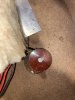
I am new to this forum. If I make any mistake, let me know please. First of all, this forum has an amazing amount of information about vintage speakers, and it has helped me a lot in my restoration for the klh model 6. Thank you all for this. Second, my question is that I hit, by accident, the coils of the crossover (as seen in picture) with a screwdriver and left some damage as seen in the second picture, is this serious? Should I replace it or is it ok to leave it like that? I haven't tested the speakers yet since I just resealed the woofers. I am sorry if this sounds a bit foolish, but I couldn't find any post related to this situation. Let me know what you think! Thank you!
 

Attachments

  • Coil1.jpg
    Coil1.jpg
    170.5 KB · Views: 51
  • Coil2.jpg
    Coil2.jpg
    169.8 KB · Views: 49
Register to hide this ad
I know zero about inductors, but if the insulation is scraped off a few windings and a short is caused, isn't that a problem or a partial problem?
 
One thing you could do to verify if the inductor is damaged is to measure resistance from end to end with a dmm (digital multi-meter). You may have to unsolder the ends to get a good reading (I can't remember off the top of my head where the inductor is in the circuit). If the damaged inductor measures significantly less Ohms than the undamaged one that may indicate that the windings have had the insulation scraped off and are shorting to each other. You need to do this with a sensitive digital multimeter because the amount of resistance in the inductor is naturally going to be very low. Likely less than an ohm because you will have continuity through the entire length of the wound wire.

Alternatively you could order one of those cheap component testers off of eBay. I have one and it is infinitely useful for basic testing of transistors. It will automatically identify an inductor and give you the inductance measurement, which will be a more accurate assessment of the parameters of inductor.

If you Don't understand what an inductor is, you should know that it is made with magnet wire, which is enamel coated for insulation. The wire is wound around either a core or a bobbin which has an air core and it's the field effect of the wire against itself which creates the inductance. When you scraped the outside of the inductor with your screwdriver you nicked some of that insulation off the coils of wire, which could allow windings to short against themselves decreasing the inductance of the inductor. My guess is that it's probably okay but to be sure the only way to really tell is to measure it.
 
One thing you could do to verify if the inductor is damaged is to measure resistance from end to end with a dmm (digital multi-meter). You may have to unsolder the ends to get a good reading (I can't remember off the top of my head where the inductor is in the circuit). If the damaged inductor measures significantly less Ohms than the undamaged one that may indicate that the windings have had the insulation scraped off and are shorting to each other. You need to do this with a sensitive digital multimeter because the amount of resistance in the inductor is naturally going to be very low. Likely less than an ohm because you will have continuity through the entire length of the wound wire.

Alternatively you could order one of those cheap component testers off of eBay. I have one and it is infinitely useful for basic testing of transistors. It will automatically identify an inductor and give you the inductance measurement, which will be a more accurate assessment of the parameters of inductor.

If you Don't understand what an inductor is, you should know that it is made with magnet wire, which is enamel coated for insulation. The wire is wound around either a core or a bobbin which has an air core and it's the field effect of the wire against itself which creates the inductance. When you scraped the outside of the inductor with your screwdriver you nicked some of that insulation off the coils of wire, which could allow windings to short against themselves decreasing the inductance of the inductor. My guess is that it's probably okay but to be sure the only way to really tell is to measure it.

Today I learned something new, thanks for the info! I tested the speakers and they sound good! I don't recognize any damage in sound. I will try to measure the inductance on both inductors and compare them, but that will be done later since I just finished restoring them (recap, grilles, cabinets and resealing) and want to enjoy them for now. Thanks again!
 
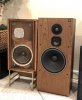
Oh yeah, forgot to mention that I just finished restoring a pair of sixes for a friend. Came in original boxes with all original paperwork which dates them to about 1969.They were stored in an attic for last 30 years. I got them for $10, but they were water damage due to the humidity and heat while they were in storage. So the boxes had a lot of swelling at the corners, but otherwise in very nice shape. I cleaned up and refinished as best I could, but they will never be perfect. These are going to be great for my lady friend who really just wanted a nice vintage system. I'm pairing them with a NAD 3140 integrated amp that I scored and recapped and also with a vintage Denon turntable. This will be a really good vintage system for her for practically free.

What blows me away is how "stupid good" these sixes sound after being brought back to snuff. I've always scoffed at these older vintage two ways with their paper cone tweeter. However, I am really impressed with how good these sound. I fully recapped crossovers, resealed woofer' surrounds and interface to cabs, cleaned grills, and refinished cabs as best I could.
 
Yup. KLH 6 is easily one of the best two-way acoustic suspension speakers of all time! Wait till you get your mitts on a pair of KLH 23s (or, as many AK members have attested to, but I've never heard, the KLH 5).

BTW, I don't think that the tweet cone is totally paper (per se, like in the woofer cones) in the early KLH 6. But either way, there is nothing wrong with 'paper/pulp' for any speaker driver. Cheaper to make plastic cones than paper/pulp?

Both my KLH 23's and my 'modern' JBL L100t's have paper woofer cones. Both speakers sound great. The JBLs are world-class (although my wife can't stand the 1980's look!).
 

Attachments

  • thumbnail_BC2A8682-0FA3-48C0-A1D2-05A8B5882173.jpg
    thumbnail_BC2A8682-0FA3-48C0-A1D2-05A8B5882173.jpg
    115.8 KB · Views: 11
Yup. KLH 6 is easily one of the best two-way acoustic suspension speakers of all time! Wait till you get your mitts on a pair of KLH 23s (or, as many AK members have attested to, but I've never heard, the KLH 5).

BTW, I don't think that the tweet cone is totally paper (per se, like in the woofer cones) in the early KLH 6. But either way, there is nothing wrong with 'paper/pulp' for any speaker driver. Cheaper to make plastic cones than paper/pulp?

Both my KLH 23's and my 'modern' JBL L100t's have paper woofer cones. Both speakers sound great. The JBLs are world-class (although my wife can't stand the 1980's look!).

Failed to mention this, but both the KLH 6 and KLH 23 and also the JBL L100t's claim to have a 12" woofer. Only one of these speakers has woofer that measures 12". I'll let you all decide. Still not parting with my KLH 6 or KLH 23's anytime soon!!! These KLH speakers are awesome.
 
Embellishing woofer size is one thing, but building speakers that sound as crisp, clear, and deep as KLH did is quite another. I spent a few hours with my Twenty Threes yesterday while I was doing some stuff around the house, but after a bit I had to just sit still and listen critically. What a nice afternoon. The Sixes are in that class, too.
 
Back
Top Bottom