Sure, just leave the UL tap disconnected and wire the outputs just like the schematic.Question: can I use these Edcor OT's which appear to have a UL screen tap for TriodLuvr's Kyoto circuit?
https://edcorusa.com/products/xse10-5k-10w-5k-ohms-single-ended-tube-output-transformer
View attachment 2603269
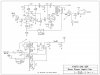
Thank you FlaCharlie!Sure, just leave the UL tap disconnected and wire the outputs just like the schematic.
Jack -Jim, the low frequency response of those particular transformers is very limited. Are you sure you wouldn't prefer to order a model with a wider bandwidth? The EF86-6V6 combination is very transparent and can do much better. Truth be told, even the Akai OPTs don't quite do justice to this combination, but they're well into the region of diminishing returns.
Jack
If your plan is to only ever build one amp and you want it to "do it all" buying larger and more expensive transformers might be the best option.I was not aware of that limitation for either said Edcors or the Akai M8 output transformers. May I prevail on you to suggest an alternative?
You can build a very fine amplifier with the Akai transformers. When used with pentodes (as they were intended), the NFB necessary to tame IMD and provide reasonable dampening also flattens and extends the response. If you prefer not to salvage a pair from the tape decks, the Edcor GXSE10-5K appears to be a more reasonable substitute than their XSE variety. The CXSE25-5K is wider bandwidth still, but at considerably higher cost. The Hammond 1628SEA would also be excellent, and Electra-Print lists several suitable models in that same price range ($150 - $175 ea). Some will disagree, but I believe the benefit of these more costly transformers is likely to be difficult to hear in this application. Note that my advice is specific to the 6BQ5/6V6 pentode output stage using NFB. It would be different for a straight-through triode amplifier with triode output. One thing I want to be clear about - building the amp as shown in the schematic with those specific components does not in any way produce compromised results. I was extremely pleased when I first fired this up about 15 years ago. When I later also used it with Grado 32 ohm phones, I was astonished. It is totally engaging, with clarity and dynamics many people spend thousands more to achieve.
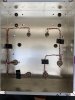
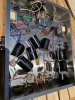
Thanks Jack, completely helpful reply. The amp per your circuit now plays I am working through the QA process now. My immediate issue is a pronounced hum from both channels. Build facts differing from your amp - EL84, Hammond 369JX PTs, 6X4 vintage NOS black plate RCA rectifier tubes. Chokes are Hammond 155 and do deviate from stock Akai M8 which I recall to be 6H vs 5H for my Hammonds. I did not run PT simulation (yet) so it’s possible as a hum culprit which by ear sounds like 120hz. Your amp has floating drivers (ungrounded) and likewise I have yet to ground pins 2,7 and 8 on my NEC EF86s. My RH84, KG84 and Akai M7s are dead silent so I’d like to achieve that with your circuit as well. Next I will triple check my grounds and OT wiring. Also note I deleted the input volume control and headphone outlet.Jack

Read with appreciation FLaCharlie. I would certainly be interested in OT’s that provide the 3D soundstage your describe. Am optimistic about the Edcors. This build is an attempt to see what would result as I did use ElectraPrint in my recent RH and KG builds.If your plan is to only ever build one amp and you want it to "do it all" buying larger and more expensive transformers might be the best option.
But I've learned that you can't really assume that something larger and more expensive will necessarily sound better. And there are alternative strategies which allow you to have plenty of low bass without spending so much on OTs. This is especially handy if you expect to be building more amps in the future.
In general, the main difference between smaller, less expensive, OTs and larger, more expensive, ones is their ability to reproduce bass frequencies. The rolloff points will vary but the biggest difference is probably under 50Hz or so.
You might want to consider just how important this is to you. Everyone has different needs. YMMV, as always.
Some music has a lot of content under 50Hz and some has relatively little. Many speakers can't really reproduce much, if anything, below that either. And, of course, everyone's hearing is different too. These are all important factors. An online tone generator can be helpful in evaluating your needs.
I had my most recent build breadboarded for quite a while using a pair of little SE OTs pulled from an old console amp. I ordered a pair of Edcor 15w GSXEs for the build, which took about 3 months to arrive. The Edcors weigh in at 2lbs 9.5oz while the little console OTs are only 14.5oz. So I figured the bass would be better and they would be a step up.
This was the first time that I've purchased new, modern production, OTs for a stereo build. I've always used junkbox OTs scrounged from various sources. I decided to give the Edcors some break-in time - around 36 hours - without listening to them before giving them a serious listen.
The Edcors were really nice and, as expected, they did go lower in the bass.
But, for this amp, I actually preferred the little console OTs, which is not what I expected. They seem more extended on top and the mids are more detailed and liquid. They reproduce the subtle textures of strings and horns better.
A lot of the difference is in the soundstage. It seemed to be a bit wider with the little console OTs but they're especially better in terms of depth. The difference in detail is most evident in the way instruments seem to inhabit their own space. The effects of reverb on more modern recordings, or natural room sound on more traditional jazz, is much more evident. The Edcors reproduce a bit of that, but not nearly as much, and their soundstage is not 3D like the console pulls.
Don't get me wrong, the Edcors were impressive, and I plan on using them on another project. But when I A-B'd them I noticed the difference. The little console OTs produce more foot tapping and head bobbing, they just swing more.
Since I do occasionally listen to music that has more low bass, I picked up an inexpensive combination of an active crossover and a Class D amp. The total cost (~$180 shipped) was less than the cost of a single large, high quality, OT. Adding a sub is another option, of course.
I find the versatility of this approach very appealing. Since I know I'll be building more amps, I'll end up spending much less on each of them since my "bass system" can be used, whenever necessary, with any of them.
And, since it's harder for an amp and the main speakers to reproduce bass frequencies, there are additional advantages to shifting that burden to a system that's optimized for bass.
Such an approach may not appeal to everyone, of course, but it's something to consider if it meets your needs.

The center tap is not grounded. And I neglected to ground the heater leads per the schematic. Will try your suggestion(s) here and report back. Thanks!It looks like there isn't a center tap for the 6.3v heater winding? If not, a 100ohm or so resistor on each lead to ground, and removing the ground from that one leg may help reduce hum if you haven't done so already. That is if there isn't a center tap.
Jack -Looks like a nice build, sorry to hear about the noise. As I'm sure you know, hum can be caused by a number of things - ground loops, transformer coupling, PS ripple, etc. It can be tricky to troubleshoot, because hum thats induced by 60 Hz sources often contains harmonics. I would start by using clip leads to ground the grids of the 6V6s. That will take the preamps and the preamp grounding out of the picture. Also, if you have a scope, check the frequency of the hum.
Jack