It's hard to go wrong with the L150. Between my L150, L100T (with t3 crossover), 4412, and L5, the L150 is my favorite.
Comparing the L150 to the L112. They both use the same woofer (128H). They use the "same" midrange (LE5-10 vs LE5-12, the only difference being the color of the faceplate). The tweeters are very similar. The L150 uses an 033, the L112 uses an 044. They are both soft-dome tweeters, with the 044 having an extra very thin layer of aluminum coated on it via "vapor deposition". This gives the 044 the appearance of an aluminum-dome tweeter, but it's actually more like an 033 coated with aluminum spray paint. The two actually sound very similar.
The crossover frequencies are slightly different. In the L150, the crossovers are 1kHz and 4kHz. In the L112, it is 1.1Khz and 3.7kHz. I'm not sure why they raised the LF crossover from 1kHz to 1.1kHz, as even 1kHz is already pretty high for the LF crossover on a 3-way. I'm also not sure I understand the benefit of giving the tweeter in the L112 more work to do by lowering the crossover from 4kHz to 3.7kHz. At least the midrange in the L112 has an easier life, but generally, in my experience, the mid is also the driver that is least likely to experience a failure. Note that the 4411 Studio Monitor uses nearly the same drivers as the L112 (only difference being LE5-9 vs LE5-12 midrange) yet retains the 1kHz and 4kHz crossover frequencies similar to the L150.
One thing I feel really makes the L150 stand out is the passive radiator. The passive radiator in the L150 performs the same function as the port tube in the L112. The passive radiator is just a cone with no voice coil or magnet. It has adjustable mass rings on the rear. This gives you the ability to tune your bass in a non-permanent way. Adding mass to the passive radiator would be the equivalent of lengthening the port tube, and will allow your bass to dig lower at the expense of some midbass. Removing mass would be the equivalent of shortening the port tube, and will give you more of a mid-bass bump, at the expense of some deep bass extension. The later would probably give you more 4311-style bass. The stock mass is a good compromise. The passive radiator also gives the bass a somewhat unique texture, which I personally
really enjoy.
Another big difference between the L150 and L112 is placement. The L112 is a bookshelf speaker and completely at the mercy of what you are able to place it on, hoping that the speaker ends up at the correct height. The L150 is a floor-stander obviously. Depending on what room you have, that could be an advantage or disadvantage.
The L150 enjoys an advantage in terms of bass, despite using the same woofer as the L112. Compare these charts, both directly from JBL documentation:
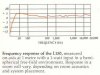

The L112 includes more than one measurement, but the equivalent comparison would be the red line in the L112 graph. From there you can see that the overall response is actually quite similar, including a bump in the bass and a slight dip just below 500Hz. But you can also see that the L150 has
considerably more bass response below 50Hz, likely a result of the much larger cabinet.



