• The move to the new server is done. There are some software and database maintenance updates in process. This has us passing the hat around to help out. We appreciate any donations. Seriously, even a dollar helps. The payment page may be found here - https://www.audiokarma.org/support.html

Lafayette LR-5555 Static

A Sound Mind

Reckless Tinkerer
This is a great looking receiver and everything's working fine, except for it having low level static in all modes.
I thoroughly cleaned the chassis and de-ox'd all the switches, pots and jacks.
I poked all around the chassis with a non-conductive probe and even used a heat gun and freeze spray to find the source of the problem, with no results.
This 50 year old receiver likely needs a re-cap, but since the static appears in all modes, perhaps I should start with the amplifier board.
Has anyone else had experience with this receiver?
Does anyone know who the manufacturer was?
 
Register to hide this ad
I would think bad power supply caps would cause hum, not static. It's probably noisy transistors. Is the static exactly the same in both channels? Do you have an oscilloscope?
 
Power supply caps are fine. I'm in the process of re-capping the amp board, but I agree that it might be noisy transistors. Static equal on both channels. Haven't tried using headphones. (doh!) Yes, I have a scope and the schematic. Also need to understand how to calibrate adjust the tuning meter. Can't get it to center.
 
Amp re-capped. Static's gone now. Still have the tuning meter centering issue. It points to the left when stations are peaked.
Also when I plug in a mic, or even just a phono plug the receiver makes a a terrible sound. I pulled the pcb, re-capped it and tested all 4 transistors on the board, but still have the same results. I ohm checked the jack and it's fine. Any clues?
 
Amp re-capped. Static's gone now. Still have the tuning meter centering issue. It points to the left when stations are peaked.
Also when I plug in a mic, or even just a phono plug the receiver makes a a terrible sound. I pulled the pcb, re-capped it and tested all 4 transistors on the board, but still have the same results. I ohm checked the jack and it's fine. Any clues?
I have the same amp and the same problem, although my 'static' is a lot more aggressive and poppy and comes in after the amp heats up a bit. I want to do a recap but I wasn't sure where to find a parts list - can you tell me what you ordered?
 
I have the same amp and the same problem, although my 'static' is a lot more aggressive and poppy and comes in after the amp heats up a bit. I want to do a recap but I wasn't sure where to find a parts list - can you tell me what you ordered?
I have a large assortment of caps in stock and simply replaced all the electrolytics with Nichicons and Panasonics. I tested all the pulls for opens/short/ESR and value and found one open and two way over value. I could have done more and upgraded all the transistors as well, but that's all I wanted to do at this time.
 
When I did the service work for a number of company-owned Lafayette NJ stores, a number of LR-5555 and 5555A's, found their way to my service bench.
At roughly their manufacturing time, the OEM was Planet Research\Pioneer.
I discovered this receiver was made by Setton for Lafayette. The LR-5555 chassis is exactly the same as their model RS-440. The Setton service manual has everything necessary for calibration and alignment.
 
I discovered this receiver was made by Setton for Lafayette. The LR-5555 chassis is exactly the same as their model RS-440. The Setton service manual has everything necessary for calibration and alignment.
Setton did not make the Lafayette LR-5555 receiver.

Setton was considered a luxury high-fidelity brand, but it operated as a boutique “on-paper” designer and contractor and was not a traditional in-house manufacturer. As far as I know and remember, Setton had no manufacturing facilities. The brand was founded in France by Jacky Setton, who was originally the exclusive French importer for Pioneer equipment. Setton wanted to create high-end audio gear with a striking, designer aesthetic. He contracted top-tier Japanese manufacturers (predominantly Pioneer and then Planet Research/Pioneer) to build the internal electronics. The exterior cabinet and front panel designs were designed by renowned non electronic designers who designed audio equipment with a striking aesthetic look and feel.

Planet Research was the Original Equipment Manufacturer (OEM) for many of Lafayette’s solid state high-fidelity products including, the LR-9090, LR-5555, LR-5555A, LR-3030, LR-3030A, LR-2020, LR-2020A, LR-1515, LR-1515A to name a few. There were a lot of others. Trio was also the major OEM for many of Lafayette's vacuum tube high-fidelity models.

Documentation was sometimes generated by the OEM, sometimes by the contractor for the specific models, sometimes by an external document producer, and sometimes, several of these groups would work in tandem. Service-related information was generated either by the OEM or the contractor, or both working together.

Having been Lafayette's longest part-time employee, I touched a lot of Lafayette products over the years and besides retail I did service support for several of the Lafayette NJ company owned stores up through bankruptcy and several years beyond. I probably still have the largest collection of original N.O.S. Lafayette parts (even though I've been trying to reduce the pile for many years) and, of course, the documentation.
 
Thanks for your in-depth and undisputable details on these Lafayette receivers. After a bit of research, I was led to believe that the LR-5555 was manufactured by Setton as the RS-440 chassis and service info was exactly the same as the Lafayette LR-5555, which helped to solve a tuning indicator issue.
(You may appreciate that back in '65 the first kit I ever built was a Lafayette LA-23 AM Transmitter. I still have several of their catalogs from the 1960s)
 
Thanks for your in-depth and undisputable details on these Lafayette receivers. After a bit of research, I was led to believe that the LR-5555 was manufactured by Setton as the RS-440 chassis and service info was exactly the same as the Lafayette LR-5555, which helped to solve a tuning indicator issue.
(You may appreciate that back in '65 the first kit I ever built was a Lafayette LA-23 AM Transmitter. I still have several of their catalogs from the 1960s)
When several contractors (Domestic U.S. and International) are shooting for similar price points and similar specifications to the same Original Equipment Manufacturer, you will most likely wind up with very similar pieces of designed equipment.

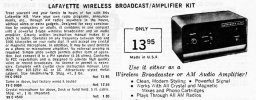
The LA-23 Wireless Broadcaster was the factory assembled and tested Lafayette KT-195 which was in kit form. We sold a lot of them.

If you like to review Lafayette catalogs, go here:
LAFAYETTE CATALOGS: Lafayette Electronics and Concord Radio
I also have several hard-bound editions of the yearly Lafayette catalogs.
The 1978 catalog was actually labeled 1978/79 catalog. In 1979, it was just labeled 1979 catalog. It was the same catalog.
 

Attachments

  • Laf_LA-23.jpg
    Laf_LA-23.jpg
    91.4 KB · Views: 3
When several contractors (Domestic U.S. and International) are shooting for similar price points and similar specifications to the same Original Equipment Manufacturer, you will most likely wind up with very similar pieces of designed equipment.

The LA-23 Wireless Broadcaster was the factory assembled and tested Lafayette KT-195 which was in kit form. We sold a lot of them.

If you like to review Lafayette catalogs, go here:
LAFAYETTE CATALOGS: Lafayette Electronics and Concord Radio
I also have several hard-bound editions of the yearly Lafayette catalogs.
The 1978 catalog was actually labeled 1978/79 catalog. In 1979, it was just labeled 1979 catalog. It was the same catalog.
I’m actually working on an LR-5555 right now and having trouble with the safety circuit on the amp board. I replaced the terribly out of spec power supply caps and that’s when several heat stressed components decided to go open. I’ve replaced everything I know but still have 41vdc on pin 2 of the S60W output modules. I actually have them out of the circuit right now to keep from destroying them.
 
Back
Top Bottom