• The move to the new server is done. There are some software and database maintenance updates in process. This has us passing the hat around to help out. We appreciate any donations. Seriously, even a dollar helps. The payment page may be found here - https://www.audiokarma.org/support.html

Lafayette LR-810 - new acquisition

nmwhitneyjr

Active Member
I gotta say, I'm a big fan of the form factor. It's small (fits on my desk). It's not flashy. And the layout is simple... just like I like it. I found this on Craig'slist for $50. Bought from the original owner AND included the Owner's Manual. It has a very warm sound through my old Polk Audio monitors.

My sole complaint (and it's a nitpick) is the separate volume controls for L/R combined in one knob. I listen alot to our NPR affiliate and it's difficult to get the volume down low enough and get it balanced. Oddly, when I run my iPhone in the aux, it's not as loud.

Any suggestions on how to tame the volume when listening to FM?

Here's a pic... I need to polish up the aluminum, but it looks nice regardless.

37052413260_a1f7db7c89_h.jpg
 
Register to hide this ad
Nothing simple that you can do about the FM output (volume) level.
Have the controls (specifically, those ganged volume control pots) been cleaned? It might help the low-level tracking - but it also might not.
The dual L/R volume is just another way to implement stereo level & balance adjustment, and requires only two pots rather than three* (i.e., it's cheaper).

__________
* The stereo level and balance scheme that we've become accustomed to still requires a ganged pair of volume pots and a third pot for balance.
 
Have the controls (specifically, those ganged volume control pots) been cleaned? It might help the low-level tracking - but it also might not.

I cleaned all pots with D5 (and followed up with a shot of F5 for lube) before plugging it in the first time. Pots are scratch free.

The receiver has rca connections for a pair of "remote" speakers. I may try running through those just to see if the low level volume plays out better.
 
I cleaned all pots with D5 (and followed up with a shot of F5 for lube) before plugging it in the first time. Pots are scratch free.

The receiver has rca connections for a pair of "remote" speakers. I may try running through those just to see if the low level volume plays out better.
The issue you're having is probably low-level tracking of the pots, then.

As you probably already know, there's no reason to think that the signal level should be any different from the 'remote' outputs -- but it won't hurt to try it.

You could use your LRE receiver as a tuner; i.e., take the line-level signal from the TAPE output and feed it to another amplifier with its own preamp/volume control functionality -- but that would work at cross-purposes to your form factor requirements.
 
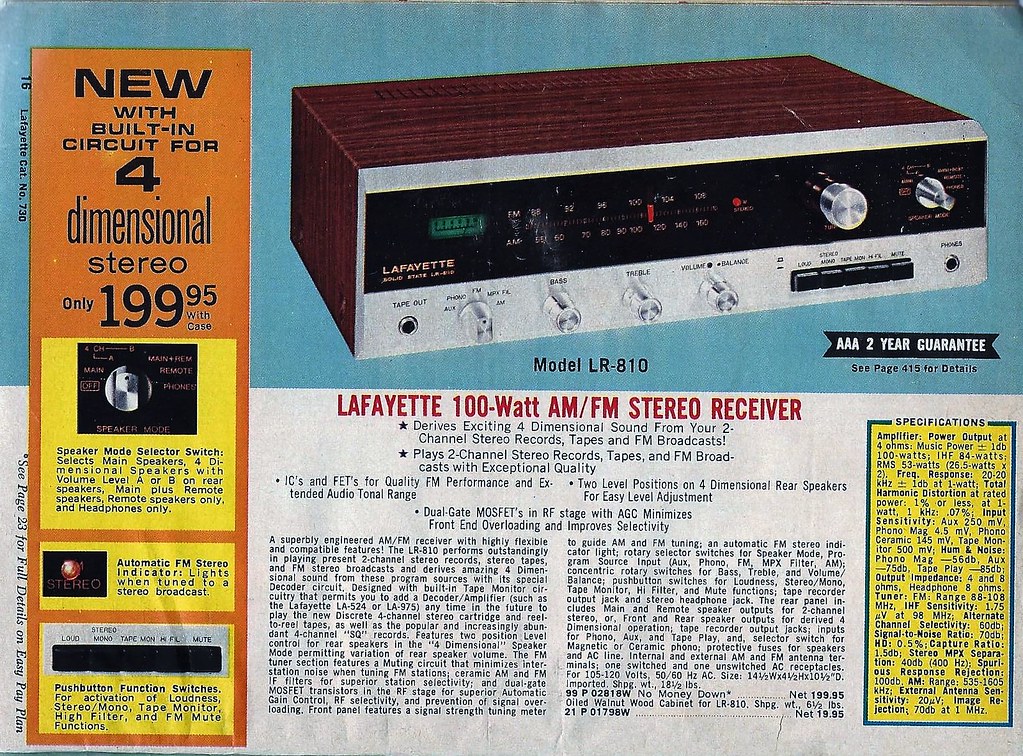
FYI and FWIW, here's the LR-810 from the 1973 LRE catalog.

That "100 watts", claim -- dating from before the 1974 FTC regulations -- that gave us "RMS watts" [sic] probably translates to somewhere around 10 to 15 "continuous" watts per channel into 8 ohms.
EDIT: Heh, I should read scans before I post 'em! Reading between the lines of the power claim (which was obviously being massaged due to growing consumer frustration with the outrageous power claims of the early 1970s) suggests just about 13 wpc into 8 ohms "RMS". at 1% THD (0.07% midband @ 1 watt).

LRE LR-810 1973 enh by Mark Hardy, on Flickr

coupla clicks on the image will allow one to see the full-sized file resolution :)
 
Last edited:
Sorry to piggyback onto your thread, but has anyone ever changed the dial lights in one of these things? I just picked one up, works great, no lights other than the dial indicator.
 
When I opened mine up to deox the pots, I noticed that it has one of the fuse-like bulbs on either side of the dial glass (2 total). Looked like it would be an easy/quick job to replace them.
 
Out of curiosity -- would that owner's manual happen to have a schematic in it? Just picked up one of these myself, and it seems to have had some "work" done on it that I'd like to correct.

Edit: Never mind! :)

Another member kindly posted one here, although it apparently didn't make it to the schematic library: audiokarma.org/forums/index.php?attachments/lafayette-lr810-schematic-pdf.1029899/
 
Last edited:
...Reading between the lines of the power claim (which was obviously being massaged due to growing consumer frustration with the outrageous power claims of the early 1970s) suggests just about 13 wpc into 8 ohms "RMS". at 1% THD (0.07% midband @ 1 watt).

I'm seeing an RMS rating of 26.5 wpc @1% THD. Boy do I miss those LRE catalogs!
 
I'm seeing an RMS rating of 26.5 wpc @1% THD. Boy do I miss those LRE catalogs!
Yup, exactly so -- at 1 kHz into 4 ohms, as the manual states. Halve that into 8 ohms (13.25 wpc @ 8 ohms @ 1kHz @ 1% THD). Full-bandwidth power would probably be about 2 dB less, if I had to guess (i.e., ca. 9 wpc 20-20 kHz @ 1% THD, give or take).
upload_2017-10-30_14-2-54.png
 
It looks like it has a mute button.
You will get finer adjustment of volume at low volumes with mute on, if it goes loud enough that way.
 
Yup, exactly so -- at 1 kHz into 4 ohms, as the manual states. Halve that into 8 ohms (13.25 wpc @ 8 ohms @ 1kHz @ 1% THD). Full-bandwidth power would probably be about 2 dB less, if I had to guess (i.e., ca. 9 wpc 20-20 kHz @ 1% THD, give or take).

Ah, I didn't notice that 4 ohm rating there...pretty sneaky!
 
I gotta say, I'm a big fan of the form factor. It's small (fits on my desk). It's not flashy. And the layout is simple... just like I like it. I found this on Craig'slist for $50. Bought from the original owner AND included the Owner's Manual. It has a very warm sound through my old Polk Audio monitors.

My sole complaint (and it's a nitpick) is the separate volume controls for L/R combined in one knob. I listen alot to our NPR affiliate and it's difficult to get the volume down low enough and get it balanced. Oddly, when I run my iPhone in the aux, it's not as loud.

Any suggestions on how to tame the volume when listening to FM?

Here's a pic... I need to polish up the aluminum, but it looks nice regardless.

37052413260_a1f7db7c89_h.jpg


I have had the earlier version, the LR-200A since I bought new in the 70's...I think I was working a summer job just before I went into High School to purchase. I have had great luck with it and it has been in continuous use in one way or the other since I initially un-boxed it!. About once a year I need to open it up and clean the contacts with some fader lube/cleaner and that gets me through another year. I just bought an LR-310 as wall as two LR-810's. I use one in my shop, one in my garage and the other is spare. The original one is on my desk connected to my computer to provide music when I am working (work from home) I have this hooked up to two Klipsch small bookshelf speakers and an older AR subwoofer...yes I know, the older units did not have a sub out, but the AR subwoofer allows me to run the speaker outs from my LR-200A to speaker inputs in the subwoofer than I connect toe speakers to the speaker outs on the sub...I get the nice low end form the sub, and because the sub has an internal crossover, it only sends speaker level outputs 80HZ and above to the little bookshelf speakers. Makes for an awesome desk system!

The LR-810 in the shop in my shop is powering two Coral 10" three way speakers that I originally used with the LR200A when I bought it. The other is powering two NHT AS1 bookshelf speakers I was given....that combination is awesome.

These are certainly are not my main systems, but I like the warm overall sound of these receivers, I think the other LR810 is going to go in my Listening room and connect to my Technics 1700 turntable...I still have 6 "Peaches" crates full of albums that I want to listen to. I have two home made speakers with Early 70's EV 12" Three way speakers that sound good with these low wattage receivers, so I though I would give that a shot...if not I may put the Corals on. Just for fun and nostalgia!
 
I gotta say, I'm a big fan of the form factor. It's small (fits on my desk). It's not flashy. And the layout is simple... just like I like it. I found this on Craig'slist for $50. Bought from the original owner AND included the Owner's Manual. It has a very warm sound through my old Polk Audio monitors.

My sole complaint (and it's a nitpick) is the separate volume controls for L/R combined in one knob. I listen alot to our NPR affiliate and it's difficult to get the volume down low enough and get it balanced. Oddly, when I run my iPhone in the aux, it's not as loud.

Any suggestions on how to tame the volume when listening to FM?

Here's a pic... I need to polish up the aluminum, but it looks nice regardless.

37052413260_a1f7db7c89_h.jpg
 
Ah yes the universal complaint about Lafayette's line in the 70's. I had a LR200A I bought new in 1975. I still have it. I used it in my college dorm. It sounded great but I hated that combination balance/volume control for the very same reasons. It was virtually identical to the 810 with the exception of the rated output was 100 watts. The LR200 was rated at 30 watts or 50 depending on whether it was a seasonal flier or the yearly catalog. It has needed control cleaning occasionally but other than that after 40 years still sounds great. I don't see a lot of 200's but there are at least 2 or 3 810's on ebay at any given time. There is usually not much wrong with them except the controls are dirty and they need dial lamps. The other big complaint of the both the Lafayette audio products is the thud you hear when you turn them on. As far as a solution there is none that I know of. All these complaints are inherent in the design. Lafayette saved money and space by eliminating controls. They also combined the speaker select and power on switch for the same reason. These and the other Lafayette's of this era were reasonably priced and well built. They were equipped with inputs for magnetic cartridges not found except on high end audiophile equipment at the time. They had solid metal chassis and covers. Their nearest competition were units made of cheap plywood and cardboard.
 
Back
Top Bottom