• The move to the new server is done. There are some software and database maintenance updates in process. This has us passing the hat around to help out. We appreciate any donations. Seriously, even a dollar helps. The payment page may be found here - https://www.audiokarma.org/support.html

Large Cap Replacement - When to consider?

JSMATT

Member
This topic is clearly not unique to Sansui products, but given these are the items I have, here goes the question.

When have you replaced the large caps, e.g., 10,000 uF, in your rig (or one you serviced)?

What were the symptoms that precipitated the replacement?

What did you use to measure the old/'bad' cap and how did it compare to the new one?

Were any other measurements taken, whether clipping, distortion, etc. of the before and after rig?

I do not have a piece of gear that I am at a loss for what is ailing it, but this is a question I have wondered about for some time.
 
Register to hide this ad
Reasons for replacement?

Value changes over time - usually negative. Often with changes different in different channels.

High ESR or excessive ripple if detected, very undesirable.

Future proofing - if you don't change them now, suitable replacements may soon become unavailable - then what are you going to use?

The chance to upgrade with higher performance, higher capacitance replacements.

That'll do for starters. ;)
 
Last edited:
Hi,
As a comparison, I bought 3 Sansui Receivers about 8 years ago about the same time.

Two "G" Models and a nice little AU-317.

The G Models needed immediate service but the AU was fine.

Just recently opened the AU up to clean the switches, as the power switch was giving a small hum on occasion.

Inspected the Caps while cleaning and they actually looked brand new and there was no swelling or leaks anywhere.

Why the difference, all three are over 40 years old, but here we are, and I have no intent to have any work done to the AU until needed?

Maybe some Techs here, have some ideas?

a543d1b1fa8e767c38bd3a3188a863cb.jpg
 
Hi,
As a comparison, I bought 3 Sansui Receivers about 8 years ago about the same time.

Two "G" Models and a nice little AU-317.

The G Models needed immediate service but the AU was fine.

Just recently opened the AU up to clean the switches, as the power switch was giving a small hum on occasion.

Inspected the Caps while cleaning and they actually looked brand new and there was no swelling or leaks anywhere.

Why the difference, all three are over 40 years old, but here we are, and I have no intent to have any work done to the AU until needed?

Maybe some Techs here, have some ideas?

View attachment 3032639

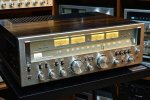
Just dropped in to say what a great photo that is. Well done. Beauty.

I’m no pro, but as far restorations and the large caps go, I practice the “take care of it all and upgrade it while in there” philosophy. Only want to be under the hood once (every 40 years).
 
Hi,
As a comparison, I bought 3 Sansui Receivers about 8 years ago about the same time.

Two "G" Models and a nice little AU-317.

The G Models needed immediate service but the AU was fine.

Just recently opened the AU up to clean the switches, as the power switch was giving a small hum on occasion.

Inspected the Caps while cleaning and they actually looked brand new and there was no swelling or leaks anywhere.

Why the difference, all three are over 40 years old, but here we are, and I have no intent to have any work done to the AU until needed?

Maybe some Techs here, have some ideas?

View attachment 3032639

They may well be within spec, but a visual inspection is unlikely to tell you much, unless they've vented or exploded!
 
Just dropped in to say what a great photo that is. Well done. Beauty.

I’m no pro, but as far restorations and the large caps go, I practice the “take care of it all and upgrade it while in there” philosophy. Only want to be under the hood once (every 40 years).
Hi,
Thanks, just a nice pic I found.

My "G's" are a 7500 and a 6700, that look almost as good! (my Avatar is the rebuilt 7500)

Love me some Sansui!
 
They may well be within spec, but a visual inspection is unlikely to tell you much, unless they've vented or exploded!
Hi,
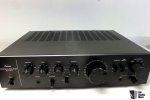
Thanks, a little switch cleaning and some cover work is as far as my talent goes.
Will have to just use my ears for the AU-317...

If she's happy, I'm happy!

3923317-034f31b4-sansui-au-317.jpg
 
Hi,
Thanks, a little switch cleaning and some cover work is as far as my talent goes.
Will have to just use my ears for the AU-317...

If she's happy, I'm happy!

View attachment 3033019

Nothing wrong with that.

On the other hand, I had the opportunity to compare a stock AU717 in good working order with a rebuilt one.

I thought the one in stock condition sounded good until I heard the other one. The rebuilt unit sounded notably better.
 
Last edited:
G9700, rail voltage showing 90 volts where should read 84.3 volts. Tone control switch was not functioning, ran some voltage checks through out the unit and every where I checked I was getting higher readings than what the schematic called for. Decided to change out the big caps. Rail voltage is now spot on and now other voltage readings are very close to what the schematic calls for. Still have not figured out the tone switch but figure that by switching out the big caps, it will be less of a head scratcher diagnosing the tone switch. In short, unit needed big caps replaced.
 
A tricky one, Hyperion gives the reasons for cap replacement but in order to determine whether or not those conditions have been met you do need some fairly serious and expensive test equipment.

Low capacity and an indication on ESR cap be picked up on those GM328 based component testers but leakage, dissipation factor and accurate ESR measurements needs a LCR bridge.

You can of course play with your 'scope to get an idea of ESR too: https://meettechniek.info/passive/capacitance.html

I have restored quite a few vintage amps and receivers from the 60s and 70s where the small caps were dried up and measuring badly or all over the place. In only three cases, a Yamaha, a H&H and a Scott that had terrible case ventilation, did the main filter caps measure below tolerance capacitance and out of tolerance high ESR. They were replaced with much better measuring replacements and the sonic improvement was noticeable. Without wishing to sound like a audiophile trying to justify a £2K mains cable, the sound "opened up" with a "blacker background" and more "slam" to things like orchestral crescendos.

Armed with these measurements I then pulled and tested the main caps on most of the rest of the amplifiers, ones that were otherwise fully recapped/restored, and found that the fresh, modern replacements indeed measured better than the old ones.

I think this is to do with the end of life definitions for these caps, they dry out just like the smaller ones but as there is much more to them they dry out slower and so whilst probably still measuring in the official spec are not quite what they used to be when new.

I replaced these caps as I had them out for measurement and found the difference in sound to be... well less obvious than with replacing truly knackered capacitors as above.

Sometimes I think I can hear a difference, sometimes not in other words.

Amps from the 80s and 90s, unless class A or otherwise hot running, don't really need recapping in my experience unless there is some know issue.

The position I've arrived at is that capacitors are consumables, if I'm going to restore an amplifier I am going to replace all consumables and leave the amplifiers that don't need restoring alone.

 
Last edited:
Hi,
As a comparison, I bought 3 Sansui Receivers about 8 years ago about the same time.

Two "G" Models and a nice little AU-317.

The G Models needed immediate service but the AU was fine.

Just recently opened the AU up to clean the switches, as the power switch was giving a small hum on occasion.

Inspected the Caps while cleaning and they actually looked brand new and there was no swelling or leaks anywhere.

Why the difference, all three are over 40 years old, but here we are, and I have no intent to have any work done to the AU until needed?

Maybe some Techs here, have some ideas?

View attachment 3032639
Some units were just never used and others were left on 24/7 for years. The caps in the former dry out much more slowly than the caps in latter.

They do all eventually dry out however.
 
Reasons:
Incrased ESR
Decrased capacitance
Visible leakage
Abnormal ac ripple
Sometimes a brand/series known to fail over years (elna duorex, roe capacitors etc)

Test gear:
RCL bridge
Multimetr
Oscilloscope
Just to add, when particularly ancient or crappy caps go really bad they can also show really high capacitance on the meter and/or identify as resistors on the bridge/meter... :D
 
Reasons for replacement?

Value changes over time - usually negative. Often with changes different in different channels.

High ESR or excessive ripple if detected, very undesirable.

Future proofing - if you don't change them now, suitable replacements may soon become unavailable - then what are you going to use?

The chance to upgrade with higher performance, higher capacitance replacements.

That'll do for starters. ;)
All valid reasons but #3 jumped out at me. I just replaced 4 in an AU-719, and the Nichicon Fine Gold with solder lugs were marked End of Life, and damn near 30 US dollars each!

I think they jack the price up when they're about to go extinct.
 
The main reason I have my 80's and 90's Sansui gear recapped is to remove the corrosive glue.
Alot of the time the old caps test within spec, but are replaced anyways.
The mains don't get replaced unless leaking, or out of spec
 
A thought.

Try measuring a new capacitor against it’s specs and you’ll probably see that it exceeds those specs by some margin.

I think the figures given are worst case figures, below which the component would be rejected by QC at manufacture or shows when replacement is needed at end of life.

It would probably stand to reason that the same state of affairs was true for the original capacitors too, ie whilst they may still meet spec they are not as good as they used to be.

On that basis the question, I think, becomes as long as it doesn’t interfere with the proper electronic operation of the amplifier, how bad does a cap have to go before it begins to affect the sound?

That question is not so simple to answer…
 
Thanks for all the input thus far.

In terms of testing and measuring ESR, I have the Peak ESR tool and have used it on smaller caps as a means of comparison among the same spec caps.

Does the amount of 'juice' available from such a dinky test unit have the where with all to make a valid test of a 10k or thereabouts cap?

I am gathering that it does not make the grade in this type of situation. And, if this is the case, is this because it runs off a small battery? Intuitively, that seems to be a factor in making such a measurement, but I have no basis for this conclusion otherwise.

So, the next step to actually measure a large cap is via a ESR LCR Bridge. And, do these, generally, have any limitations, at least in terms of having the ability to make an accurate measurement?

(If only I had kept working on my EE degree way back when...)
 
Unless you're truly interested, you can buy a lot main filter caps for what a good LCR bridge costs.

Keep an eye on ebay if you are, the non-automated stuff from the 90s can usually be had cheaper. I got a Wayne Kerr .:D
 
Back
Top Bottom