• The move to the new server is done. There are some software and database maintenance updates in process. This has us passing the hat around to help out. We appreciate any donations. Seriously, even a dollar helps. The payment page may be found here - https://www.audiokarma.org/support.html

Large electrolytic cap in series as 1st component of crossover - remove or replace?

ericj

Well-Known Member
Last week i bought some Ohm Walsh 1's. They are good, i like them, but i did not fall in love with them like i did with my Walsh 3's.

I have re-capped many crossovers and found that it usually breathes a lot of life and sparkle into an old speaker. So i got curious about the Walsh 1 xover.

Tonight i overcame my fears, dripped a little naphtha onto the goo at the base of the can, and unsealed the holy of holies. I have seen what cannot be unseen. I now know the secrets of the walsh 1. Strohbean forgive me, for i have sinned.

Anyhow.

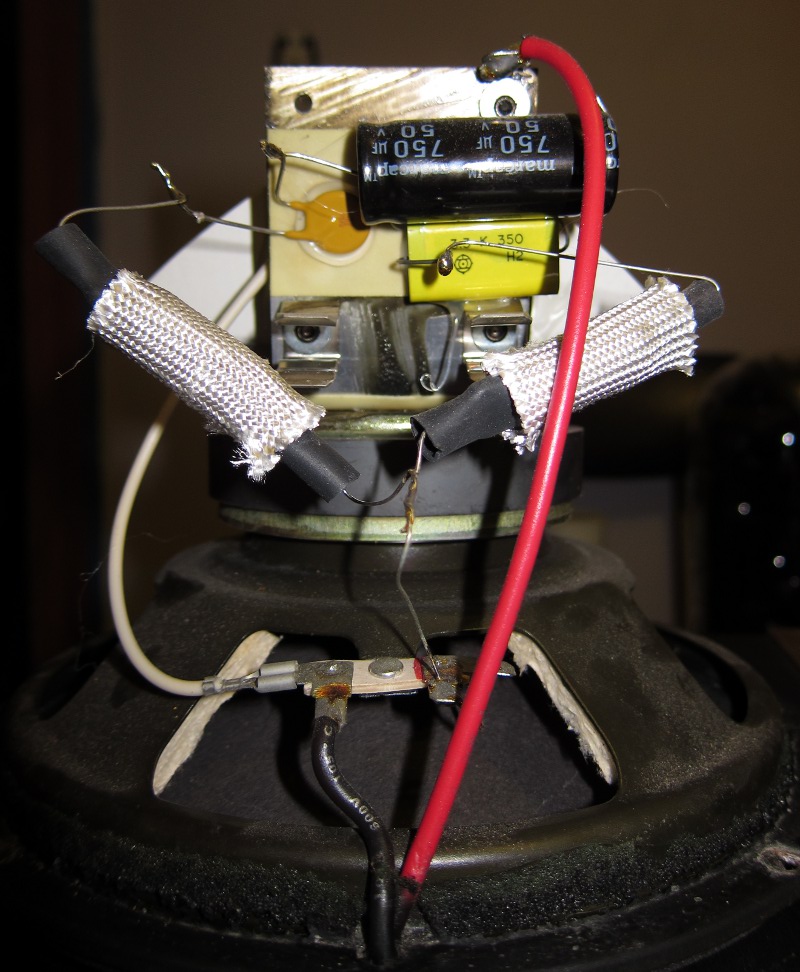
The only electrolytic cap is a big 750uf nonpolar which is the very first stop the signal makes. It's followed by a little protection device, then the tweeter has a 3.3uf film cap in front of it and both tweeter and woofer have incandescent lightbulb protectors - which are both intact in the one i opened up.

If i did my math right, the effect that this has on the frequency response, ideally, is to roll off the low end at about 45hz. Which is reasonable - these are baby walshes after all.

But i wonder if it's intended more as a DC blocker than anything else.

Naturally 750uf is not a value i can just buy. Mouser doesn't even carry non-audiophile 680uf or 820uf nonpolar electrolytics. Madisound can sell me Bennic 500uf and 250uf, which i could parallel, and i could throw one of their surplus 10uf polypros in there too for added sparkle.

I could get 1000uf bennic too, and lower the xover frequency, but if I'm going to do that I could just take these caps out of series completely.

I know my amps aren't outputting any DC, and not having to drive a capacitor directly should make them an easier load, right?
 
Last edited:
Register to hide this ad
Just replace it(PE has a variety of good NP caps too btw).

If the Walsh designer could of got away without the cap,they would of :yes:.
 
If the Walsh designer could of got away without the cap,they would of :yes:.

I'd like to be able to believe that, but I've seen the Walsh 3 crossover. there's a LOT in there they could have got away without. Like aspect controls.

I looked at P-E's caps but I'll take a known brand over a house brand. The price is roughly the same after shipping, near as i can tell.
 
Last edited:
Hi,

There was a vogue for capacitor coupled sealed box bass units
a while back, KEF used it quite a lot. Box Q is usually about 1.
The capacitor flattens the upper bass a little, lifts the lower
bass a little and offers some subsonic rejection (for vinyl).

see : http://www.humblehomemadehifi.com/download/Humble Homemade Hifi_Black Box_copy.pdf

Its purpose isn't just DC protection, but it offers that too.

You should stick to the used value, playing with a simulator
indicates the value needs to be say +/- 10% of optimum.

I'd suggest say 3 x 220uF and a good quality 100uF.
Or 7 x 100uF and a good quality 47uF, this may
have a bit more ripple current rating than above.

rgds, sreten.

What it is doing in series with the tweeter is anybodies guess
but it clearly should not be. Lightbulb protectors on bass units
also doesn't seem a good idea, only seen them on tweeters.
 
Last edited:
I'd suggest say 3 x 220uF and a good quality 100uF.
Or 7 x 100uF and a good quality 47uF, this may
have a bit more ripple current rating than above.

rgds, sreten.

What it is doing in series with the tweeter is anybodies guess
but it clearly should not be. Lightbulb protectors on bass units
also doesn't seem a good idea, only seen them on tweeters.

How about 2 x 280uf + 180uf + 10uf polypro? Just looking at what madisound has in stock.

I still wonder if they were just concerned about big transients from dropped tone arms and the like.

And i agree about where the tweeter is in this circuit, and the light bulbs, but that's the situation.

Perhaps i should post a picture.
 
Last edited:
Alright, all ye who wish to maintain innocent of the knowledge of what hides inside the can of a Walsh 1, well, too bad.

Walsh-1a.jpg

Walsh-1b.jpg


Looks like signal goes in 750uf, through protection device, to lightbulb, to woofer, to lightbulb, to 3.3uf, to tweeter.
 
The All-Seeing Eye! Aiiiiii..!

Actually, that circuit path sounds almost rational. If you were sick and tired of people decentering your cones with subsonics from badly-matched turntable setups, you'd be tempted to lop off the bass with a series cap too. But why this one? I don't think they all have this. Am I mistaken?
 
Sure looks like it was meant to do the same thing. Tune the box lower with a smaller-diameter port, lop off any input below the cutoff, thereby tightening the bass. Makes some sense for a ported enclosure or for small speakers.
 
Generally speaking it seems as though Ohm offers updating older speaker models with the option of installing the sub bass activator. However it's not offered for the Model 1, perhaps because it's there already.
 
Generally speaking it seems as though Ohm offers updating older speaker models with the option of installing the sub bass activator. However it's not offered for the Model 1, perhaps because it's there already.

well, the port is sorta small. compared to my model 3 at least.

But they also don't offer replacement hats for the model 1.
 
I guess I'd assume the ports are designed correctly.
If you feel the speaker needs attention, just go ahead and replace the capacitors with equal values.
 
Ohm does offer a bass-extender kit for the Walsh 1 that includes a new port tube. Is that different from what you're talking about?

Eric: I lean toward jumpering rather than replacement. Most sources don't have frequencies so low it goes beyond a large speaker's vented-box cutoff where the woofer just flaps around uselessly. Ohm's idea, I believe, was not to waste cone motion and amplifier power feeding the speaker frequencies that it not only couldn't reproduce but couldn't even handle safely.

The other part of the mod, the new port tube, appears to be a box re-tuning, allowing the speaker to safely handle lower frequencies before the port unloads the woofer. Both worthwhile. I just think the big cap's function could be better handled at line level, in the preamp: a subsonic filter.

But try it both ways and see what you think. Put a toggle switch on the cabinet.
 
Well, they don't explicitly call it an SBA, but then neither do they call it an SBA in the list of upgrades for the Walsh 3s that ericj and I both own. I'm just guessing that it amounts to the same thing, or at least, part of the same thing.

Right now the Ohm website seems to be in a tailspin.. Ah, now they've fixed it. Nope, no sign that I can find of an explicit SBA mention anywhere on the Walsh 3 page. Doesn't mean it's not already part of the 3's elaborate crossover/EQ board. If you're already dealing with a low-efficiency driver, it makes sense to use a short voice coil (can't have very high inductance anyway, since it's not a woofer) and a very intense, focused magnetic field. In this scheme, cone excursion is the enemy, so you use a ported enclosure and carefully tune the driver to the box (adding to the cost), and filter out anything below the -3dB point.

I'm still not convinced that the 750uF cap is needed these days, unless you like pipe organ music or you still have a rumbly-bumbly old turntable with an heavy undamped arm holding a stupid-high compliance cartridge, and no effective subsonic/rumble filter.

I went through all the old photos of Walsh drivers with inside-the-can crossovers I had, and sure enough, a few had what I'll call the SBA Cap, but most did not. Interesting!
.
 
Last edited:
Found some clues today that these may have been modified.

1: Although there is a pad of double-sided foam mounting tape on the xover side of the tweeter bracket, all xover components were adhered with silicone.

2: What might be a date code on the big cap - 8904 - would indicate that the cap was made in 1989. unsure if the walsh 1 was in production at that time.

3: There are two sets of mounting holes in the cabinet, and the position of the, wossname, little sheet metal clip nuts, toes in the tweeter rather than pointing it forward (vs. where i can see the adhesive from the "point to center of room" sticker in the corner of the top of the cab).

unfortunately i seem to have ordered the wrong value of one cap from madisound, so, my experiment is not quite done yet.
 
Hm! Don't forget to take some photos. This is getting more interesting the deeper you go.
 
Back
Top Bottom