


Haha. My continuing education series!
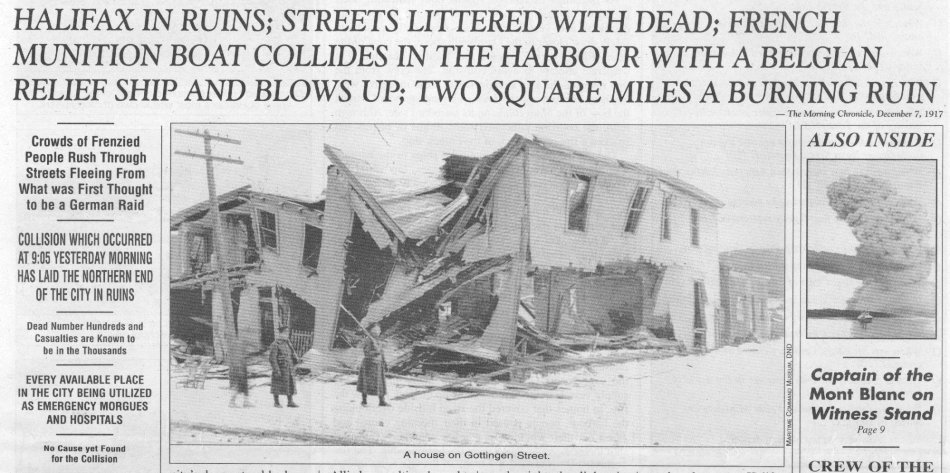
One of the more terrifying non-nuclear explosions ever to occur was in 1917 in Halifax, Nova Scotia. !n December of that year, the French-flagged Mont-Blanc plowed into another ship, the Imo, starting a ferocious fire. Ten minutes later the Mont-Blanc went up, creating what is commonly considered to be one of the largest non-nuclear explosions in earth history.
To avoid being torpedoed, the Mont-Blanc wasn’t flying any dangerous cargo flags, so no one except for her crew knew her cargo was so dangerous; almost 3,000 tons of munitions bound for the war that was then tearing Europe apart. When the fire got out of control, the Mont-Blanc’s crew tried to warn as many people as possible – but they only spoke French and the language of Halifax was English. Not realizing the danger, crowds began to form to watch the blaze. The Mont-Blanc, on fire, also began to drift toward a nearby pier … that was also packed with munitions bound for the war.
When everything finally came together – the criminal negligence, the miscommunication, and worst of all the fire and the explosives – the blast was roughly equal to 3 kilotons of TNT. The fireball roared up above the town and the shockwave utterly destroyed the town and everything within one mile of the epicenter. Metal and wreckage fell as far away as 80 miles from the blast and the sound of the detonation was heard more than 225 miles away.
An area over 400 acres was completely destroyed by the explosion while the harbour floor was momentarily exposed by the volume of water that vaporized. A tsunami was formed by water surging in to fill the void, which rose up as high as 60 ft above the harbour's high-water mark on the Halifax side. The Imo was carried onto the shore at Dartmouth by the tsunami.
Approximately 2,000 people were killed by debris, fires, and collapsed buildings, and it is estimated that nearly 9,000 others were injured. The blast was the largest man-made explosion prior to the development of nuclear weapons, with an explosive equivalent of ~2.9 kilotons of TNT. In a meeting of the Royal Society of Canada in May 1918, Dalhousie University's Professor Howard Bronson estimated the blast at some 2400 metric tons of high explosive.
A pyrocumulus cloud forms over the event.


One of the more terrifying non-nuclear explosions ever to occur was in 1917 in Halifax, Nova Scotia. !n December of that year, the French-flagged Mont-Blanc plowed into another ship, the Imo, starting a ferocious fire. Ten minutes later the Mont-Blanc went up, creating what is commonly considered to be one of the largest non-nuclear explosions in earth history.
To avoid being torpedoed, the Mont-Blanc wasn’t flying any dangerous cargo flags, so no one except for her crew knew her cargo was so dangerous; almost 3,000 tons of munitions bound for the war that was then tearing Europe apart. When the fire got out of control, the Mont-Blanc’s crew tried to warn as many people as possible – but they only spoke French and the language of Halifax was English. Not realizing the danger, crowds began to form to watch the blaze. The Mont-Blanc, on fire, also began to drift toward a nearby pier … that was also packed with munitions bound for the war.
When everything finally came together – the criminal negligence, the miscommunication, and worst of all the fire and the explosives – the blast was roughly equal to 3 kilotons of TNT. The fireball roared up above the town and the shockwave utterly destroyed the town and everything within one mile of the epicenter. Metal and wreckage fell as far away as 80 miles from the blast and the sound of the detonation was heard more than 225 miles away.
An area over 400 acres was completely destroyed by the explosion while the harbour floor was momentarily exposed by the volume of water that vaporized. A tsunami was formed by water surging in to fill the void, which rose up as high as 60 ft above the harbour's high-water mark on the Halifax side. The Imo was carried onto the shore at Dartmouth by the tsunami.
Approximately 2,000 people were killed by debris, fires, and collapsed buildings, and it is estimated that nearly 9,000 others were injured. The blast was the largest man-made explosion prior to the development of nuclear weapons, with an explosive equivalent of ~2.9 kilotons of TNT. In a meeting of the Royal Society of Canada in May 1918, Dalhousie University's Professor Howard Bronson estimated the blast at some 2400 metric tons of high explosive.
A pyrocumulus cloud forms over the event.


