
• The move to the new server is done. There are some software and database maintenance updates in process. This has us passing the hat around to help out. We appreciate any donations. Seriously, even a dollar helps. The payment page may be found here - https://www.audiokarma.org/support.html

Lay them on their sides?

Jayrosc

Super Member
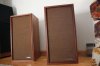
I've always wondered if there any sound quality issues with placing speakers on their sides as opposed to standing up. I know in the home theater world manufacturers tell us to avoid it and buy a special center channel speaker that is designed to sit that way, but what about nice old bookshelf types like these Optimus 1B's? I know I can do a test, which may or may not show anything obvious, but just curious. It does seem like engineers spend lots of time getting things to sound right, and laying them down would seem to contradict much of that effort. This comes to mind due to a recent posting here about Altec Lansing 890 c speakers....I found some pics of old ads that show them sitting both ways!
Seems like a special feature. Anyways, anyone know?
 

Attachments

  • IMG_1704.jpg
    IMG_1704.jpg
    63.7 KB · Views: 79
Register to hide this ad
Most Vintage Speakers under 24" tall were marketed as bookshelf speakers. I think the intention would be that the tweeters would be nearer to the center and the woofs would be on the outside.
 
It's not a special feature. You can lay those on their sides no problem. It all depends on what you're trying to accomplish.

A center channel speaker usually has the drivers arrange in a symmetrical fashion. Are you going for a center channel?
 
Most Vintage Speakers under 24" tall were marketed as bookshelf speakers. I think the intention would be that the tweeters would be nearer to the center and the woofs would be on the outside.

Yes, I had some old Jensens and the manual talked about book shelf on their sides. It's been a while but I think they said tweeters outside for better dispersion.

Speaker placement should be based on your room and your chair and your ears.
Forget about what the engineers did.
If they were worth a damn, they engineered and tested to get best performance in ideal situation, not your place.
 
I only ran into trouble once when it came to a horn tweeter's wave guide. The dispersion was all wrong.


Sent from my iPhone using Tapatalk
 
I only ran into trouble once when it came to a horn tweeter's wave guide. The dispersion was all wrong.


Sent from my iPhone using Tapatalk

I have a set of '67 Jensen TF-25 Bookshelf, the manual talks about putting them on their sides on a shelf..but pull them to the front so the horn disperses correctly, and states tweeters outside...(no shelf bounce of the sound). Also states not to put them on their sides on the floor as it renders the horn ineffective.

My second favorite speaks....though, I normally run them standing up.
 
There are a couple of things to consider when deciding whether to place speakers vertically or horizontally (sideways).

One is that the woofer will "couple" with the floor when it is close enough, boosting the bass response. Basically, you can think of the floor as acting like one side of a horn's mouth. This would suggest that if you want more bass response, orient the speakers vertically. If you want less, you can raise the speakers up higher (but that might affect the high end, as the tweeters optimally should be at ear level), or turn them sideways/horzontally (which can leave the tweeters at the same height).

Some speakers are DESIGNED to be used horizontally or vertically. The Yamaha NS-1000 series, for example, was designed from the start to be used that way, because many studios like to mount their monitors horizontally above the window that usually separates the recording space from the mixing/control area. Some speakers are designed so that the tweeters (and sometimes the logos) can be rotated 90 degrees to suit the orientation. With those Yamahas, I think the absolute best orientation IS a horizontal one, PROVIDED that you augment the low end with an appropriate subwoofer. The end result is almost in another league from the original/typical installation.

For other speakers, though, such as those with large fixed diffractors in front of drivers (usually tweeters), changing the orientation will have a negative impact on the sound.

In most cases, it is worth experimenting to see which sounds best to your ears, in your space.
 
I had a pair of Altec 886's, with 10" active driver/passive radiator flanking a phenolic ring tweeter, and they gave an amazingly wide soundstage when turned sideways and raised to ear level. I could see problems with horns, though.
 
Many older speakers were actually meant to be placed sideways on bookshelves. For example I have a pair of old AR2 speakers that only have three sides finished in walnut veneer - the two short sides and one long side. The other long side is unfinished plywood because it was always supposed to be the bottom. Believe it or not it was actually an extra cost option back then to get all four sides veneered in walnut. The original AR2 and the AR2a (basically the AR2 with a dome tweeter added) were designed to sit sideways at ear level mostly because of the dual angled 5 1/4" drivers (one faces left and one faces right). Once they started using single drivers in place of them I don't think it mattered anymore. Optimus 1 and 1B it doesn't really matter which way you place them though I've always preferred them on their sides sitting on shelves, seems to improve the bass response a bit. Nice looking speakers IMO.
 
Yes, many older bookshelf speakers were designed (surprise!) to go on bookshelves. This had the benefit of adding 3db bass boost due to the proximity to the wall. Some (like the AR2 mentioned above) were intended for sideways placement, and many allowed you to swivel the badges so they'd read correctly in either orientation.

It was later when those interested in imaging and soundstage reproduction began to notice that speakers did those particular things better when placed away from the walls and on stands. While true, such placement screwed up performance in other areas. Baffle Step Compensation is one attempt to help the old bookshelf units be used on stands and still retain the sound the designer had in mind.
 
Last edited:
Thanks everyone. To those that mention possible issues with horns I say yes...that is what I was worried about. Seems like horns are meant to shoot sounds wide, but not so much high and low. I don't know though. These do not have horns. Funny thing is that they each have two tweeters stationed slightly right of center when the speaker is standing up. That is what made me think they were not intended to sit sideways because you cannot have the tweeters level with one another. I've got them on their sides now and I'll play them for a couple days and see how it goes. This is all about logistics by the way. They just fit better on their sides.
 
I have Optimus-1Bs set up that way in my office -- tweeters face out. They sound very good set up this way, but they're mostly used for background music, not critical listening. Placing them a shelf or two lower might give better results.

attachment.php
 
Recording studios often lay the monitors on the sides when the console is a little too high. I guess it depends your room, they might image better sideways, or worse. I remember one speaker manual stating to achieve optimum imaging your ears should meet the middle ground between the HF and MF. Obviously thats not possible when a speakers is sideways. I wouldnt consider it a hard and fast rule but it is worth trying whenever possible. Some speakers do image a lot better there while others do not (depending).
 
I remember reading years ago that the tweeters should go to the outside when on their side like has been mentioned. I didn't read an explanation for it but it makes sense to me that the mid and highs go outside because we detect the source of those mid and higher frequencies better than low bass so there's a better stereo affect. I detect the source of the mid and highs but bass source location is harder for me to detect, it's just "in the room" to me so it makes sense to put the bass closer together when on their sides. Just using my logic there, don't know for sure, I'm sure several people here know. I think my little Altecs are bookshelves because of where they placed things on back.
 
I previously owned a pair of Infinity Qe's, which were bookshelf speakers that allowed you to rotate the tweeters so they could be placed vertically or horizontally.
 
All of the Wharfedale W60-type models were designed to be positioned that way, as were basically any of their smaller models with the same shape. Placing the 3-way versions like that gets the tweeter and mid in a verticle array while simultaneously putting the woofer and the midwoofer/tweeter on the same plane, plus it widens the soundstage.

Only negative? You have to place them much higher than you would if they were vertical, the main reason being that the tweeter position gets lowered when you lay them on their sides, and you have to compensate for that in order to keep the tweeter at eye/ear-level.
 
I only ran into trouble once when it came to a horn tweeter's wave guide. The dispersion was all wrong.

This.

My Mach Ones sounded horrible on their sides. When I first moved into my house, I didn't have a TV stand. So I laid the Mach Ones on the floor, side-by-side and used them for a TV stand. I couldn't buy a TV stand fast enough, LOL
 
The Mach one's use a horn tweeter. I think that Horns have a dispersion pattern that is not circular. Placing the Mach one horizontally will hurt the dispersion pattern. Non horn loaded tweeters will radiate in the same pattern no matter how you place the speaker. What becomes important when you lay down a speaker is the placement of the drivers. Normally having the tweeters to the outside will give you better response.
 
Some 2-way speakers are designed to have a vertical alignment of axis of the tweeter and woofer in terms of producing a unified wavefront (some 3-ways as well). That said, if a horizontal placement will put the tweeter closer to ear level, I'd still use the horizontal placement.

That is, getting tweeter and midrange (if any) closer to ear level is 1st priority in the decision, and vertical alignment of drivers is second priority.

M2
 
Back
Top Bottom