• The move to the new server is done. There are some software and database maintenance updates in process. This has us passing the hat around to help out. We appreciate any donations. Seriously, even a dollar helps. The payment page may be found here - https://www.audiokarma.org/support.html

LE Audio VM60 problems

Subchannel

Active Member
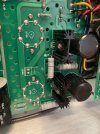
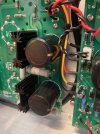
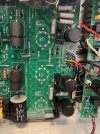
I bought a pair of LE Audio VM 60 tube monoblocks, and the previous owner have put one of the output tubes in the wrong way (broken tab on the tube socket).
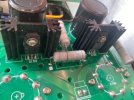
I have tried to measure it, and D159 measures different from the other three (one for each output tube. Three measures a bit over 3ohms, the fourth is in the megaohm range). It´s not possible to see what kind of component it is as the lettering is sanded off.
I´ve sent an email to the producer but no luck so far.
The amp is working, but plays much lower than the other.
Anyone here with xperience?
thank you in advance.
 

Attachments

  • IMG_0648.jpg
    IMG_0648.jpg
    104.8 KB · Views: 24
Register to hide this ad
D would imply some sort of a diode. There are dual diode TO-220 packages like this, but the question is whether its a common anode or common cathode diode. If you could follow the traces to and from it, likely it could be worked out. It could be either, or one of each depending on the power supply config.

or it could be something not a diode and the board marking is just dumb, I really don't know without a schematic or at least some idea what goes in and out of that device. Must be a double sided board and the traces are not on the side I can see.

**edit** found this blurb on the interwebnets about them "Fitted with Nelson's proprietary silicon-carbide power JFETs from SemiSouth" and there is a picture of this exact area by this, so maybe these are being used as a source follower? Not a diode in that case.
 
I loath proprietary parts. Sony did that. But in Sony's case a lot of them were common parts they slapped there own part number on.
Even a proprietary part should have some kind of part number on it.
All I've run across have. Sanding the part number off makes me think those J-FETS may not be so special. Why go to the trouble of putting a part number your "proprietary" part and then shave it off? :idea:
 
Last edited:
Thanks for the input. I agree, what a waste og time sanding all components. I too was thinking diode (D), but don’t know what kind. I’l trace the surrounding components and take some pics.
Thanks again.
 
Ah, well that certainly confuses matters. Yammering about some other amp while showing a picture of this one.

anyway,
Sanding the part number off makes me think those J-FETS may not be so special. Why go to the trouble of putting a part number your "proprietary" part and then shave it off?

100%. Probably just some common part that they will sell you at 10x what it costs on the open market simply because you don't know what it is.

I've dealt with plenty of things with proprietary numbers, but they have the number on them. That gets real irritating when the manufacturer is out of business or at least not supporting the whatsit anymore and you have to use best-guesstimation in order to try and figure out what makes sense for a substitute.
 
Ah, well that certainly confuses matters. Yammering about some other amp while showing a picture of this one.

anyway,


100%. Probably just some common part that they will sell you at 10x what it costs on the open market simply because you don't know what it is.

I've dealt with plenty of things with proprietary numbers, but they have the number on them. That gets real irritating when the manufacturer is out of business or at least not supporting the whatsit anymore and you have to use best-guesstimation in order to try and figure out what makes sense for a substitute.
I went through this with a Sony power amp. When I got it it wasn't working and I found a mess inside. Burnt resistors replace with random values, random small signal transistors used as replacements. The drivers were toast and they were a proprietary part with no way to find them from Sony for an amp sold in the 70's. Another AK'r ran into a similar problem with failed drivers. He was able to come up with a transistor made by Fairchild that worked. I bought a few extra incase I ran across another one of those amps. The output transistors had Sony part numbers on them also.
Someone found out Sony used surplus US made mil spec transistors and just put there numbers on them.
 
Some more pic´s, maybe someone can spot what kind of diode it is.
Thanks again.
 

Attachments

  • IMG_0673.jpg
    IMG_0673.jpg
    92.9 KB · Views: 4
  • IMG_0674.jpg
    IMG_0674.jpg
    80.2 KB · Views: 4
  • IMG_0675.jpg
    IMG_0675.jpg
    74.8 KB · Views: 3
  • IMG_0676.jpg
    IMG_0676.jpg
    94.5 KB · Views: 4
I just can't tell where the legs go. Its probably on the other side of the board. I can't see anything on this side.
 
Three measures a bit over 3ohms, the fourth is in the megaohm range). It´s not possible to see what kind of component it is as the lettering is sanded off.
Those are almost certainly dual diodes, perhaps a common-cathode and a common-anode package creating a bridge rectifier for the power supply. The parts measuring 3Ω are probably shorted. Did you measure the other one using the semiconductor setting of your ohmmeter?

Jack
 
Someone might be willing to take a look in person, but no one knows where the OP is. He didn't fill out his profile location. That should be a required field for registration.
 
Thanks for input, and I´m located in Norway so not that easy to drop by (thought I filled that out when registrating, but will do asap).
I have mailed the distributor in Norway, maybe they can provide schematics.
I guess it´s not that smart to test the two different diode IC´s in circuit.
Did not use the semiconductor setting on my Fluke 117, but the difference in ohm between the one with 3ohm´s and the three others are quite obvious in my opinion.
I´m not that experienced with tube amps, and there´s a lot to disasemble to reach the underside of the pcb.
 
I can try to solder out two of the dual diodes and measure them.
I think it might be wise to wait until you have a schematic. Those parts are probably bad, but there's a chance they're connected across another component. It can be difficult to remove parts like this without damaging the PCB.

Jack
 
I´m sending the amp´s back to the seller/ distributor. He neather could provide any schematics. What a shame, and not a wise choise by the producer.
Thanks anyhow for good help.
 
Back
Top Bottom