• The move to the new server is done. There are some software and database maintenance updates in process. This has us passing the hat around to help out. We appreciate any donations. Seriously, even a dollar helps. The payment page may be found here - https://www.audiokarma.org/support.html

left channel intermittent on Lux PD-272 table

ghaubrich

New Member
I recently bought a Luxman PD-272 and after a whole lot of tinkering with balance, counterweights, anti-skate, and cartridge experiments that it is an electrical fault rather than a tracking/cartridge problem. The cartridge is a Grado Gold 3. The PD-272 has a Micro-Seiki TA-1 tonearm, hard to get specs on but in perfect condition ... a low-mass arm but the Gold 3 is moderately compliant (20 ug spec) ... . A prior owner replaced the RCA output cables with Van Damm silvers ...

This has been quite a journey of technical frustration and education. Somebody (granddaughter?) blew out a voice coil on a Kaber which disguised to some extent what I was dealing with. Grado generously provided me a brand new Gold 3 after directly consulting with them, so now I have two and believe I owe one of them back because it turns out the cartridge was not the problem. Replacing the speaker(s) and cartridge, and adding a gram of mass to the tonearm, did not help.

So, the left channel cuts in and out. Bumping the tonearm very lightly will bring the left channel alive, and then it will go away again ... . If both channels are playing, putting the dust cover down will drop out the left channel. A light bump on the dust cover or base will cause the channel to drop in or out.

So, before I take the table apart, I'd appreciate any suggestions .. The rest of the system is Lux TP-117 preamp tuner, two Sony TA-300 ESs strapped mono, B&W CDM-1 Special Editions bi-wired, and Velodyne 8" powered sub.

Which sounds absolutely totally wonderful, except when it is all coming out of only one side.

Anyway please weigh in and advise. Much appreciated. Butter aka Greg
 
Register to hide this ad
You have a wiring issue, either in a RCA cable, or in tonearm wires, or at their connection point inside. One connection is intermittent somewhere, going fully open with time as the connection deteriorates further. You will have to trace the wires with a multimeter, and inspect the soldering inside the turntable (probably through the bottom panel). If the RCA plugs are accessible (can be unscrewed) check the connection of wire to the plug. The finger points to the previous owner replacing the stock cable.
 
You have a wiring issue, either in a RCA cable, or in tonearm wires, or at their connection point inside. One connection is intermittent somewhere, going fully open with time as the connection deteriorates further. You will have to trace the wires with a multimeter, and inspect the soldering inside the turntable (probably through the bottom panel). If the RCA plugs are accessible (can be unscrewed) check the connection of wire to the plug. The finger points to the previous owner replacing the stock cable.
yes ... thank you ... agree re either replacement cable (as primary suspect) or tonearm wires ...
 
yes ... thank you ... agree re either replacement cable (as primary suspect) or tonearm wires ...

I think you are on the right track.
I had a faulty turntable cable, lived with it for years. Worked just fine unless the connection at the tt was bumped or turned, then it let out a very scary loud hum. One of those rush to turn down the volume before something really goes poof. Finally I just replaced the RCA ends on the end that plugs into the receiver. Fixed.
 
I think you are on the right track.
I had a faulty turntable cable, lived with it for years. Worked just fine unless the connection at the tt was bumped or turned, then it let out a very scary loud hum. One of those rush to turn down the volume before something really goes poof. Finally I just replaced the RCA ends on the end that plugs into the receiver. Fixed.
either that or some of that duct tape you're holding ...
 
If the cartridge clips are tight on the cartridge and the phono cable plugs in properly and you are missing a channel, start with wiggling the wire at the RCA plug. This is a common failure point indicating a need for refreshed RCA plug soldering and maybe broken wires in the first inch or three of the wiring back to the turntable. I have replaced a dozen RCA ends over the years on different tables. If this isn't the issue and your messing with the tonearm and getting the channel back seems to indicate the RCA ends are not the problem...

Time to get inside and see what is going on. Should have some wiring out the bottom of the tonearm that goes to a connection with the phono cables. This is where you test to determine if the phono cable or the tonearm wiring is suspect.

But you say messing with the tonearm will bring the channel back. This makes me suspect the tonearm wiring, first at the cartridge and second at the other end inside the table at the connection. Check it for faults and then check it with a voltmeter on the ohms setting for continuity. See if moving stuff can get the continuity to stop. If so, investigate that part.

Checking the green wire for example, you can put a lead on the green wire at the cartridge and the other meter lead would be in the Right Channel Ground (outside wire) at the connection or the RCA plug.
Red is right hot or center pin of the RCA
White is left hot or center pin of the RCA
Blue is left ground.

Since the cartridge has a certain measurable resistance with it installed you can meter the ohms from R hot to ground and L hot to ground and read that resistance. A missing reading or OL on digital meters indicate the circuit is not complete and that section could contain your issue.

Find where the fault is and if not in the tonearm, fix it. If in the tonearm, post some drag and drop pictures and maybe some here can help you correct the problem.
 
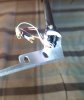
This arm is likely similar to the one on my PD-277. I'd recommend starting by checking the far ends of the cabling - the RCA's as suggested, and the headshell wires. Despite having a non-removable headshell, the internal wiring terminates inside the headshell and then a set of leads connects the external portion to the cartridge. These leads are longer than those supplied with AT carts, not sure if they are available off the shelf. These original external leads had lightweight clips, and were quite dull looking, possibly oxidized. I replaced mine.

If it's the same arm it could have a set screw underneath. I didn't need to remove mine and it seemed frozen. As I recall the headshell pins didn't seem to have any colour coding, so if you replace them, do it one at a time.

LuxHeadshellWire.jpg
 
total thank you Shadow ...

Checking the green wire for example, you can put a lead on the green wire at the cartridge and the other meter lead would be in the Right Channel Ground (outside wire) at the connection or the RCA plug.
Red is right hot or center pin of the RCA
White is left hot or center pin of the RCA
Blue is left ground.
 
If it's the same arm it could have a set screw underneath. I didn't need to remove mine and it seemed frozen. As I recall the headshell pins didn't seem to have any colour coding, so if you replace them, do it one at a time.

I just looked at a 277 and it appears to be the same arm. there is a set screw on the bottom of the headshell ... I'll turn the headshell around and check the pins and connectors, plus have a look at the RCA connections ... how you like your table? cartridge? ... and many thanks
 
If it's the same arm it could have a set screw underneath. I didn't need to remove mine and it seemed frozen. As I recall the headshell pins didn't seem to have any colour coding, so if you replace them, do it one at a time.

I just looked at a 277 and it appears to be the same arm. there is a set screw on the bottom of the headshell ... I'll turn the headshell around and check the pins and connectors, plus have a look at the RCA connections ... how you like your table? cartridge? ... and many thanks
I do like the old table... bought it new in 1979. This Luxman style still looks great, IMO. It spent most of its time with a Grado GF1. Most recently installed is a Dynavector 10x5, which sounds good.
 
Back
Top Bottom