

You are using an out of date browser. It may not display this or other websites correctly.
You should upgrade or use an alternative browser.
You should upgrade or use an alternative browser.
Let's Talk About Amplifier Clipping.
- Thread starter ken kantor
- Start date


Chris Brown
Super Member
I have a few questions remaining regarding clipping.
Without having anything to do with harmonics or tweeters, isn't there still a possibility of damage due to clipping simply as a result of the extra power being fed into the speaker?
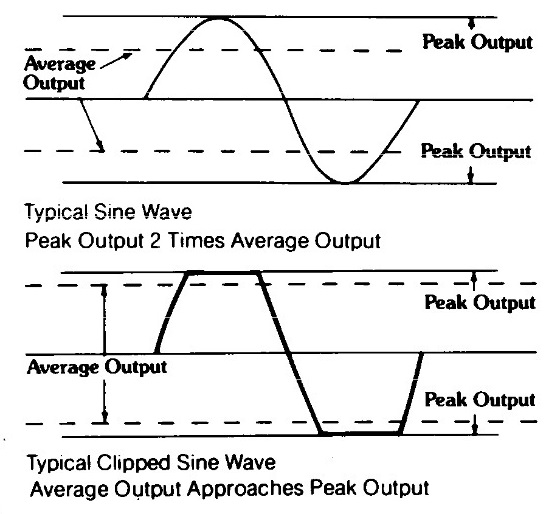
Despite the amp being at it's maximum and clipping, the average power output can still increase. You could end up with a 100wpc amp putting out much more than 100wpc.
Again, without anything having to do with harmonics or tweeters, isn't that fact dangerous all on it's own?
Without having anything to do with harmonics or tweeters, isn't there still a possibility of damage due to clipping simply as a result of the extra power being fed into the speaker?
Despite the amp being at it's maximum and clipping, the average power output can still increase. You could end up with a 100wpc amp putting out much more than 100wpc.
Again, without anything having to do with harmonics or tweeters, isn't that fact dangerous all on it's own?
Last edited:

I was the guy power testing the Eminence Kilomaxx speakers while they were being developed. The thought of using them as a grill for burgers at lunch was always in the back of my mind.
That had to be fun... I have Krell class A monoblocs here at home that idle at 170F on the heat sinks and draw 8A each at idle... using them on the "amp killer" Kappa 9's...

That had to be fun...
Early on in the development I was testing a couple and there was a failure. I went in to investigate without thinking things through. I grabbed the terminals to unhook them and suddenly realized that I hadn't turned off the amps (outside the room) with 2kW of EIA426A pink noise. It's amazing how fast someone can moonwalk across a room.
Back to the topic at hand...clipping was not an issue with our amp array.


ken kantor
Fowl Humor
Early on in the development I was testing a couple and there was a failure. I went in to investigate without thinking things through. I grabbed the terminals to unhook them and suddenly realized that I hadn't turned off the amps (outside the room) with 2kW of EIA426A pink noise. It's amazing how fast someone can moonwalk across a room.
Back to the topic at hand...clipping was not an issue with our amp array.
Sounds like your nervous system clipped!
-k
ken kantor
Fowl Humor
I have a few questions remaining regarding clipping.
Without having anything to do with harmonics or tweeters, isn't there still a possibility of damage due to clipping simply as a result of the extra power being fed into the speaker?

Despite the amp being at it's maximum and clipping, the average power output can still increase. You could end up with a 100wpc amp putting out much more than 100wpc.
Again, without anything having to do with harmonics or tweeters, isn't that fact dangerous all on it's own?
You are correct. But, the original question was about the relative danger between small and large amps.
If you add a third graph to your first two, one just like the second one, except where the amp is made bigger... even MORE Watts go to the speaker. This shows, yet again, that the bigger amp is ALWAYS more potentially dangerous. There is >NO< situation where a bigger amp presents less danger to the tweeters or the woofers than a small amp.
-k
ken kantor
Fowl Humor
This is interesting.
It seems the takeaway remains that underpowering speakers remains a higher risk than overpowering them; the reason why this is so is different than was commonly thought.
I don't quite know how you got that as your take away. There are >NO< circumstances where a smaller amp is more dangerous to woofers or tweeters than a larger amp. None. The bigger amp >ALWAYS< presents more danger. That is the correct take away. If you are coming up with a different answer, you need to think the problem through again. No other answer is correct, I'm afraid.
-k

Yeah, I mean when I connect my little Pioneer BS22's to one of my t-amps, I have no fear of damage, but the first time I used it with my 200wpc B&K, I was real mindful of the volume control at first until I realized they were ok with it. I bet if I really drove that amp hard, those BS22's would go bye bye, but they get as loud as I need before that so they continue to live.

Great, as in the last week I have been using a fairly small tube amp to power a pair of Infinity Quantum Line Source speakers, and from all the accounts of people claiming how a lack of amp current will cause damage to my EMIT's in these old Infinity's had me a bit concerned. But I couldn't control myself I just couldn't get myself to pull the plug.
So now my only concern will be damage to the poor little amp. I hear no signs of clipping or distortion and its not like I am having a party, just simple nice listen levels.
So now my only concern will be damage to the poor little amp. I hear no signs of clipping or distortion and its not like I am having a party, just simple nice listen levels.

davidro
Lunatic Member
There are >NO< circumstances where a smaller amp is more dangerous to woofers or tweeters than a larger amp. None. The bigger amp >ALWAYS< presents more danger.
-k
someone needs to keep this as his/her AK signature.

I don't quite know how you got that as your take away. There are >NO< circumstances where a smaller amp is more dangerous to woofers or tweeters than a larger amp. None. The bigger amp >ALWAYS< presents more danger. That is the correct take away. If you are coming up with a different answer, you need to think the problem through again. No other answer is correct, I'm afraid.
-k
I've got it. Crystal clear.
I'd posit, however, having worked tech support, that more tweeters ARE blown by smaller amplifiers. I have no hard data.
If we choose to accept this premise, should we consider the less-invested (and possibly less knowledgeable) owners the mechanism?

JimPA
Distinguished Member
3- Speaker voice coils are NOT cooled very much by motion, nor overheated by lack of motion. To a very great extent, coils are cooled by radiation to the pole piece and into space. They are not cooled by air or air flow, to a large extent. (I, and many others, have designed drivers with enhanced airflow or pumping in the gap, only to find that there was little or no improvement in power handling.)
-k
Ken I was once told that the extended pole piece helped to increase the power handling of a driver?
The pole piece of some of the OEM drivers I use have a pole piece that are 5-10 mm longer than the stock verisons.
My thoughts on your third point would lead me to believe this.
Having a longer pole piece is a larger surface area and volume for heat diissipation away from the voice coil to prevent overheating.
Sounds like your nervous system clipped!
-k
Well, part of me compressed, that's for certain.
I've got it. Crystal clear.
I'd posit, however, having worked tech support, that more tweeters ARE blown by smaller amplifiers. I have no hard data.
If we choose to accept this premise, should we consider the less-invested (and possibly less knowledgeable) owners the mechanism?
With a higher powered amp the overall volume keeps going up more linearly as you crank the knob. Before you get to the point where the tweeter gives up, your ears do. With a lower amp that goes into clipping/compression the volume doesn't go up much as you dump more and more power to the tweeter.
Another possibility is that more people own smaller amps than monsters so the absolute frequency of tweeter failure is higher but a normalized statistic might tell a different story.
ken kantor
Fowl Humor
I've got it. Crystal clear.
I'd posit, however, having worked tech support, that more tweeters ARE blown by smaller amplifiers. I have no hard data.
If we choose to accept this premise, should we consider the less-invested (and possibly less knowledgeable) owners the mechanism?
My guess would be cheaper speakers. ?
-k
ken kantor
Fowl Humor
I appreciate Ken's knowledge and expertise. Isn't it great to have people like him members of this forum?
T'anks!
-k
ken kantor
Fowl Humor
Ken I was once told that the extended pole piece helped to increase the power handling of a driver?
The pole piece of some of the OEM drivers I use have a pole piece that are 5-10 mm longer than the stock verisons.
My thoughts on your third point would lead me to believe this.
Having a longer pole piece is a larger surface area and volume for heat diissipation away from the voice coil to prevent overheating.
Yup! Larger pole piece = more area. And, probably, more time spent close to the coil.
-k
ken kantor
Fowl Humor
someone needs to keep this as his/her AK signature.
OK, but only for a few days.
-k

nailer
audionerd
Think I've figured it out. Low power amps destroy tweeters because being small makes them angry and picking on tweeters makes them feel powerful. Big amps just like blowing things up, after all that's what the big and powerful do - destroy. So I'm sticking with moderate power amps because in their moderation they don't want to cause any trouble.
Last edited:

ofajen
Daddy-O-Daddy-O-Baby
I have a few questions remaining regarding clipping.
Without having anything to do with harmonics or tweeters, isn't there still a possibility of damage due to clipping simply as a result of the extra power being fed into the speaker?
Despite the amp being at it's maximum and clipping, the average power output can still increase. You could end up with a 100wpc amp putting out much more than 100wpc.
Again, without anything having to do with harmonics or tweeters, isn't that fact dangerous all on it's own?
Perhaps, but the average output won't get much more than 3 dB higher before it is essentially all pulse waves (at which point the average and peak are roughly the same).
Otto