• The move to the new server is done. There are some software and database maintenance updates in process. This has us passing the hat around to help out. We appreciate any donations. Seriously, even a dollar helps. The payment page may be found here - https://www.audiokarma.org/support.html

Lightning damaged Dunlavy SCII’s?

Kevin6860

New Member
I got a pair of SCII’s as part of a trade recently with a known issue. There is very low bass output below 160hz or so. I tested the woofers individually, they definitely are able to hit the lower notes when not hooked up to the crossover and the mids and highs sound wonderful. I removed the crossover plate and thankfully it’s only a first order low pass- the high pass is much more in depth. I was able to determine that it uses a 2.7uf 400v Solen poly cap and a 10 watt 2ohm audio grade resistor but I can’t find any values on the inductor. Nothing appears to be blown or damaged but the owner said that their house does get lightning strikes often so my question is, should I find a way to measure the inductor to replace it or is it unlikely to be out of spec? Also if there are any recommendations for getting quality caps- I’m thinking i would stick to exact replacement from Solen since there’s a lot of science and measurements behind the design of the SCII’s.
Both speakers have the same exact issue so whatever did happen to them happened at the same time or to the same components. I read on another thread for SCIII’s that someone had the same component fail in both, which was the inductor. Any insight is appreciated I want to get the SCII’s sounding to their fullest potential. I’ve never recapped a pair of speakers before since they’re usually in and out of the house but these are worth putting the extra time into.
 
Register to hide this ad
If there's a cap in the low-pass, then it's a second order, not first order crossover. Inductors rarely go bad, although if the speaker did get a lightning strike then it is technically possible and there could be an internal short between windings, although I can't see how that would cause the problem you're experiencing. More likely would be a break in the coil, which would give you no output at all.

If you remove the jumpers between the low and high inputs on the back of the speaker, and then just connect the amp to the low section, how are the lows? If good, that would indicate a problem in the high-pass crossover interfering with the woofer. If still problematic, I'd try bypassing the inductor, then the resistor, and cutting out the cap, one at a time, to see if any of those solve the problem.
 
If there's a cap in the low-pass, then it's a second order, not first order crossover. Inductors rarely go bad, although if the speaker did get a lightning strike then it is technically possible and there could be an internal short between windings, although I can't see how that would cause the problem you're experiencing. More likely would be a break in the coil, which would give you no output at all.

If you remove the jumpers between the low and high inputs on the back of the speaker, and then just connect the amp to the low section, how are the lows? If good, that would indicate a problem in the high-pass crossover interfering with the woofer. If still problematic, I'd try bypassing the inductor, then the resistor, and cutting out the cap, one at a time, to see if any of those solve the problem.

It seems the woofers are getting a full range signal and the tweeter starts to come in around 2-300hz when running them through a frequency sweep. When running just the woofers through the crossover it’s the same issue. You can hear the bass but it’s very low output and gets much louder as it goes from 150-250hz. Is there an easy way to bypass the inductor, capacitor and resistor without having to desolder them from the board? Perhaps by bridging the solder points with some wire?
 
Inductor and resistor, yes, you can bridge them with jumpers or even alligator clip leads. But since the cap is installed in parallel (I assume) with the woofer, you'll need to unsolder or cut one leg.
 
Is there an easy way to bypass the inductor, capacitor and resistor without having to desolder them from the board? Perhaps by bridging the solder points with some wire?
probably but we have no idea of what you are looking at to see about where to bridge.

Have you tested the inductor for continuity
 
probably but we have no idea of what you are looking at to see about where to bridge.

Have you tested the inductor for continuity

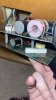
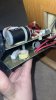
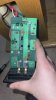
Yep doesn't seem to be split or blown on either crossover. I bridged the resistor and the inductor with no difference to sound output. I also tried to make a schematic of the low pass but it didn't look right so I went back and took pictures as well so maybe you can see something I am missing. The last picture is the high pass for the tweeter. They use the same PCB as the lowpass and I'm having no issues with themIMG_3151.jpg IMG_3146.jpg IMG_3145.jpg IMG_3150.jpg IMG_3147.jpg on either speaker.
 
Are you listening to one speaker at a time or both at once?

Lightning can't really damage the speakers unless they are plugged directly into the wall. :yikes:

Lightning usually damages things plugged into the wall such as tv's, lamps, stereo's, microwave ovens etc.
 
Are you listening to one speaker at a time or both at once?

Lightning can't really damage the speakers unless they are plugged directly into the wall. :yikes:

Lightning usually damages things plugged into the wall such as tv's, lamps, stereo's, microwave ovens etc.

I had a hard time believing it could be lightning damage as well but that’s the explanation the owner offered up. He didn’t know too much about them either, they came with a house he bought. I tried all sorts of configurations with both speakers, one speaker and with and w/out the bridge plates for the crossovers installed and can’t seem to isolate the issue. I thought maybe it could be the woofers themselves but they measured at a stable 5.6-5.9 ohms with the multimeter which checks out. I did notice that the rubber surrounds were quite stiff so I did a bit of research and read that with age/low temps the rubber can stiffen and raise the FS of the woofer but these are rated for 70hz- I would understand a couple hz increase but not over 100hz. I’ve read up on the restoration properties of wintergreen oil but I would want to eliminate the chance of it being the crossovers before starting to mess with the drivers. I may also try to soften them up with a heat gun set on low before trying the wintergreen oil- let me know if this is a dumb idea or not, I wouldn’t want to mess up the drivers
 
Not at the moment. I have a basic multimeter but have been on the lookout for a used nicer one and an oscilloscope. Is the Sperry DM6850T a good option?
That would work as a multimeter, but it does not have capability to check esr. For that, you would need a separate esr/capacitance tester. Amazon has a few, at reasonable prices. How good they are :dunno:. Read the reviews.
 
Back
Top Bottom