• The move to the new server is done. There are some software and database maintenance updates in process. This has us passing the hat around to help out. We appreciate any donations. Seriously, even a dollar helps. The payment page may be found here - https://www.audiokarma.org/support.html

Limiting peak wattage so subs don't clip?

Thall777

New Member
Hi all, new to the forum...

I recently threw together a new setup, a carver c-4000 into a carver m1.5t (1200w RMS) into some 80's Snell series III type a speakers. I listen to a lot of classical music, and today was listening to Stravinsky's Rite of Spring. (volume on around 5/12 on power amp)
This recording - (http://www.amazon.com/Stravinsky-Sp...9307&sr=8-2&keywords=rite+of+spring+cleveland)
All sounded great until the louder parts came on. There are some pretty intense drum beats in this peace, and on one of these instances the power amp turned off for a second, lights flashing, including the light indicating the power was 600w (amp has a scale of lights for each channel, most of the time other than the drum beats only the bottom lights were on). Worried for the speakers, I turned it down. I checked my speaker wire and found that not all the wires were threaded into the terminals.
So I tried again. The amp didn't go into protection this time (or whatever it was doing), but there was some slight clipping on the sub. Is there any way that I can limit the peak wattage? Is there any other things to look at? I have to crank the amp because the speakers aren't very sensitive (86db).
Thanks.
 
Register to hide this ad
Clips are due to more demand than your amp can provide. Either turn it down, or limit the bass. Turn down either the volume or bass. Make sure your loudness is off and the tone controls are on, and maybe try playing with the input level as well. The C4000 also has a 3db trim button that could help a lot, and try turning correlation off if you're using that.

And slight clipping isn't usually gonna hurt the speakers, but I do know Carver amps do tend to clip hard. You're also talking a LOT of watts for ANY speaker, so keep that in mind as well.
 
Loudness is off, tone controls are on but set dead center at the moment. What does the correlation even do? I'm not with the speakers right now, but I think its off.
 
I don't think even Bob Carver is quite sure what the auto correlator does ... <G>

(Sorry Bob ... the devil made me say that!) <G>

In it's simplest form, we'll call it a fancy band pass filter, only it works with several bands at a time, both high and low. That's where it gets tricky - you get some circuit drift over time, and I understand it's a bear to calibrate properly. So ... best to leave it off ... or on ... depending on who you talk to ... and what day of the week it is.

If all else fails, it's possible the C4000 power supply could benefit from a quickie recap. Just the big electrolytics, which is fairly easy. Seems to me, it's quite common to sub in bi-polars instead of standard caps for improved signal purity and reduced noise, but don't quote me on that with this specific model.
 
Amp Clipping won't hurt subs because their own inductance protects them from the resultant HF content, however it will very quickly ruin HF drivers due to coil heating - won't do your ears too much good either.

Running bass speakers past Xmax for any period of time will however quickly damage them via coil heating at either end because the coil is no longer completely in the magnetically charged gap. And of course approaching Xlim will damage parts through mechanical contact, stretching or perhaps tearing.
 
Running bass speakers past Xmax for any period of time will however quickly damage them via coil heating at either end because the coil is no longer completely in the magnetically charged gap.
Simply not true.

Xmax refers to the point or limit(of travel of the moving assembly) where the acoustic output becomes non-linear with the electrical input, period.

A speaker can be driven to and beyond Xmax all night long, night after night as long as Xmech(the mechanical limitation of travel) is not exceeded, or Pe(thermally limited electrical input) is not exceeded.

It sounds to me like the "clipping" the OP detected was more likely the woofers groaning(popping sound) from being driven to or beyond Xmech, something to easily be expected when a speaker is connected to an amplifier more than twice the output of the maximum recommended by the manufacturer and then driven hard.
 
Last edited:
adding a compressor /limiter works for me when using p.a gear . cant see why it wouldn't work in a home environment .
it would be much easier to use tone controls and vol control you already have though ..
 
The answer here is there is simply not enough rig for the gig.

In the mean time, your answer is to keep the volume at a point where the speakers are not popping/clunking as bowtie427ss mentioned.

Adding compressors/limiters can be dangerous. If it's a peak limiter, as most are afaik, you will stop the peaks from pushing the speakers to overexcursion. However, if you still crank the power as much, or maybe more because the speakers are no longer popping/clunking, you're just going to increase average power and ruin the speakers by thermal damage.

If the amp had an RMS/power limiter too, then both bases would be covered.

However, remaining within the confines of the gear limits (basically don't crank it as much) doesn't add cost and is pretty much 100% effective.

Otherwise, as mentioned before, the main problem is not having enough rig for your gig. Meaning, the system's capability is less than the real demands placed upon the system.
 
The amp didn't go into protection this time (or whatever it was doing), but there was some slight clipping on the sub. Is there any way that I can limit the peak wattage? Is there any other things to look at? I have to crank the amp because the speakers aren't very sensitive (86db).

It sounds like this is only happening with very low frequency content. The op refers to "the sub" but sounds like he is actually referring to the woofers in his speakers. Seems like a good solution in this case would be to get one or more subwoofers, dial in the crossover to the point where the speakers are no longer being burdened with ultra-low frequency content that they can't handle at that volume.
 
Yeah, basically comes down to not enough rig for the gig.

Add subs, add a high pass filter, almost certainly will mitigate bottoming out the woofers in the speakers. Doesn't however, necessarily mitigate the thermal overload aspect. Conceivably could make that aspect it worse if it facilitates higher average power to the speakers.

I have pretty much the same situation at my place. 700+wpc amps to "210W" speakers. High pass is 80Hz so I don't have any bottoming of the woofers but if I applied high average power for some length of time there is no doubt the speakers would fry.

Given mine is a HT setup, the peak to average ratio is pretty low. Classical could fall into the same situation. Caution needs to prevail though. Just because the speakers are no longer bottoming doesn't mean there aren't other risks such as thermal overload.
 
Last edited:
Thanks guys, I think I'll just turn the bass down and turn the volume down on that recording. So far, that's the only peace that bottoms out the subs, but I'll keep listening to them. And yes-- by subs, I do mean the woofers. I'll test tonight.
 
Cue up Russia on Ice (Porcupine Tree) and see what happens in the end riff ... they do some pure sine that's almost guaranteed to shred any speaker ... another good test is Bjork's Army of Me ... have fun, and keep the duck tape ready! <G>

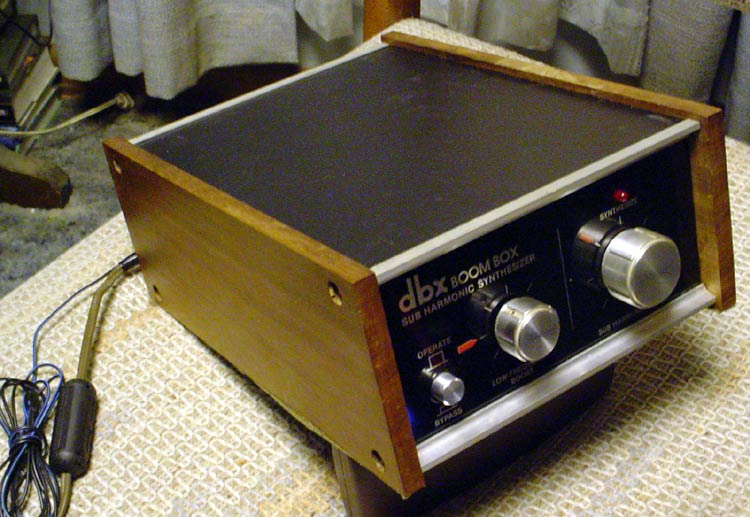
Betcha you could REALLY have fun with one of these ...

dbx-boombox.jpg


The red lines on the controls are just that ... anything higher (lower?) on my system, and things start to melt ...
 
Back
Top Bottom