Hi guys,
I bought a couple of years ago a Heathkit SA-2 amplifier, but I don' t know why.
This is a full integrated stereo amplifier with phono sections. A nice little amp to have in an office.
I then decided to dive into it and restore as it is extremely clean and beautiful, with the same iron than the UA-1 so I knew it will sound nice.
I received it untouched, and decided to try it. The amplifier did work nicely, just with some audible hum.
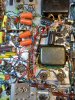
It has no shield near the input jacks, a big huge caps was added on top of the chassis which didn't look original.
Other than that it looks super nice.
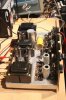
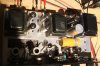
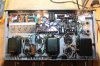
I started by testing the resistors and caps and they were all out of tolerance, so by the end of my investigation, I realized most of the components were bad so no point to keep some old parts (I've been burned before), and change all.
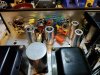
So here is the results after a rebuilt:

But I had hum. A bad one. Noise was everywhere but mostly at the 6AN8 stage.
I swapped all tubes around, did nothing.
I started to do the usual tricks to find the root cause.
I've started with the PS as it was a weird 60/120 modulated signal.
I then discovered that the PS filtration was very poor as is, Even with the Authenticap cap I installed with an increase of capacitance, with a V+ ripple of several volts to the OT CTs. Not good.
When I debug an amp I always use a SS rectifier so I don't wait. And ramp slowly with my variac.
So I added more capacity on the B+ and B+2. It did help. But not enough.
I ended by adding 2 identical decoupling stages before the regular power supply, of 50R 56uF.
That did the trick nicely with a ripple now of 100mV.
And I did add a 120uF at the B+2 (after the 4.7K), which also greatly help.
All this lower the B+ a bit, but with the SS plug, it wasn't a problem.
But the hum was still there, around 7 to 14 mV at the speakers. So I ruled out the PS.
The ground was nice to begin with, I changed just a couple of path, like the cathodes return directly to the PS can, the feedback reference in the OT to the input reference, that sort of things.
No change as I was expected, unfortunately.
So something was picking up noise. I decided to use shielded wires for each EL84 grid. These wires were long so a potential problem. It did nothing.
I then shielded the 6AU6. No change. Then the 6AN8, nothing. The 12AX7 were already shielded.
Now I was getting mad at that thing. It should make no noise as it was and I spent a lot of time already on it.
At the end, I just changed the 2 identical NU 6AN7 with some others I had and... the hum disappeared.
The amp was totally silent.
I was mad at myself not trying other tubes but to my defense, I did swap them with each other but they were both equally bad. I did not expect that.
So all this hum investigation (Thanks Gadget for your advices) lead me to some mods which in fact did improve the amplifier, so I wanted to share them. Here they are:
I am listening as I am writing this, and this little amp is wonderful. It's a nice little guy.
Some last pics.
Cheers,
Brice.
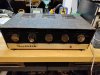
I bought a couple of years ago a Heathkit SA-2 amplifier, but I don' t know why.
This is a full integrated stereo amplifier with phono sections. A nice little amp to have in an office.
I then decided to dive into it and restore as it is extremely clean and beautiful, with the same iron than the UA-1 so I knew it will sound nice.
I received it untouched, and decided to try it. The amplifier did work nicely, just with some audible hum.
It has no shield near the input jacks, a big huge caps was added on top of the chassis which didn't look original.
Other than that it looks super nice.
I started by testing the resistors and caps and they were all out of tolerance, so by the end of my investigation, I realized most of the components were bad so no point to keep some old parts (I've been burned before), and change all.
So here is the results after a rebuilt:
But I had hum. A bad one. Noise was everywhere but mostly at the 6AN8 stage.
I swapped all tubes around, did nothing.
I started to do the usual tricks to find the root cause.
I've started with the PS as it was a weird 60/120 modulated signal.
I then discovered that the PS filtration was very poor as is, Even with the Authenticap cap I installed with an increase of capacitance, with a V+ ripple of several volts to the OT CTs. Not good.
When I debug an amp I always use a SS rectifier so I don't wait. And ramp slowly with my variac.
So I added more capacity on the B+ and B+2. It did help. But not enough.
I ended by adding 2 identical decoupling stages before the regular power supply, of 50R 56uF.
That did the trick nicely with a ripple now of 100mV.
And I did add a 120uF at the B+2 (after the 4.7K), which also greatly help.
All this lower the B+ a bit, but with the SS plug, it wasn't a problem.
But the hum was still there, around 7 to 14 mV at the speakers. So I ruled out the PS.
The ground was nice to begin with, I changed just a couple of path, like the cathodes return directly to the PS can, the feedback reference in the OT to the input reference, that sort of things.
No change as I was expected, unfortunately.
So something was picking up noise. I decided to use shielded wires for each EL84 grid. These wires were long so a potential problem. It did nothing.
I then shielded the 6AU6. No change. Then the 6AN8, nothing. The 12AX7 were already shielded.
Now I was getting mad at that thing. It should make no noise as it was and I spent a lot of time already on it.
At the end, I just changed the 2 identical NU 6AN7 with some others I had and... the hum disappeared.
The amp was totally silent.
I was mad at myself not trying other tubes but to my defense, I did swap them with each other but they were both equally bad. I did not expect that.
So all this hum investigation (Thanks Gadget for your advices) lead me to some mods which in fact did improve the amplifier, so I wanted to share them. Here they are:
- Separated the common 4 tubes cathode resistor 100R / 50uF into 2 x 250R / 50uF to each channel EL84 cathode resistors. Channels are now independant.
- Added UF4007 diodes upstream the rectifier.
- I use a SS rectifier and not a GZ34 any longer: save heat and power for the PT.
- Added 2 stages of 50R 50uF before the regular supply. Ripple much much reduced from 2 volts to 0.1V
- Added 120uF to C24 so now 160uF instead of 40uF.
- Added a thermistor.
- Added an internal B+ fuse.
- Changed C16/C41 from 0.1uF to 0.22uF.
- Shielded all long grid wires to each EL34.
- Added shields to all driver tubes.
- Added tube retainers to each EL84.
- Added a snubber cap across the power switch.
I am listening as I am writing this, and this little amp is wonderful. It's a nice little guy.
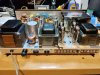
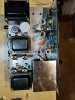
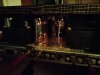
Some last pics.
Cheers,
Brice.
Last edited: