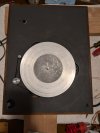
It's ALIVE!
Many many thanks to
@sfrost for coming through with all the parts I needed to save this turntable from the dump. As well as
@gkimeng for advice on how to unstuck the platter bearing.
I've just barely got it playing a record, haven't tuned anything, and it's sounding great! Lots of tuning left to do.
I loosened up the platter and tonearm shafts with multiple iterations of isopropyl alcohol and deoxit, and working the platter shaft in and out for about an hour.
Cleaned the pulleys and platter with alcohol and a very light sanding with 1000 grit, kind of amazing how much of an rpm difference that made.
I went on a wild goose chase looking for actual real talcum powder, which apparently doesn't exist at stores anymore. Then I realized it's magnesium silicate, which is an ingredient used in the ceramics world, so called a potter friend and got a nice bag of 100% talc to shake-n-bake the belts in. And just that application of talc made the motors able to spin the platter without a nudge, pretty cool!
Soldered the tonearm in, and installed an old AT cartridge that was on-hand for testing.
I used the F5 fader lube that came with my can of deoxit to lube the shafts, which seems to be working well.
According to the rpm app on my android phone it's spinning at 33.24 rpm. I tried increasing the speed by shimming the motor on one side and then the other, like the manual says, but no matter where I put a shim it makes it slower. I put the android on another newer dj turntable with a quartz lock and it read almost perfectly 33.3 so I'm pretty sure the app is working but also ordered a laser tachometer to check with that.
I can't tell the difference sound-wise though.
The starter motor seems like it's more hot than it should be, the main motor is not hot. Anyone know if that's normal?
What's the reason for the metal plates that cover the motors, I haven't put them back on, are they needed?