

You are using an out of date browser. It may not display this or other websites correctly.
You should upgrade or use an alternative browser.
You should upgrade or use an alternative browser.
Looking for Speaker Builder Article "The Disappearing Speaker" Phantom Images, Phantom Center
- Thread starter Pete B
- Start date
Register to hide this ad

maxhifi
Addicted Member
I had a look on world radio history - no such article exists.

Dunno. There is a list of Weems books on Amazon.I pulled up the May 1987 issue of Hands-On Electronics magazine. The article does not exist there.
maxhifi
Addicted Member
Prolly scraped from an originally wrong-cited date and title.
That's the limitation of AI. Not-so-good data in, not-so-good data out. Hopefully, David Weems rings a bell.
David Weems wrote popular books about how to build speakers, which could be found at libraries, bookstores, and even Radio Shack in the 80s and 90s. In the pre-internet era he provided inspiration and information to a lot of beginner level speaker builders. The first speakers I ever built were based on his "mini-cubes" using a pair of Radio Shack full range drivers.

flavio81
Turntable technician
And that's why you shouldn't believe anything an AI (LLM model) says.I pulled up the May 1987 issue of Hands-On Electronics magazine. The article does not exist there.

Thanks everyone! And for the index, found it, by Victor Staggs:
Volume 13 Number 3
May 1992
3 GOOD NEWS
9 EDITORIAL Poems or Codes?
10 A 1/3-OCTAVE NOISE SOURCE BY ROY LITTLER
14 A HIGH-QUALITY SPEAKER CABINET BY MARK FLORIAN
24 BI-AMPING THE SAPPHIRE II SUB-I SYSTEM BY GARY GALO
34 CAPS FOR PASSIVE CROSSOVERS BY RICHARD HONEYCUTT
42 THE DISAPPEARING LOUDSPEAKER BY VICTOR STAGGS
Last edited:
Edit: After reading the article I remembered that it was Victor Campos at AR not Staggs.
From memory, Victor Staggs worked at AR, fairly positive about this. And I remember his letter
in response to a series of articles on modifying the AR-3a, he was not pleased with the work!
I also think that he's been mentioned at CSP as working there.
From memory, Victor Staggs worked at AR, fairly positive about this. And I remember his letter
in response to a series of articles on modifying the AR-3a, he was not pleased with the work!
I also think that he's been mentioned at CSP as working there.
Last edited:
maxhifi
Addicted Member
I remember reading articles from Weems I think it was in Popular Electronics.
I've never heard of Hands-On Electronics or an article like this from Weems.
The original Ziff-Davis Popular Electronics became a computer magazine in the 80s, and the original magazine disappeared. Gernsback owned Hands-On Electronics was around for a short while in the mid 80s, but then got renamed to Popular Electronics and existed until the end of the magazine.
Lots of respect to Weems but I figured you'd be looking for something a little more advanced level, so the Weems reference surprised me.

That's the answer you get with AI, LOL! Go figure...I remember reading articles from Weems I think it was in Popular Electronics.
I've never heard of Hands-On Electronics or an article like this from Weems.
I got a copy from a friend here in town in our local club.
First, if you ask me disappearing speakers are what this hobby should be all about because when it
happens for one you get a really solid center phantom image and it seems like there's just music in
the room. Yet no one (but me) talks about this, Harmon with all their research, as far as I know, never
talk about this. I've never seen a reviewer talk about it, in fact most of them stress a big wide soundstage
yet for me if you don't get the center phantom image right I just want to turn off the system.
PSB Stratus Golds do it and that combined with their outstanding performance is why I've suggested
them here often. But most commercial speakers do not do it or talk about it in their literature. I've
listened to a lot of commercial designs in my home and most do not do it, even top rated ones.
I wanted to reread this article to confirm my memory of it, the article is all about his measurements,
simulation and optimization of the complex crossover networks. There's no mention about what is
required for a disappearing speaker. He simply comments that when his audiophile friend heard them,
he called them the disappearing speakers, and then more of their friends wanted to hear them.
I don't know the answer, what I think is required is the right amount of baffle step so that human voice
and the body of instruments sounds "right". And a smooth midrange that's not tipped up so much that
sibilance sounds so unnatural that it is a give away to the brain of being amplified music. Insufficient
baffle step is what causes a boxy sound, like sound coming from a box that so many designs have.
I believe that if you get enough things "right" to cross a threshold, the ear-brain system is fooled into
thinking that there's real music in the room but I've not read any technical papers with studies on the
topic. I never see reviewers talk about a boxy sound, or the disappearing act, but I have a feeling that
when they talk about tapping their foot, or staying up late wanting to go through their collections they
might be experiencing disappearing speakers.
Large Advents in stock condition sound boxy, bright and harsh, add baffle step compensation and they
are able to disappear. I mentioned this years ago in the threads about this topic, and users confirm that
they hear it in their rooms also.
Disappearing speakers sound so "right" that you just want to keep on listening, it makes home listening
a highly enjoyable experience. It is like magic.
If anyone knows of papers on this topic please let me know.
Are you willing to share, or secure a copy in the AK database for all posterity?I got a copy from a friend here in town in our local club.
maxhifi
Addicted Member
I got a copy from a friend here in town in our local club.
First, if you ask me disappearing speakers are what this hobby should be all about because when it
happens for one you get a really solid center phantom image and it seems like there's just music in
the room. Yet no one (but me) talks about this, Harmon with all their research, as far as I know, never
talk about this. I've never seen a reviewer talk about it, in fact most of them stress a big wide soundstage
yet for me if you don't get the center phantom image right I just want to turn off the system.
PSB Stratus Golds do it and that combined with their outstanding performance is why I've suggested
them here often. But most commercial speakers do not do it or talk about it in their literature. I've
listened to a lot of commercial designs in my home and most do not do it, even top rated ones.
I wanted to reread this article to confirm my memory of it, the article is all about his measurements,
simulation and optimization of the complex crossover networks. There's no mention about what is
required for a disappearing speaker. He simply comments that when his audiophile friend heard them,
he called them the disappearing speakers, and then more of their friends wanted to hear them.
I don't know the answer, what I think is required is the right amount of baffle step so that human voice
and the body of instruments sounds "right". And a smooth midrange that's not tipped up so much that
sibilance sounds so unnatural that it is a give away to the brain of being amplified music. Insufficient
baffle step is what causes a boxy sound, like sound coming from a box that so many designs have.
I believe that if you get enough things "right" to cross a threshold, the ear-brain system is fooled into
thinking that there's real music in the room but I've not read any technical papers with studies on the
topic. I never see reviewers talk about a boxy sound, or the disappearing act, but I have a feeling that
when they talk about tapping their foot, or staying up late wanting to go through their collections they
might be experiencing disappearing speakers.
Large Advents in stock condition sound boxy, bright and harsh, add baffle step compensation and they
are able to disappear. I mentioned this years ago in the threads about this topic, and users confirm that
they hear it in their rooms also.
Disappearing speakers sound so "right" that you just want to keep on listening, it makes home listening
a highly enjoyable experience. It is like magic.
If anyone knows of papers on this topic please let me know.
I know exactly what you are talking about. A good pair of speakers which is properly set up will project a wall of sound, with a stable center image. I think this illusion is the goal of most high end audio speakers. Placement is a big factor, if the room isn't symmetrical, the speakers are close to boundaries, or the speakers have excessive distortion, it becomes easy to localize them and it spoils the illusion. I never considered baffle step but it makes sense. Any sort of anomaly in the frequency response that would draw your attention to one side seems like it would be a potential issue.

jazzmans
Super Member
I agree 100%I got a copy from a friend here in town in our local club.
First, if you ask me disappearing speakers are what this hobby should be all about because when it
happens for one you get a really solid center phantom image and it seems like there's just music in
the room. Yet no one (but me) talks about this, Harmon with all their research, as far as I know, never
talk about this. I've never seen a reviewer talk about it, in fact most of them stress a big wide soundstage
yet for me if you don't get the center phantom image right I just want to turn off the system.
PSB Stratus Golds do it and that combined with their outstanding performance is why I've suggested
them here often. But most commercial speakers do not do it or talk about it in their literature. I've
listened to a lot of commercial designs in my home and most do not do it, even top rated ones.
I wanted to reread this article to confirm my memory of it, the article is all about his measurements,
simulation and optimization of the complex crossover networks. There's no mention about what is
required for a disappearing speaker. He simply comments that when his audiophile friend heard them,
he called them the disappearing speakers, and then more of their friends wanted to hear them.
I don't know the answer, what I think is required is the right amount of baffle step so that human voice
and the body of instruments sounds "right". And a smooth midrange that's not tipped up so much that
sibilance sounds so unnatural that it is a give away to the brain of being amplified music. Insufficient
baffle step is what causes a boxy sound, like sound coming from a box that so many designs have.
I believe that if you get enough things "right" to cross a threshold, the ear-brain system is fooled into
thinking that there's real music in the room but I've not read any technical papers with studies on the
topic. I never see reviewers talk about a boxy sound, or the disappearing act, but I have a feeling that
when they talk about tapping their foot, or staying up late wanting to go through their collections they
might be experiencing disappearing speakers.
Large Advents in stock condition sound boxy, bright and harsh, add baffle step compensation and they
are able to disappear. I mentioned this years ago in the threads about this topic, and users confirm that
they hear it in their rooms also.
Disappearing speakers sound so "right" that you just want to keep on listening, it makes home listening
a highly enjoyable experience. It is like magic.
If anyone knows of papers on this topic please let me know.
this is precisely what I look (hear) for with my stereo systems, a believeable phantom center focused soundstage. when I'm center center. Funny thing is, depending on the speakers, an inch right or left of center center, and the whole thing collapses, and the right or left speaker suddenly becomes dominant, in which case i just aim for a 'diffuse' stereo image 'round the room.
I'd love to read some deeper papers on the psychoacoustics involved, but other then those crazy binaural recordings, no-one talks much about this.
Q sound was one of those methods to create believeable center (and on and off stage, and upstage/downstage) images from a stereo recording, using phasing, I believe. Unfortunately, the damn waste of space 'surround sound' craze took off right as Q sound was perfected and doomed it.
jazzmans
Super Member
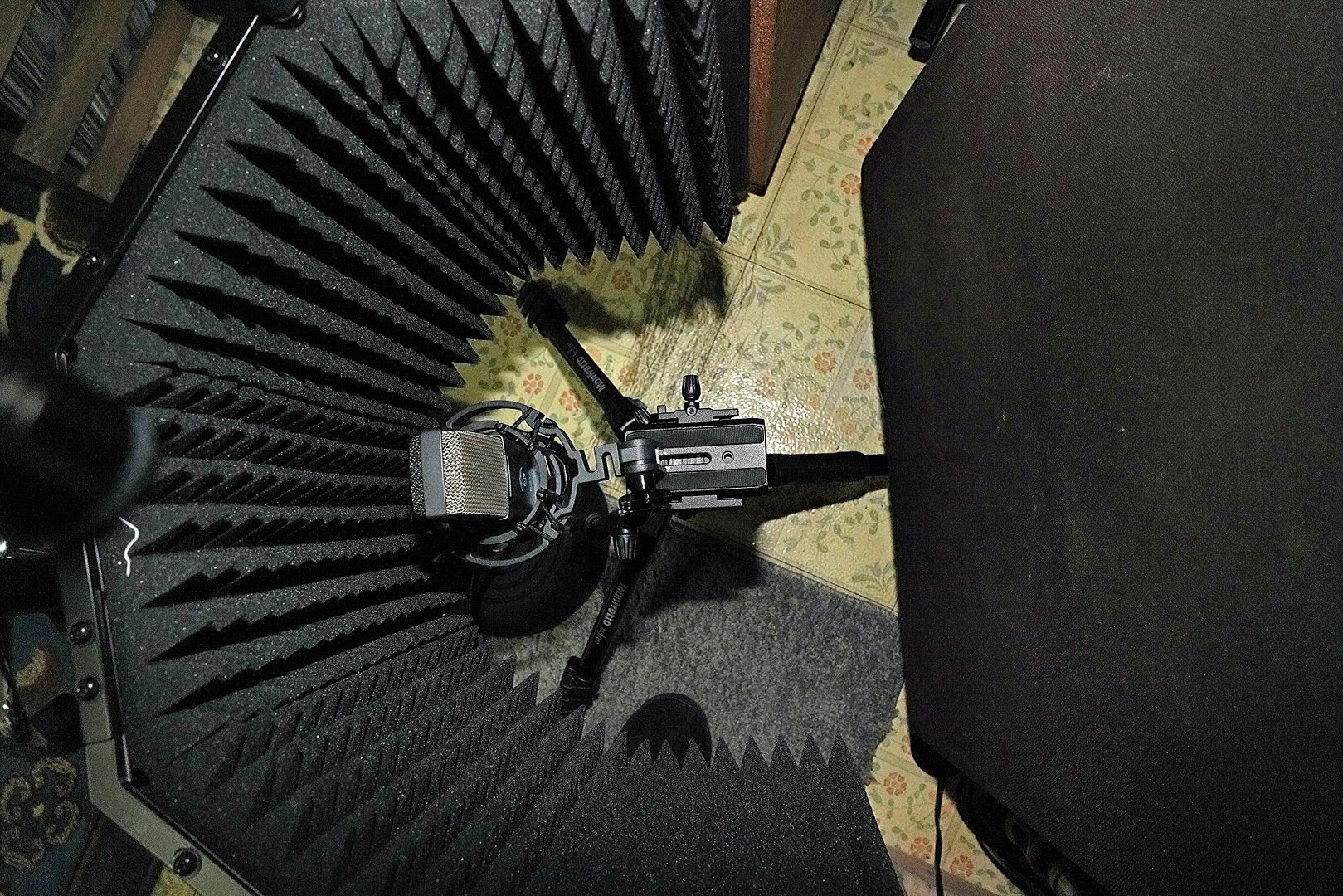
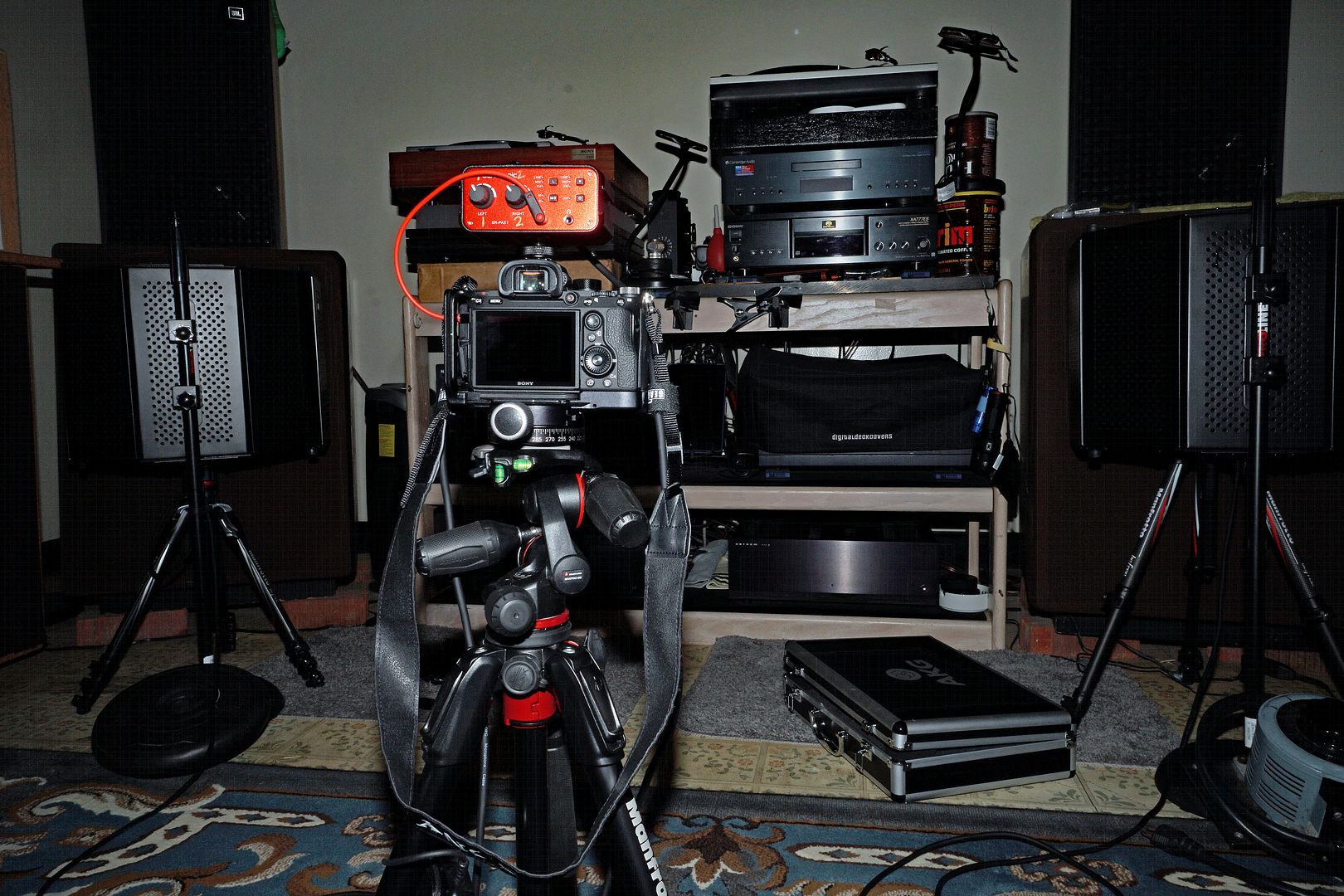
I assume you have to adjust mic distance/height based on what speaker you're recording, or do you only record with one set of speakers?When I record, I use two mics. Each is closed mic'ed to the right and left speakers, like 12-18 inches from the front of the speaker grille. Yet the engineered, centered vocals and instruments are in the middle, as if there were a microphone there. Really odd how that works.
Tiny Dancer.
Elton John - "Madman Across The Water." DJM Records. FP 80393. Toshiba Musical Industry pressing (Japan). Second variant. 1971.
Run-out: DJLPH-420-A 1S 5 (scribbled out JIS logo) 1L

truly I'm fascinated by this.
Would you mind (if this is a threadjack, new thread) laying out in detail your recording path to your camera?
I've been recording ambient scenes with my cameras Lumix G9II and Lumix GX8, but haven't sprung for separate mikes/diffusers or any of that .... yet.
example.
TIA!
I was gathering up papers around the house today and came across this one by Siegfried Linkwitz (SL)
on the coffee table: I do remember skimming it but also getting tired of all the untested theories,
he seems to believe that placement and room reflections (and therefore dispersion pattern) are very
important. I have a lot of respect for SL as an engineer and speaker designer, and have been reading
his website for decades. But I do disagree with him on several points. I have to carefully read this
paper, probably several times to really have it sink in. It's an AES 127th Convention Paper 2009
Oct 9-12: .pdf download link: https://www.linkwitzlab.com/AES-NY'09/The Challenge.pdf
There's also a slide version that might be more to the point:
"The challenge to find the optimum radiation pattern and placement of stereo loudspeakers in a
room for the creation of phantom sources and simultaneous masking of real sources"
Basically, I don't believe that it is primarily radiation pattern and placement that matters, rather it is the
correct on axis target frequency response - just my theory and experience.
More from this paper, Abstract:
Stereo sound reproduction relies upon the creation of an illusion. Ideally the two loudspeakers and
the room disappear, leaving only a phantom acoustic scene to listen to. The polar frequency response
of a loudspeaker determines the angular distribution of room reflections and their spectral content.
The placement of the loudspeakers relative to the room surfaces determines the initial delay of the
reflections. Together they affect the formation of phantom sources. A proven loudspeaker and room
configuration is proposed as a starting point for listening tests to determine the optimum loudspeaker
radiation pattern. It is an invitation to extend our understanding of the psychoacoustic processes that
are involved with stereo listening in a room and to replace anecdotal with scientific evidence.
This paper cites 53 other papers though many are foundational and not directly on topic of phantom sources.
I've started to read several of his papers on this topic and I find there to be too much emphasis on room
reflections, but I'll give it another try.
A link to more of SL's publications:
Last edited: