• The move to the new server is done. There are some software and database maintenance updates in process. This has us passing the hat around to help out. We appreciate any donations. Seriously, even a dollar helps. The payment page may be found here - https://www.audiokarma.org/support.html

Looking for suggestions to improve sound of Fisher console speakers

grindfix

Full time hobby
Subscriber
Greetings, speaker gang!

I'm in the process of restoring this console:
https://audiokarma.org/forums/index...es-on-restoration.927475/page-4#post-14133204

The console receiver unit sounds pretty incredible with my basement speakers that I use as test mules on just about anything I work on or restore. They are cheap JVC rack system floor standing ported 3-way with 12" woofer.
It does not sound nothing near to that with original console speakers. The console has 15" down firing woofers with see-through cloth surrounds, "dust" cap and spiders. Surrounds seem to have some kind of treatment but they are still not sealed. Cap and spiders have no treatment.
2 x midrange drivers are capped with cardboard tube with tinned end cap. Both are stuffed with soft fiberglass insulation. 1 x tweeter in closed basket.

Woofers are bottoming out on heavier low notes and the rest of the sound is not impressive. Crossovers are recapped. All original non-polar electrolytics were replaced with Dayton film caps, except for 100uf.

I'm hoping that someone has experience improving console sound. My thought is to treat surrounds, throw away original itchy fiberglass that was covering woofers and use modern pink insulation to cover everything except woofers themselves and add a port tube.
Can anyone comment or suggest opinion on this subject?

Thanks!
 
Register to hide this ad
Downward (or upward) facing woofers have a tendency to sag, which makes them likely to bottom out. Sometimes inverting them and putting some weight on the cone (something soft like a blanket or pillow so the cone isn't distorted) and letting them sit for an extended period will restore them, but eventually they will sag again. The surrounds have probably lost their coating, and that isn't helping.
Redoping them (and the spider and/or dustcap, if it appears to have been doped to begin with) may make a significant improvement.
I would leave the damping treatment as it is unless you have a specific reason for changing it - fiberglass doesn' wear out, and presumably the correct amount of damping is there (at least for the woofers as they were originally). Just randomly replacing it may make matters worse.
Adding a port tube is almost certainly a terrible idea - not only will you be changing the alignment of the woofer dramatically, but once the woofer surround is sealed, the seal is the think keeping the woofer from sagging immediately.
If the upper frequencies still don't sound good, it may not be worth bothering to sort out the woofer issues, but might make sense to redesign the speakers with a new woofer and maybe an econowave top end.
 
Last edited:
It looks like surround was "doped" but spider and dust cap was not. What would be the best doping material? I'd think it needs to be really soft and thin.
I think highs are not the problem. It sounds to me that mids are too dominant and woofers are boomy that resonates through the whole console and there's no punch. I realize that some of it is a "character" of console sound but would like to improve it if possible.
 
I've had good luck with the dopant that is sold for use on ARs and KLHs. Trying to remember the name.
 
I saw it on ebay. I think surrounds in those AR and KLH speakers are much stiffer though. These ones are extremely soft.
 
The ones on the ARs and KLHs are very floppy - it is a requirement of true acoustic suspension designs. Many smalled sealed boxes look like acoustic suspension designs but have a bump built into the low frequency response, which is achieved with a stiffer foam or other material surround. But the ARs and KLHs were designed to extend deep into the low end with a smooth roll off, rather than achieving the bump (which can give the impression of good bass) at the expense of lower frequencies.
 
Could be anything since most of the time the black color is carbon filler added. It is possible that one of the black roofing caulks that stay flexible, such as Black Jack, could be thinned down sufficiently to apply a thin uniform coating to the cloth. But that is a guess. And the experiment would probably cost not that much less than using the AR stuff. The color would be different, but I suspect the flexibility would be the same, or better.
 
I’ve been playing with some materials I have available to me and so far I’m pretty sure I’ve developed a “proprietary “ mix that should work for period of realistic lifetime. I have Butyl rubber in 5/16” diameter rope. This tape is used to attach plastic sound insulation film in car and truck door panels. I believe Dynamat is same thing too, except it’s backed with aluminum foil. I dissolved some of this butyl rubber in rubber solvent that is designed for preparing radial tires for internal patch application. Butyl gets dissolved and mixture becomes thick applicable liquid and dries to touch within 10-15 minutes. It could be diluted further and can be applied multiple times because fresh layer blends with previous one. It stays tacky and soft. I’ve opened 30 year old car door panels and this stuff is as sticky as if it was new. Doesn’t seem to age. I will have to courage myself to pull the woofer out and try my discovery on section of actual surround to make sure it doesn’t dissolve original adhesive and detach the surround from the cone or the basket.
What do you think?
 
Sticky worries me - if, by chance, the surround gets pushed in, will the side adhere to each other? But something as simple as a coating of baby powder might solve that issue (and I'm tiptoeing away from the talc/cornstarch issue). And obviously, a solvent that dissolves the glue that holds the surround to the basket and cone isn't what you want. But you could test it on a small section to see if it is a problem - and given the rapid evaporation rate, it probably won't be.
I suspect that multiple coats of dilute sealer would be better than fewer thicker applications.
Other than that, I think it ought to work, and if it does, that would be helpful information for others.
 
I've been a tinkerer of many things all my life and always share my experience and discoveries with others without any reservations.
My father was fairly high level aircraft engineer and many of his inventions and designs are still flying in soviet block, he never got proper credit for that.
My achievements are microscopic in comparison and it just hurts to know how much MORE my dad could have contributed to the world, would he be born and lived here all his life. Last several years of his life he worked for NASA. No clue what he was working on...
 
Could be anything since most of the time the black color is carbon filler added. It is possible that one of the black roofing caulks that stay flexible, such as Black Jack, could be thinned down sufficiently to apply a thin uniform coating to the cloth. But that is a guess. And the experiment would probably cost not that much less than using the AR stuff. The color would be different, but I suspect the flexibility would be the same, or better.

No no no. Never use any material other than non-hardening butylene rubber without any additives.

Caulking, cements, adhesives, varnish, etc. will stiffen, some sooner than others, and raise Fs, ruining the speaker. This has been well documented. RoyC's work at Classic Speaker Pages is thorough and definitive. He did all of the heavy lifting.

You are correct, btw, that carbon black is added to the butylene rubber as a coloring agent.

Some of the writeups I've created on this subject of butylene rubber:

And on the subject of how the surround functions:
That should get you started.
 
Well, it seems that I'm on the right track. I don't know exact formula of rubber solvent I used but I will look-up MSDS tomorrow. I suspect it is a mix of Toluene and Xylene as it has a smell of both. Probably another half a dozen of other tasty ingredients. Butyl rubber strip dissolved nicely and I applied three thin coats about a week ago. Surrounds are somewhat tacky but I do not see the need to use any powder to reduce that.
Woofers are sitting with magnets down and terry towels in the cone to re-center the spider. I'm going to keep them this way until I'm done with the receiver that goes into the console.

Retro, I always enjoy reading your extensive and informative posts! Thank you!
 
Well, it seems that I'm on the right track. I don't know exact formula of rubber solvent I used but I will look-up MSDS tomorrow. I suspect it is a mix of Toluene and Xylene as it has a smell of both. Probably another half a dozen of other tasty ingredients. Butyl rubber strip dissolved nicely and I applied three thin coats about a week ago.

Toluene and xylene are very similar: toluene has 7 carbons and xylene has 8. Naphtha (aka mineral spirits), is a non-standard blend of hydrocarbons that varies by the batch, as it is the remnants from distillation during petroleum cracking after the desirable components have been shunted off for gasoline. The component molecules of naptha all have between 5 and 12 carbon atoms, so toluene and xylene are potentially components of naptha.

The evaporation rate is faster or slower depending upon the molecular weight, which is how adhesive work time is increased or decreased. A common use is in rubber cement and contact cement. So a little more xylene (higher boiling point) than toluene (lower boiling point) slightly decreases the volatility and thus the amount of time to reposition the two objects being glued.

For making a rejuvenator solution the two solvents are essentially identical, as work time should not be an issue.

Surrounds are somewhat tacky but I do not see the need to use any powder to reduce that.

The original butylene rubber painted on the surround remained tacky for some time, as did the rejuvenation solution recommended by KLH (I've elsewhere posted the memo), so no harm accrues from leaving it in a sticky/tacky state.

Retro, I always enjoy reading your extensive and informative posts! Thank you!

You're welcome.
 
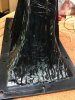
I keep forgetting to lookup the solvent I used but surrounds look like this now. I'm pleased with the result.

1.JPG

Here is another use I found for this Butyl rope. Use it in place of Dynamat on Klipsch Forte II horns and woofer / passive baskets.

2.JPG

Not as pretty as foil coated Dynamat but probably better due to thicker application. Dynamat sheets are 1/16" thick. This stuff after using a roller and getting my fingers num is probably about 1/8' - 3/16" thick. I compared tapping coated and uncoated mid horns with the pencil. Huge difference. This is my 3rd Forte restoration. I will have ALK crossovers in one of these sets and will be comparing A/B with stock crossover pair, including basic efficiency measurements. Will post results in Klipsch Korner soon
 
Back
Top Bottom