• The move to the new server is done. There are some software and database maintenance updates in process. This has us passing the hat around to help out. We appreciate any donations. Seriously, even a dollar helps. The payment page may be found here - https://www.audiokarma.org/support.html

Looks like it’s time to see how hard I can push a pair of 6L6gc’s

Carbsandcaps

Super Member
I found one cheap so I figured I’d look for another one. Paid more than I wanted to but should be a fun project. I was looking into kt88’s but they cost stupid money so I’ll stick with some 6l6gc’s. I’m going to try to run them right on the verge of red plate with some andjustable biasing and see how they sound!
 

Attachments

  • IMG_3238.jpeg
    IMG_3238.jpeg
    151.4 KB · Views: 47
Register to hide this ad
These originally used a field coil speaker so I’m not sure what the pre field coil voltage is but it used 6000ohms so I’m thing king there’s going to be plenty of b+ to mess with.
 
"Line amplifier" means no power transformer? If so, I don't see a doubler cap for higher B+ voltages. GC is probably an overkill
 
Those were also meant to run the metal 6L6.

6L6GC's should be no problem except for heater ratings compared to the metal 6L6.

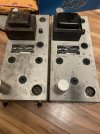
A lot of these Wurlitzer amps tend to have their output transformers mounted under the chassis.

Those are the actual power transformers on top or they would't use rectifier tubes.
 
Last edited:
Yes the outputs are underneath. Pretty decent size for what it is. Planning on a garage system and also experimenting but I’m trying to get as much out of them as I can. IMG_3241.jpeg
 
I thought that those were power transformers, being close to the fuse holder and rectifier. Undermount OT must be very small then.
 
They’re a decent size. The chassis is pretty deep and they aren’t potted but they might get upgraded down the road IMG_3243.jpeg
 
Those were also meant to run the metal 6L6.

6L6GC's should be no problem except for heater ratings compared to the metal 6L6.

A lot of these Wurlitzer amps tend to have their output transformers mounted under the chassis.

Those are the actual power transformers on top or they would't use rectifier tubes.
They all draw the same heater current 6l6 metal or glass,6l6gc as well as even the 1614 which is 900 milliamps.Where everything differs is in the plate voltage handling votages.The1614 which is a metal tube like the 6l6 metal one is way different.The 1614 is more like a 6l6gc.
To put this in perspective my Fairchild 260 amplifiers called for 1614 tubes and not 6l6 for obvious reasons as a normal 6l6 would probally self destruct from the b+ put on them
.i run 6l6 gc in them now even though i have 1614's i could use.Even the mcintosh mc30 called for 1614/6l6gc tubes.which i also had a pair of.
 

Attachments

  • IMG_3125.jpeg
    IMG_3125.jpeg
    65.1 KB · Views: 15
  • IMG_3126.jpeg
    IMG_3126.jpeg
    80.2 KB · Views: 15
They all draw the same heater current 6l6 metal or glass,6l6gc as well as even the 1614 which is 900 milliamps.Where everything differs is in the plate voltage handling votages.The1614 which is a metal tube like the 6l6 metal one is way different.The 1614 is more like a 6l6gc.
To put this in perspective my Fairchild 260 amplifiers called for 1614 tubes and not 6l6 for obvious reasons as a normal 6l6 would probally self destruct from the b+ put on them
.i run 6l6 gc in them now even though i have 1614's i could use.Even the mcintosh mc30 called for 1614/6l6gc tubes.which i also had a pair of.
I guess I am getting lazy in my 60's. I could have looked them up but thought I remembered them having different heater current.

Thank you for the info. :thumbsup:

I have always wanted a pair of 260 Fairchild amplifiers ever since I saw a friend in high school back in the 80's bring one to school and right when he plugged it in, the power transformer shorted and smoked. Even when he smoked it, I asked if I could buy it and he said HAIL NO! I am keeping this for life. Don't know whatever happened to my friend after graduation, but we did find out that while bringing it to school, a 1614 fell out and broke the guide pin and he just put it back in any 'ol way. o_O:biggrin:
 
Any chance you have the schematics? That would tell us a lot here.

are you planning to change this to a different circuit or run it more or less in the stock design?
 
I found one cheap so I figured I’d look for another one. Paid more than I wanted to but should be a fun project. I was looking into kt88’s but they cost stupid money so I’ll stick with some 6l6gc’s. I’m going to try to run them right on the verge of red plate with some andjustable biasing and see how they sound!

they may sound a bit better until they don't. Why not try something like adding a pie filter network to the PS circuit. That should lower your noise floor by 7-10 db. Or maybe look at improving the quality of the feedback parts. And have you installed new PS caps? If the amp is completely OEM with a original parts I fail to see the point of burning up a set of tubes unless you're just curious to see how they fail.
 
I also fail to see the point.
These are organ amplifiers, which are limited by the output transformers they use which are small.
They're not big enough to make any real good power past about 12 or 15 watts. They just don't have the core area to produce any bass, and they never needed to... You'll be torturing a pair, or quad of perfectly good power tubes to death, for what? Once They're dead, you'll need to spend good money to replace them, and you'll still be playing with organ transformers, so not ideal. Maybe, instead of testing to destruction, you could put the amplifiers up for sale, and use the proceeds to fund some HiFi amplifiers or at least some HiFi output transformers suited for 6l6s. The amplifiers you have aren't going to sound great simply by biasing the tubes hotter.
 
The point is experimentation and education. If it ends up needing bigger ot’s than I’ll put bigger ot’s on them. If they blow up oh well they don’t owe me anything. I could follow a cookie cutter amp design online and make a decent amp but what fun is that? It just a project to have fun with. If I sell them to somebody so they can sit in their basement for another 20 years what good does that do? I’ve got plenty of hifi stuff now i’m going for power.
 
thats pretty typical stuff, low gain, paraphase inverter, likely not a whole lot of global feedback.


I can't quite figure out where the field coil sits in here but it sure looks like it has to be between the transformer center tap and ground. The drawing with the plug wiring has me kind of confused. I definitely see the tie from CT to ground but it almost looks like there is a second jumper in there that ties a B+ to ground and that can't be right.

I'd probably re-work the power supply to eliminate that, and just tie the center tap to ground like a conventional supply. That will bump your B+. Add a choke in the mix to drop a little and add filtering, so CLC filter and the output transformers would feed from that second cap. That should make it quiet enough for the common mode noise rejection to do it's magic.

Depending on how it performs and how good or not the output transformers are I might consider changing the 6SN7 to a 6SL7 and changing the resistors as needed. That will give you more open loop gain which would allow more global feedback to maintain same sensitivity. The transformer is really going to determine that though, some just are not all that good and simply will not accept a high level of feedback without becoming an unstable mess.

I'd probably also do something for the screen supply to make it more stable. Looks like its just a resistor dropper now. A gas reg or zener or something to fix that voltage drop would be a better idea. When the screen supply starts to drop with extra load it ends up limiting power and increasing distortion.
 
The point is experimentation and education. If it ends up needing bigger ot’s than I’ll put bigger ot’s on them. If they blow up oh well they don’t owe me anything. I could follow a cookie cutter amp design online and make a decent amp but what fun is that? It just a project to have fun with. If I sell them to somebody so they can sit in their basement for another 20 years what good does that do? I’ve got plenty of hifi stuff now i’m going for power.
I don't think the amps are going to blow up. Just the tubes. I have blown plenty of power tubes without intentionally trying to blow them up. Would guess many others have done the same. Part of the penality you pay for using tube gear. But to me and many others the sonic benefits are worth the extra trouble. The key with using tubes in the signal path is the sonic qualities of of the sound, so much more organic sounding than sand power (SS). The only sand power amp that comes close are the Dart-Zeel SS amps but they will set you back a huge chunk of change. Going from a 6L6GC to a KT88 will give you a bit more power output but not a huge difference in real terms. Even if you were to change the OPT so the proper impedance is obtained, that change will not add that much power. Also don't forget the first watt or two is what you are listening to most of the time unless you have really inefficient speakers. Decware has a great slogan that is quite applicable to audio. "If the First watt sucks, why go on?' So true in so many cases.
If you are looking for more power, then why not look for something with a quartet or sextet of KT88s per channel? or a quartet of KT150s, that will give you more power. Or if you want that really out of hand midrange, go for a quartet or octet of EL34s per channel. If you are looking for a fuller bottom end with great extension, look for an OPT that is huge has freq response down into the single digits.
 
Actually, those organ output transformers can sound pretty good. I am using two organ amplifiers in my tube system. A mono Gulbransen 25 watt and mono Wurlitzer 25 watt amplifier.

They both have female RCA phono\aux inputs in the sides. I gotta say they sound pretty damn good with plenty of bass and treble.

I have not felt the need to look up nor measure the 20Hz - 20KHz thing but they sound great. It looks like the output transformers are about the same size as what Carbsandcaps has in his pair of Wurlitzers right there.

Remember that most higher end organs have to be able to produce the bass (bass pedals) and treble (think Piccolo) for the treble.

One of these days I would love to get ahold of a pair of Allen organ 75 amplifiers.
 
Last edited:
I can't quite figure out where the field coil sits in here but it sure looks like it has to be between the transformer center tap and ground. The drawing with the plug wiring has me kind of confused. I definitely see the tie from CT to ground but it almost looks like there is a second jumper in there that ties a B+ to ground and that can't be right.
Gadget, that jumper acts like a B+ cut off. Unplug the original field coil speaker and it also cuts off the B+. My Magnavox mono field coil radio also does it this way.

To Carbsandcaps, you will have to jumper that socket in order to use permanent magnet speakers. You will also need to use a 6000Ω choke or high watt 6000Ω resistor at pins 7 and 1 for it to work. Pins 4 and 6 would be for your speaker.
 
Last edited:
Back
Top Bottom