• The move to the new server is done. There are some software and database maintenance updates in process. This has us passing the hat around to help out. We appreciate any donations. Seriously, even a dollar helps. The payment page may be found here - https://www.audiokarma.org/support.html

Loud pop as tubes warm up - MC30

CDinMB

Active Member
Just received my "excellent condition" flea-bay MC 30s. I love them with the La Scalas but they are a bit less than excellent, besides the two DoA tubes when I start them one generates a VERY loud pop through the speaker about 10 seconds into the warm up. No pops, static or cycling after that. I checked the plate voltage at start up and it peaks at 447v just before the pop and then drops to 426v where it stays. Wall voltage is 121v and plate is 426v. At 115v variac line voltage the plate is 405v. The amp sounds great after the warm up but I am afraid it will hurt my speaker every time I turn it on. Volume control has no effect.

My theory is it is high voltage arcing due to the higher voltage before music starts flowing and tubes are heating up. A component is breaking down and is probably marginal but working in steady state. I have pulled and cleaned all the tubes, pins, and sockets, swapped tubes, and checked for black arcing traces inside and out. Found nothing obvious.

Any ideas for simple things to check before I start to unsolder and replace components? TIA

Carmen
 
Register to hide this ad
What, exactly, does 'excellent condition' mean? If work was done to these amps, you'll need to know what that was. Here's why:

As per other threads here at the Mac forum, after a rebuild of the power supply and replacement of the bias circuitry and coupling caps, resistors are known to cause problems. Arcing, drifting values and cracks in the body can contribute to the symptoms observed.

Frankly, I would not trust claims of 'excellent condition' until the real condition is confirmed by some experts. Pull the bottom covers and take some pictures of the circuitry there for some of the 'armchair bench techs' here.

Cheers,

David
 
David, thanks for the reply. The seller did replace three power caps in one of the units and sent the old caps along, but I don't think it was this unit, since these look original.

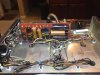
Okay took a close look and think I found the arcing. Here is a picture of it and others of the circuit. I circled a black carbon arc link between R19 and R30. I am not sure if this is the culprit but that can't be good. I broke the carbon free but I am sure the resister is toast.
Another unrelated question. Now that I'm tracing all the circuits, I also notice this circuit has 6 caps not 7, missing C6 .01uf to ground. I saw this on one other MC30 on the forum. Is this a design change or the fact that both of these amps were used for medical instruments until now? IMG_4186.JPG
This unit is also running on the 117v transformer tap (blk/y) not the 125v (blk/r). I've seen both and not sure whether to change this.
IMG_1970.JPG
 
It's hard to say where the pop is coming from because there are so many possibilities. Occasionally, an octal tube will have a bad connection between the wire that comes through the glass and the sleeve it's soldered to. That bad connection can temporarily get bridged by an arc, but eventually it will fail. Or it could be a loose tube socket contact or a solder joint that's cracked. Rereading your post, I see you've checked some of those things. When you say "plate voltage," are you talking B+ voltage or the actually voltage on the output tube plates?

Personally, I would be leery of operating an amp with capacitors in it as old as those pictured. I have seen too many of those bumblebee capacitors leak DC current. I would consider them time-bombs. I have a Scott tuner that had one of those caps at its output, and there was 14VDC at the output jack. I would rather replace capacitors than burn up tubes.
 
I realize the age of the caps is a concern and have all the caps on order from Sonic Craft. If I bring the amp up to 117V slowly with a variac there is no pop and it works fine. I've pulled all the tubes and cleaned the sockets and pins, traced and flexed all wires for brittle insulation and traces of arcing. All I found was the carbon arc between the two resisters pictured. I was hoping that was it.

I am using a plate voltage and cathode bias current meter that uses a socket fitting between the output tube and socket.
 
I hope that that was it. Does the pop affect both output tube plate voltages equally? Are both output tubes conducting before this happens? (This would be a good time to use a resistive dummy load for testing to protect your speakers.) You could also power the amp up without the rectifier tube and observe the behavior of the negative bias supply. Since the 12AX7 and output tubes are all direct-coupled, any kind of resistor problem could cause a pop. Is the cathode winding center-tap properly grounded?

I worry about coupling capacitors after a guy turned on an amp with bad caps and burned up a pair of Blackburn Mullard EL84s. That was a sad day in the shop.
 
That wasn't it. So back to slow power up using the variac. Only one output tube is running and affected. Checking bias, this seems way off or I am measuring it wrong. The bias resister is 4.7k which from what I've read, is a bit low. I should mention this amp is 20% louder than my other MC30 and my MC40 which are both running fine. All terminations from the OT seem fine. Not sure which is the center tap. Measuring some of the resistors, many have drifted more than 20%, so I may just replace them while I am replacing the caps. For now it is out of service after a week of use.

An MC30/40 stereo is an interesting combo. Thanks for the help!

Carmen

IMG_1972.JPG
 
It's been said before, but all the electrolytics need to be changed.

Sounds like you have the schematic. Do you have all the voltage /resistance tables from the manual? Look in the digital docs section here. Quite a bit of information in the Hints & Kinks sticky in the Mac Forum. One entry talks about a popping on startup. It was either repairing cracked wire insulation and arcing or a new PS filter cap that solved it.

B+ should be 440v with the bias at -42v.
 
To be honest, I wouldn't run an amp in this condition except to the extent necessary for troubleshooting. I would verify transformers and then start replacing things that I know need to be replaced for safe and reliable operation. I wouldn't risk transformers or old-stock tubes over 60 year-old capacitors and/or resistors. I've seen too many people blow things up that way.
 
It won't see power again until I've replaced all the capacitors and resistors and checked the wiring a third time. Since I am not sure if the CC resistors are drifting when heated, I am just going to replace them all. Some are way off spec cold. I bought all new capacitors (Mundorf, Jupiter, and Sonicap). The caps have shipped but I need to order the resistors. Need to research good and not too expensive ones.

I have a schematic and component layout. I will get the voltage chart, thanks. I am not sure how to test the transformers. When I bought these three amps I thought the 30s would be my reliable pair for listening while I rebuilt the 40, but it seems the 40 just needed tubes and I still have a new project. Guess I should start an MC30 rebuild thread.

Thanks for the help guys!
Carmen
 
If you're going to get new can caps, the Authenticaps are the closest in physical size and they are far better than the CE cans. You can get them from Yves at Vintage Vacuum Audio or direct from Jan in Germany - . I've sourced from both.
 
I had not found the multi cap replacement, so thanks! Just ordered them (2) from Yves. Figured I will replace the one in the other 30 too.

Cheers,
Carmen
 
Yep, exact component replacement in both units. I'll do one at a time so I can swap them into my system and keep my 30/40 stereo going, lol! Then I'll rebuild the 40, which was my intended project.
 
Back
Top Bottom