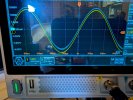
I've gone down the rabbit hole a bit already with this unit. First, love the design and form factor. Arrived with one channel out, replaced the trouble prone DML-01 ics with new versions from ivandezole here. Used his DML-02s without incident. Replacing the DMLs restored sound to the channel, but on the scope, I'm getting what appears to be oscillation at the negative (bottom) part of the sine wave if voltage rises about about 2.5v rms. Below that, no fuzziness in trace and sound is really good. At modest volumes neither heat sink gets hot, but one is slightly warmer than the other.
Interestingly, I've hooked up scope via pre-out and no oscillation. Hooked up scope with sig-gen into main in and no oscillation even up to about 7v rms. But together, getting that fuzziness only on one channel. I've tried mildly upping the capacitance of the "miller capacitors" which are 33pf to 47pf. no change. Could try adding a little more capacitance. Have replaced some capacitors that appeared sketchy (2 silver micas with broken epoxy covers) but they tested okay anyway.
It has been suggested that the new DML transistors may have much higher transition frequencies than the originals, perhaps creating the issue. I'm also wondering if it's possible that any of the paired transistors (stuck together for thermal pairing) in the amplifier board of the bad channel may have something to do with it.
Open to suggestions other than taking out all semi-conductors and attempting replacements (not that desperate yet!) Service manual and pic of trace attached.