Generally a tuned port will extend the bass to a lower frequency but will also un-damp the woofer. The result is lower bass response but can also (sometimes) make the bass boomy. If you plug the port, the woofer will be damped by the back pressure of the sealed cabinet and may produce cleaner bass but the bass will not go as low.
I recommend that you read the measurements page of the
Stereophile Review of the Dynaudio Special 40 speakers. (Since you're considering buying these, you should read the entire review if you've not already done so.) In the review, John Atkinson makes measurements of the speakers with ports open and plugged. The impedance curve in Figure 2 shows the lower resonance removed when the port is plugged, compared to Figure 1.
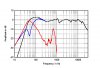
Figure 4, which I've copied below, shows the frequency response measurement. The red line shows the output from the port and the blue line shows the output directly from the woofer. The black line shows the overall response of the port + woofer. You can imagine that if the port where plugged, the overall response (black line) would be the same as the woofer output (blue line) below about 200 Hz.
View attachment 1953347
"Fig.4 Dynaudio Special Forty, anechoic response on tweeter axis at 50", averaged across 30° horizontal window and corrected for microphone response, with nearfield responses of: woofer (blue) and port (red), respectively plotted below 350Hz and 1kHz, and complex sum of nearfield responses plotted below 300Hz (black)."
Looks like Dynaudio gives you the option to run with the ports plugged or unplugged so you can set that by ear. If you have a small room with boomy bass, you might what to plug the port, for example.
Reading through the review, I see that the Dynaudio Special 40 are easy to drive in terms fo the impedance curve but not very efficient "
at 84.4dB/2.83V/m". Given this number, we can get, a very
approximate, or
ball park idea of how loud the MAC4100 / Dynaudio Special 40s will play. The loudness at your listening seat depends (mostly) on the power into the speakers, how efficient or sensitive the speakers are and how far you sit. This
online tool calculates that. It shows, for example that if you sit 10' from the speakers ( 3 meters) and allow 10 dB of head room for transient peaks in the music, about 80 Watts/channel (160 Watts total), which is about what the MAC will deliver, will get you an average listening level of around 87 dB at your seat. That's a bit low if you like loud rock and roll. You can play with this tool to see what you need depending on how close you sit and how loud you listen. If you have a smart phone, several sound pressure level meter apps are available for free that you can use to see about how loud things are when listening.
This is only an approximation but gets you in the ball park. If you consider other speakers, you can plug in their sensitive specs into the tool and see what happens.