• The move to the new server is done. There are some software and database maintenance updates in process. This has us passing the hat around to help out. We appreciate any donations. Seriously, even a dollar helps. The payment page may be found here - https://www.audiokarma.org/support.html

Marantz 2252 relay slow to open?

goldswimmerb

Failed out of engineering, but look at me now!
Subscriber
Hey guys, so I have a 2252 that gives me a large thud, and significant DC through the speakers on shut down. The amp Powers up just fine, no thuds and typically the relay opens within the expected 5 seconds or so. On power down the relay seems to take much longer to close, to the point where I can actually power cycle the amp off and on before the relay has a chance to close. I've already replaced the capacitors on the amp board and power supply, does anyone have any ideas where to look? The amp works perfectly fine otherwise, just a bit annoying having a quick thud on power down. My other 2252 does not do this...
 
Register to hide this ad
C731 is the RC circuit capacitor, right? I tried increasing the value, but even going up in value didn't seem to change the time all that much. I tried going up by 220uf (so 440uf to test) and the pop on power on and power off was quieter but still there. The relay seems to close about a second after power on and several seconds after power off, and on power off I get a pretty loud pop when the relay opens.
 
I think you are working on a 2252B, is that correct?
The 2252 is a different beast.
If I understand the 2252B documentation, the time for the relay to energize at power on is roughly controlled by the time it takes for C731 to charge through R775.
The the time it takes for the relay to de-energize on power off is controlled by the time it takes C740 (a 10µ/50V electrolytic capacitor) to discharge through the relay coil.

It could be that the de-spiking diode Q746 is bad. It is there to 'quench' the back EMF as the relay coil magnetic charge collapses.
Pops on power off can also be due to the power amps having high DC offset. When the relay de-energizes, the offset goes away and a 'pop' is heard as the offset is removed from the speaker.

Tom
 
I think you are working on a 2252B, is that correct?
The 2252 is a different beast.
If I understand the 2252B documentation, the time for the relay to energize at power on is roughly controlled by the time it takes for C731 to charge through R775.
The the time it takes for the relay to de-energize on power off is controlled by the time it takes C740 (a 10µ/50V electrolytic capacitor) to discharge through the relay coil.

It could be that the de-spiking diode Q746 is bad. It is there to 'quench' the back EMF as the relay coil magnetic charge collapses.
Pops on power off can also be due to the power amps having high DC offset. When the relay de-energizes, the offset goes away and a 'pop' is heard as the offset is removed from the speaker.

Tom

Nope, it's a 2252 not B, the original, black/blue dial. Not sure how different the amp boards are between them
 
I think you are working on a 2252B, is that correct?
The 2252 is a different beast.
If I understand the 2252B documentation, the time for the relay to energize at power on is roughly controlled by the time it takes for C731 to charge through R775.
The the time it takes for the relay to de-energize on power off is controlled by the time it takes C740 (a 10µ/50V electrolytic capacitor) to discharge through the relay coil.

It could be that the de-spiking diode Q746 is bad. It is there to 'quench' the back EMF as the relay coil magnetic charge collapses.
Pops on power off can also be due to the power amps having high DC offset. When the relay de-energizes, the offset goes away and a 'pop' is heard as the offset is removed from the speaker.

Tom

Also checked the DC offset, when amp is running it's roughly 0.7mv and 1mv or so. When the amp is powered off that spiked way up when the relay opens.
 
I would replace the power supply transistors and diodes (including the dual diodes). Should cost like $5 in parts. I have a list if you want it.
 
2252, OK.
There is a set of auxillary contacts on the power switch that causes the relay to de-energize as soon as the power switch is turned off.
If you turn the unit off with a plug strip, instead of the power switch, you may hear a 'pop'.

Tom
 
2252, OK.
There is a set of auxillary contacts on the power switch that causes the relay to de-energize as soon as the power switch is turned off.
If you turn the unit off with a plug strip, instead of the power switch, you may hear a 'pop'.

Tom

Could those contacts be dirty or worn out? I'm using the power switch on the unit. I swapped out pretty much everything in the relay circuit to see if it would fix the issue and nothing has yet
 
2252, OK.
There is a set of auxillary contacts on the power switch that causes the relay to de-energize as soon as the power switch is turned off.
If you turn the unit off with a plug strip, instead of the power switch, you may hear a 'pop'.

Tom

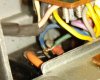
The relay looks like a good lead. Was looking at the power button and came across this (see attached image) that doesn't look factory especially given its proximity to AC, could the switch have been replaced and someone just went and shorted the relay section?
 

Attachments

  • IMG_20190627_213135.jpg
    IMG_20190627_213135.jpg
    84.4 KB · Views: 52
2252, OK.
There is a set of auxillary contacts on the power switch that causes the relay to de-energize as soon as the power switch is turned off.
If you turn the unit off with a plug strip, instead of the power switch, you may hear a 'pop'.

Tom

Found the issue, someone swapped the power button at some point and just bridged the relay line. This was causing the relay circuit to float at whatever the residual rail voltage was until the caps. Thanks so much for that info about the power switch, I wouldn't have guessed that the relay was directly connected to it.

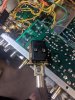
Attached is the image of the wrong switch, looks like it's from a lower model. It has a much better click to it than my replacement but whatever.
 

Attachments

  • IMG_20190627_235616.jpg
    IMG_20190627_235616.jpg
    65 KB · Views: 48
Yeah, that’s probably your issue. Just replace the switch and knob and you’ll be set. Unless you can find a new flat-bladed switch, you’ll have to use the standard new replacement switch with a new pushbutton.
 
Yeah, that’s probably your issue. Just replace the switch and knob and you’ll be set. Unless you can find a new flat-bladed switch, you’ll have to use the standard new replacement switch with a new pushbutton.
Definitely was the issue. Had a spare replacement and it's working great. Probably going to increase the RC time delay cap anyway since the amps aren't completely settled before it opens. But my power off pop is completely solved.
 
:thumbsup:
Good deal!!
When you say the relay opens, you mean closes as the normally open contact of the relay are making.

Tom
P.S. Thx Bob!
 
There are other models that use a second set of contacts (I call them auxillary contacts) to perform relay functions, some of the quads for sure.
I don't have a list, just look at the power switch for an extra pair of 22 gauge wires going 'somewhere'.

Tom
 
Hello, do you guy know (for the same model not B), what could be the issue with relay not opening at all.

Only replaced all caps and transistors and before work, it was working fast but now, not opening at all.

Im retracing my steps, putting back few original transistors that are good, the C731 that @goldswimmerb I replaced for a bipolar (green), not sure if other component is involved in the relay.
 
Hello, do you guy know (for the same model not B), what could be the issue with relay not opening at all.

Only replaced all caps and transistors and before work, it was working fast but now, not opening at all.

Im retracing my steps, putting back few original transistors that are good, the C731 that @goldswimmerb I replaced for a bipolar (green), not sure if other component is involved in the relay.
You put something in wrong. Best to start your own thread with pictures and what parts you used and where.
 
Back
Top Bottom