• The move to the new server is done. There are some software and database maintenance updates in process. This has us passing the hat around to help out. We appreciate any donations. Seriously, even a dollar helps. The payment page may be found here - https://www.audiokarma.org/support.html

Marantz 2270 unstable DC Offset causes?

rustyhusky

Member
Well, I almost got through my second rebuild without tapping the AudioKarma brain trust, but I'm having an issue with the DC offset on the right channel P750 power amp board of my cousin's 2270 (S/N 53625).

Without going into too much detail, this unit initially required a new power switch and bridge rectifier to bring it back from the dead. I then installed a "rebuild kit" that consisted of mostly electrolytic & tantalum capacitor replacements, a new speaker protection relay, and a two pairs of MPSA92 transistors to replace the original differential amp transistors (H751/H752) on each power amp board. NOTE: Although the original transistors were siamesed together with heat shrink tubing, the notes from the rebuild kit supplier said that it wasn't necessary with the replacement transistors, so I installed them without heat shrinking them together.

I also rebuilt the bias circuit on both boards by replacing the original H760 bias transistor with a MJE243G transistor and the H761 bias diode with a 1N4004 diode. For good measure, I also replaced the original DC offset and bias pots (R762 & R763) with new, 4-turn Bourns pots.

During the initial adjustment, I noticed that the offset on the right channel was harder to zero out than the left. There was more +/- swing to the right channel DC offset. After a two hour warm up, I hooked up a CD player and ran the receiver at 30% volume for 5 hours straight with no problems.

However, when I came back the next day and powered it back up, I immediately got a minor buzz from the right channel after the speaker protection relay pulled in. At the time, I had no input and the volume control was at zero. I then noted that the right channel DC offset was at 2 volts!. I shut things back off, turned off the speaker switch, waited a minute, and then powered it back up again. With the speaker disconnected, I still had a 2V DC offset, but noticed it was decreasing. After about a minute, it settled down and I reconnected the speakers. No buzz. I then fired up the CD player and everything was fine.

So, something is flaky in the right channel. Other than the H751/H752 transistor pair, the rest of the transistors on the power amp are all original. I hate to do a wholesale replacement of the rest of the transistors on the board, but I'm not sure how to track this problem down. Any suggestions?
 
Register to hide this ad
Check that the screws and nuts on the driver transistors are snug. I've caught them loose and had issues something like you're experiencing.
 
From some years ago, now, I seem to recall that the H751/H752 pair need to be matched and heat-shrunk together. I think I recall posts by Echowars on this. Here's what he wrote at the time: Replacing all of them is likely unnecessary. Commonly, the input pairs (751,752) need replacing. They are called a differential pair, and perform an important function. For some reason, a lot of Marantz receivers have issues with these transistors and they need to be replaced. The new ones need to be matched in pairs for replacement. I use Zetex ZTX795A's. If you went this way, the Zetex ZTX795A's are CBE layout instead of the 2SA640's BCE layout, and you won't be able to heatshrink them together like the originals are (which means offset might drift during warmup a little more than the stock transistors, but is not really a big deal).

There is also a very useful posting by ecluser on bias during warm-up. Here's what he wrote at the time: According to the service manual, the bias transistor (H760) and the bias diode (H761) are thermally coupled to the power transistors through the heat sink. It was a bad idea for an amplifier of this topology (complementary darlington). I recommend that you transfer these temperature sensitive biasing components to one of the driver transistors (H758 or H759). Your bias current in the output transistors will be much more stable after this change. An easy solution is to fix H761 to H758, and fix H760 to H759.

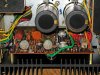
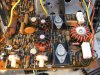
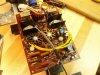
I took his advice and moved H760, the photo shows what this looks like. I also downloaded a pdf explanation of his bias recommendation, which I attach. You can look for his posts and read them, all good stuff.
 

Attachments

I assume you have a 'late' model 2270, above serial number 3900.
I would think about checking the regulated voltages supplied by H762 and H763 along with their electrolytic filter capacitors C759 and C760. Proper polarity is important.
If those voltages are stable and near abs 15VDC, I wouldn't hesitate to replace the differential pair again. I use Hfe matched KSA992 from a reputable supplier, bonded together with heat shrink flat to flat with a smear of thermal compound between them.

Tom

RPA (2).JPG
 
From some years ago, now, I seem to recall that the H751/H752 pair need to be matched and heat-shrunk together. I think I recall posts by Echowars on this. Here's what he wrote at the time: Replacing all of them is likely unnecessary. Commonly, the input pairs (751,752) need replacing. They are called a differential pair, and perform an important function. For some reason, a lot of Marantz receivers have issues with these transistors and they need to be replaced. The new ones need to be matched in pairs for replacement. I use Zetex ZTX795A's. If you went this way, the Zetex ZTX795A's are CBE layout instead of the 2SA640's BCE layout, and you won't be able to heatshrink them together like the originals are (which means offset might drift during warmup a little more than the stock transistors, but is not really a big deal).

There is also a very useful posting by ecluser on bias during warm-up. Here's what he wrote at the time: According to the service manual, the bias transistor (H760) and the bias diode (H761) are thermally coupled to the power transistors through the heat sink. It was a bad idea for an amplifier of this topology (complementary darlington). I recommend that you transfer these temperature sensitive biasing components to one of the driver transistors (H758 or H759). Your bias current in the output transistors will be much more stable after this change. An easy solution is to fix H761 to H758, and fix H760 to H759.

I took his advice and moved H760, the photo shows what this looks like. I also downloaded a pdf explanation of his bias recommendation, which I attach. You can look for his posts and read them, all good stuff.

The bias is stable. The problem is with the offset. The differential pairs were replaced on both power amp boards, and I did verify that the Hfe of both pairs were close (+/- 1). I may go back and heat shrink the pairs togetner or try a different pair.
 
Check that the screws and nuts on the driver transistors are snug. I've caught them loose and had issues something like you're experiencing.

Good idea, since this issue appears to be temperature related and things may tighten up when heated. Will check tomorrow
 
I assume you have a 'late' model 2270, above serial number 3900.
I would think about checking the regulated voltages supplied by H762 and H763 along with their electrolytic filter capacitors C759 and C760. Proper polarity is important.
If those voltages are stable and near abs 15VDC, I wouldn't hesitate to replace the differential pair again. I use Hfe matched KSA992 from a reputable supplier, bonded together with heat shrink flat to flat with a smear of thermal compound between them.

Tom

View attachment 1626975

Yes, the 2270 is a late s/n (53000 range). I wondered about those zeners too, but hadn't looked into them yet. Will fire up the scope tomorrow and see what I get. I also have some KSA992's left over from my 2265B rebuild, so may try those if the zeners check out. Thanks!
 
I recall that when I was doing mine, the factory wiring was long enough to pull the amp boards out to work on them - except the ground connection, which I pulled off and didn't notice until later when I had to find the problem.
 
I recall that when I was doing mine, the factory wiring was long enough to pull the amp boards out to work on them - except the ground connection, which I pulled off and didn't notice until later when I had to find the problem.

Yeah, not so much with this unit. Wires were way too short. I ended up clipping them off to get the boards out and installed longer wires with quick disconnects so I could test and adjust them while outside of the chassis. Worked out great!
 
UPDATE: I connected DVM's across the two 15V zener diodes supplying power to the offset circuit and powered the receiver up cold. Got a minor "buzz" again from the right channel, however the voltages across H762 was a steady 15VDC and H763 was a steady 15.5VDC. The DC offset was initially around 150mV, but started coming down almost immediately. While the hum was still going on, I tapped around with a plastic alignment tool. No changes in the hum until I tapped on the predriver transistor H756; hum varied with my taps, and then went away entirely. Fired up the CD player, and everything sounded fine.

I'm positive this is a temperature related issue since as the amp warms up, the issue goes away and there are no problems.

My assumption at this point is that I have a flaky transistor at H756 (solder joints look good), so will try replacing the H756/H757 pair with 2N5416/2N3440 (TO-39) pair and see if the hum issue on power up goes away. For good measure, I'm also going to install a matched pair of KSU992FBU transistors at H751/H752 and siamese them together with thermal compound and heat shrink tubing.

Stay tuned!
 
UPDATE #2: I took all of the above advice and did the following:

1) I replaced the H751/H752 differential pair with hfe-matched KSA992's and siamesed them together with thermal compound and heat shrink tubing
2) Since H756 was suspect, I desoldered and removed the predriver transistors H756/H757 so I could redo the solder connections
3) Since loose driver transistor hardware might be an issue, I removed the hardware, desoldered and removed the driver transistors H758/H759 so I could replace and retighten the hardware and resolder the connections.
4) With a nice clean board to work with, I relocated the bias transistor H760 and the bias diode H761 from the large heatsink to under the driver transistors H759/H759 heatsinks as referred to by LWB

After putting things back together, I powered it back up and readjusted the offset and bias. First thing I noticed was the stability of the offset had greatly improved. Ditto for the bias. Now to let things sit overnight and see if the buzz on startup is gone tomorrow morning. If so, I plan to go back and make the same mods to the left channel power amp.

PICT0333.jpg
 
any notice about?
My experience with the 2270 has been if the DC Offset is unstable, it comes down to replacing the H751/H752 differential transistor pair with a new Hfe-matched pair. I dumped the MPASxx transistors that came with the rebuild kit and used OnSemi KSA992FBU as replacements instead since I had great results with them on my 2265B. I also bent the leads to make the flat faces of the pair touch together, then added a dab of silicone grease and heat shrinked the pair together. After doing the former, I had a large improvement in the stability of the DC Offset (refer to UPDATE #1)

The DC Bias stability improved after making the changes I outlined in UPDATE #2. I also eliminated the "buzz" in the right channel on startup by replacing the predriver transistors H756/H757 with 2N5416/2N3440 (TO-39) pair.

Looks like I'll be putting the old girl back together later this week and then running it for a while to make sure there are no other issues.
 
UPDATE #3: Well, every time I think I've rounded the corner with this beast, it exhibits a new problem. After over 12 hours of burn in time, the left channel started running hot. With only a modest input signal, the left channel bias is running well above 120 mV, but when the signal is removed, the bias returns to the desired 10 mV idle level almost immediately. The right channel runs a more normal 35 mV with the same input signal level.

What's going on here? Do I have an oscillation problem in the left channel power amp that's not audible? Time to pull out the scope and see what's up.
 
Back
Top Bottom