• The move to the new server is done. There are some software and database maintenance updates in process. This has us passing the hat around to help out. We appreciate any donations. Seriously, even a dollar helps. The payment page may be found here - https://www.audiokarma.org/support.html

Marantz 2275 Power Amp Board Need Help Troubleshooting

I need help, please troubleshooting my Marantz 2275 that I got at an estate sale a few months ago. I have clear audio through the right channel but no sound through the left channel.

After cleaning connectors, switches and potentiometers, I did a test by connecting left preamp RCA output to right Main in and and right preamp RCA output to left Main in. I could hear the left channel but not right channel when I did this switch. I believe this shows that the left channel preamp is working and I suspect that there is a problem on the left channel power amp board. I removed the left channel amp board and plugged it in to the right power amp connector and there was some very distorted but audible music.

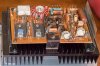
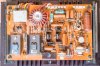
It appears that someone has done some work on left channel power amp board because a couple of screws are missing in that area and there is a odd looking crimp near the capacitor at H710 as can be seen in the photos. I plan to rebuild both power amplifier circuit boards but I would like to pinpoint and repair this issue before doing anything else. What are the next steps I should take to get this beast of a receiver back on the road?
 

Attachments

  • _DSC5303.jpg
    _DSC5303.jpg
    136.7 KB · Views: 57
  • _DSC5307.jpg
    _DSC5307.jpg
    94.9 KB · Views: 52
  • _DSC5310.jpg
    _DSC5310.jpg
    118.8 KB · Views: 52
Register to hide this ad
When you swapped Pre and main jumpers, and the bad channel swapped sides, that usually points to a bad channel on the preamp or a problem with the controls. Was the sound in the left channel good when you did that, and before swapping the amps? That odd looking crimp near H710 is a varistor that is usually glued to or near a Pre driver or driver transistor to help bias tracking as it heats up.
 
Connected normally, the left channel channel works well and the right channel does not work at all. When I use RCA cables connecting left main in to right preout then the left speaker works with balance fully to the right. I think this tells me that both preamp channels work and left power amp channel works. What do you think?
 
Last edited:
Just trying to get it straight — in the first post, you said the right channel was good to start with. But either way, if the good channel switches sides when you swap the inputs, it’s a bad preamp channel or flaky switch/pot or broken wire. Switches/pots are prime suspects. Sometimes they require multiple cleanings, and lots of working them over and over to get good contact again.

Edit: OK, read again, and you are right. If left side works both ways and right side doesn’t work either way, then the right amp is suspect. If that is the case, and the amps are connected by plugs, make sure the plugs have good contact. Otherwise, it’s amp troubleshooting, which usually starts with testing the output transistors.
 
Last edited:
Sorry for the confusion. I think what is confusing about it is that there are both left and right preamp channels as well as left and right power amp channels.
 
I cleaned out the connector plugs to the power amp circuit board with isopropyl alcohol and brushes as well as I could this morning. I have a multimeter and a lot of experience using it. What is the best way to test the output transistors? Can I just do a voltage test?
 
You could pull and test, and wait for the compound to reassemble. Get a small tube of Dow Corning 340 Thermal Compound on Amazon. Unfortunately, it’s not dirt cheap. But you only have to buy it once. A tube lasts forever for a hobbyist.
 
CPU thermal compound is often conductive and absolutely should not be used here unless it definitely states non-conductive.
 
OK thanks Steven. I found my Silicon Heat Sink Compound DC 340 High Thermal Cond. Is that what I should use when reinstalling these transistors?
 
OK thanks Steven. I found my Silicon Heat Sink Compound DC 340 High Thermal Cond. Is that what I should use when reinstalling these transistors?
That should be it. Clean the old compound off of all surfaces, including mica insulator, with isopropyl alcohol. If the insulator is not intact, it needs to be replaced. Put a VERY thin coating on both sides of the insulator, and a very thin coating on the bottom of the transistor. You don’t want a lot of excess or the film thickness will be too great and defeat the purpose. Tighten the screws snug plus a tad, but don’t crank them down.
 
I tested the two transistors on the suspect right channel amplifier board using your link. Thanks!

Comparing results with those in your link, the black NEC D382 M44A transistor in location H713 tests as if it were a good NPN transistor and the blue NEC B537 M45B transistor in location H714 transistor test as if it were a good PNP transistor. Is that what they are supposed to be?

There was no gasket or any sign of there ever being thermal compound on these transistors. They are pretty clean as you can see in the photos. Do I need to add a gasket and paste or is it not needed for this type? Thanks so much!

View attachment 1915436
 
Links are not working for me. But it sounds like you tested the driver transistors - the flat transistors mounted on the amp board. That’s OK - they were next in line to test. But the output transistors are the silver cans mounted on the black heat sink. The only reason for testing them early in the process is that they are often bad in an amp that isn’t working. The metal case is the collector, and if the two pins are not marked on the bottom of the case with an E and a B, you will need to google the datasheet to identify the emitter and base.
 
Thanks for your help! I am beginning to remove and test the output transistors right now and excited to be learning.

I bought the Marantz 2275 at an estate sale this fall with a broken off volume pot. There was also a 2220 and 2230 at the estate sale that I chose not to purchase, probably a dumb mistake. My flawed logic was if I am going to put this much work into something and for a receiver to take up so much floor space, I want it to have plenty of power. Modern stereo equipment does small pretty well.

After replacing the volume potentiometer, and rebuilding the power supply circuit board, I have just been listening to the receiver and making notes about any issues. Before losing one channel completely, the channel was going out intermittently. I would have to turn up the volume until the channel cut back in and then I could turn it back down. It felt almost like something just needed a little more power to engage and then once it was engaged both channels would work fine. Does that sound like any symptom you have seen? Could that be a symptom of a failing output transistor?
 
Unlikely. Outputs tend to be all or nothing. It could be a component failing somewhere, but I would be looking closely at the protection relay, and probably go back and reclean all of the controls. Those seem to be the most common sources of intermittent sound.
 
Back
Top Bottom