• The move to the new server is done. There are some software and database maintenance updates in process. This has us passing the hat around to help out. We appreciate any donations. Seriously, even a dollar helps. The payment page may be found here - https://www.audiokarma.org/support.html

Marantz 3300 repair

Dingman

Do you know where your towel is?
Subscriber
Heyas guys~

I have a 3300 pre, attached to a 250 amp. The amp has been upgraded with the service bulletin mods, including replacing all the outputs with higher-rated replacements. So the amp is doing well, finally.

But recently the 3300 has developed a "blip". Every once in awhile, it will "pop", I think just out of one channel.

I bought the 3300 used and don't think it's ever been opened. Well, I'm fixin' to open it and see what I can find.

Has anyone else gone thru a 3300, and maybe a thread with the details?
Any tips specific to this unit?
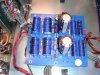
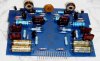
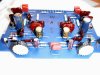
I'll fill up the thread with pics and details as I go. Teaser pic until then.
attachment.php
 
Register to hide this ad
Is the pop on all functions? Sometimes on phono you can hear pops from static discharges. Other than that I haven't had the pleasure (!?) of working on this model. Of course get rid of any 2SC458's you may find if any, and I'm too lazy to look up the schematic on a lazy Saturday morning to know).

As far as the setup goes: :ntwrthy:

Pardon my speaker ignorance but what Make/model are they?
 
Is the pop on all functions? Sometimes on phono you can hear pops from static discharges. Other than that I haven't had the pleasure (!?) of working on this model. Of course get rid of any 2SC458's you may find if any, and I'm too lazy to look up the schematic on a lazy Saturday morning to know).

As far as the setup goes: :ntwrthy:

Pardon my speaker ignorance but what Make/model are they?

Pop on all functions??... Hmm, for sure on the Aux that I normally use, haven't had a turntable on that system, so don't know.

Tuner...I *think* it did. Sorry, I hate vague and inaccurate info. I should have tested a little more.

Thanks for the tip on the 2SC458, that's just the type of info that could make it oh-so much easier to find the weak spots.

The speakers are KLF-20's and too effecient to need much power from the Marantz 250 amp. But it's still fun to crank up once in awhile, until my ears start to crackle.

Unfortunately they came with the infamous loose baffle due to glue failure. So, mine are modified, repaired and upgraded. :)
 
Have you considered that the "pop" may be coming from the amplifier?

I did double check on the amplifier - meaning I completely change it out. Reason being, at first I did think it was the amp. This 250 amp has had a variety of problems, and so it was the first suspect.

So, I removed it from the loop, and put in 2 ma500 monoblocks. I'll be darned if I didn't hear the same pop.

Oh, wait - just remembered - had fell asleep listening to music, with the 3300 still inline. Woke up to a hum buzz....kinda loud. I was still half asleep, turned it off, back to sleep. Whatever the problem component is... it finally failed, IMO.

Removed it the next day.

Thanks for ideas, I'll put it on the bench this week. I'll find out the exact symptoms and go from there.
 
Ha, I am an absolute PRO when it comes to procrastination.

I am picking out caps for this 3300.

I am not sure why some caps are so much more expensive than others when I can't really see a spec difference. For example, on the power supply board with the axial caps. This is the mouser list and some caps are just under $2 while others are just over $5.

Is this just marketing, or is there a valid functional difference?

http://www.mouser.com/Passive-Compo...rs-Leaded/_/N-75hqw?P=1z0z819Z1z0wrk5Z1yzn53n
 
I have found that Vishay capacitors are often more expensive than Nichicon.
I typically use Nichircon TVX Series if the correct values and sizes are available.
 
Dingman..... First thing to do is re-solder the pins for each board (phono, Xten, tone boards) and also the connecting socket for each..... then test..... you might find the "pop" problem solved.

The problem I'm having now maybe a bad volume control.... causing an imbalance. Don't know yet where to find one. (AKer elgrillo I think is having the same issue with his). I've replaced all the caps and some resistors and the transistors on the Xten board...... no change in the imbalance problem. Sound is still good. Going to replace all in the power supply board in the next few days.
 
My work on this will be sloooow. Holidays and my job have me busy - I'm guessing a little progress thru the new year, and we'll see where we land.

Thanks for the updates and advice, I'll take pics and notes and update accordingly.:thumbsup:
 
Getting started on this - some time available over the holidays. I have most all the caps\diodes but I didn't get any transistor replacements. I'm going to do that.
I will reflow the board connectors\pins, most joints look good but there are a few sketchy ones.

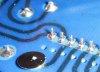
I've played with photoshop trying to see if I could more easily identify cold\cracked joints. As I play around with this electronics hobby, I've found that I'll identify flaws\errors in photos, where I missed it in real time! Sounds weird, but seems like even my phone camera can take really nice macro photos.
But alas, photoshop isn't helping yet... For example, the end of the pin assembly (where the board plugs in) almost looks like it's cold and the solder not correctly attached to the pin. But the darn camera flash is killing the view... Maybe I need external flash and diffusers, heck , the trace shows up great as well as little bits of debris. Hmmmm.
closeup trace 01.jpg closeup trace 02.jpg
 
We have an optical inspection machine at work and it uses red LED lighting to "look" at solder joints. Maybe just rigging up some red lighting may help?
 
Heh, you guys will laugh at me, but this first board is done. Some of the axial caps I could only get in Vishay (which some people don't like, some people hate them, I've read) and so I did use those for the first stages of the power supply but then for the "second stage" filters, I did use radial Nichions'. I might be all wrong but I figured if the Vishay's could take care of the "rougher" control of power, then the Nichon for the more sensitive filtering (based on a factor proportional beta of the transistors).
Bumped up the value of the of C604\605 since they are also connected directly to ground and also do some filtering. Up from 100uf to 220uf. I hope that's acceptable. All other values I left the same.
Then there's some feedback protection (isolating the phono output from the tone\x10 outputs) - I think that's the diodes (not the zenors), so I changed those also for new fast-switching diodes.
I'm not sure all this means much on the power supply, since it's not directly in the signal path - but oh well, it's done now.
EDIT: What do you guys use to anchor large caps? RTV? Hot glue?

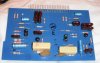
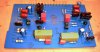
So, power supply has all new caps, new zeners, new non-zener diodes. Checked all the resistors, they are are spot on. I'd like to change the transistors but couldn't find a replacement, I may have to ask for help on that.
Marantz 3300 PS board 01.jpg
Marantz 3300 PS board done.jpg
 
Last edited:
Dingman.... I replaced the transistors as follows .... and they seem to work just fine........ I did not replace any diodes thinking that they either work or they don't (I don't know enough about them) but I did replace all the resistors with metal film 2% ....... most likely that not even needed.

Mouser Parts
Q601 462-1019 NPN SO36049 2N5320 610-2N5320 $2.52
Q602 461-1014 PNP SO36048 2N5322 610-2N5322 $2.66
 
Dingman.... I replaced the transistors as follows .... and they seem to work just fine........ I did not replace any diodes thinking that they either work or they don't (I don't know enough about them) but I did replace all the resistors with metal film 2% ....... most likely that not even needed.

Mouser Parts
Q601 462-1019 NPN SO36049 2N5320 610-2N5320 $2.52
Q602 461-1014 PNP SO36048 2N5322 610-2N5322 $2.66

Thanks, I'll order those up. Yeah, seems like alot of differing opinions on what to swap out. I'm right down at the knowing enough to be dangerous level, so I'm kinda guessing at some things. I do have a couple of years in consumer electronics (ass. degree) and alot of field experience in another industry (building automation), so I'm not flying blind at least.

Resistors - for me, if they look ok, smell ok, taste ok (i.e., measure right on value), then I leave them alone.

I'm moving more to the opinion of changing most transistors as well as all diodes and caps. So many things have improved, such as the construction (clean rooms) environments, material, bonding agents - I can't help but think most all of the caps and diodes (transistors are basically diodes) should be replaced. But now we're starting to talk about real money, especially if we splurge and put in some larger film and C0G? caps. I don't mind the extra money if it results in some improvement in functionality.

So, I'm still feeling my way thru these things. The 3300 is the first piece with any real value (IMO) that I've done.
 
X10 board is done. I did up the 0.03uf ceramics to 0.047 films.
I still need to order up and change the transistors, and I'll leave those fancy "precision resistors". Just caps and diodes replaced.
Before and after pics.
Marantz 3300 Rebuild X10c.jpg
Marantz 3300 Rebuild X10b.jpg
 
Last edited:
The Phono Board had more caps, and 6 of them are those high-ESR caps - the blue ones. As I've been removing the old caps, I check the values. The big 250v gold colored 1uf caps test really well.
The blue caps seem to have varying degrees of high ESR. The first pic shows the values of caps on off of this phono board. Note for example, the 100uf rated caps, you'd figure they'd at least be close but one is at 12Ω and the other at 23Ω!
Again, I upped the value of the 0.03 ceramics. This time, I didn't use the 0.047 films, as the leads were too darn short and bending them like I did before, might not have been a good idea. I *think* I could hear cracking when I bent the leads. So, replaced with 0.056 films that had long leads.
The transistors are 2 matched pairs of SPS1928.
Marantz 3300 Rebuild Phono 01.jpg
 

Attachments

  • Marantz 3300 Rebuild Phono 02.jpg
    Marantz 3300 Rebuild Phono 02.jpg
    87 KB · Views: 65
  • Marantz 3300 Rebuild Phono 03.jpg
    Marantz 3300 Rebuild Phono 03.jpg
    81.4 KB · Views: 70
Has anyone identified a replacement transistor for the SE6021? They are funny looking, blobish and although it's listed with a pdf on ChrisMarantz site, he doesn't list a replacement, and AK turns up empty as well.
Any ideas? Time to go search spec sheets?Marantz 3300 Rebuild SE6021.jpg
 
Did you ruleout the 250 as the source of the problem?
You may have a cold solder or bad cap(s) or transistor(s).
Try leaving the 250/3300 on until it starts to 'pop". Start with the mode selector in Phono.
Time it and repeat the test a few times to be certain. Start with a cold amp/preamp. Leave it off over night.
Do you have a DMM or other test gear?
This type of problem requires patience and a good DMM to measure voltage, resistance, transistors/diodes & continuity.
Hope this helps.
 
Back
Top Bottom