• The move to the new server is done. There are some software and database maintenance updates in process. This has us passing the hat around to help out. We appreciate any donations. Seriously, even a dollar helps. The payment page may be found here - https://www.audiokarma.org/support.html

Marantz 8B Restoration Saga

Must be a different kind of Good-All.
The Marantz units use a molded plastic variety. No wax encasing at all.

capGoodall.027-100.jpg


This helps keep moisture out much longer, increasing reliability.
Still, like anything 40+ years old, they can fail due to age.
However, it's worth checking for leakage before replacing them wholesale.

Kevin Hayes of VAC was able to have the Good-All capacitor replicated by the same folks who made the original ones.

I would try to source them before trying any other brand..

I plan to throw away a large number of Good-All wax-encased capacitors that I just ripped out of my Bogen DB230A. They look like the typical time bombs you'd find in an old radio, just waiting to destroy an output tube. Whatever Good-All part was used in the Marantz must be a very different cap :scratch2:.
 
Hi,

I know this is an old post, but maybe you can help me on my Marantz 8 restoration.
I´m replacing the original lytics caps because they are destroyed and need to replace C3A,B. I don´t have 15uF 6V polarized, but I have 15uF 70V Mundorf Ecap bipolars. Can I use these on that positions.

Any help will be appreciated.
 
Hi,

I know this is an old post, but maybe you can help me on my Marantz 8 restoration.
I´m replacing the original lytics caps because they are destroyed and need to replace C3A,B. I don´t have 15uF 6V polarized, but I have 15uF 70V Mundorf Ecap bipolars. Can I use these on that positions.

Any help will be appreciated.

Yes, you can use non polars in this position. Make sure you test every cap before replacing it. I tend to replace only what's broken. There is a very inexpensive tester that can be found on eBay that is invaluable for this. It's the TC1 multi-function tester. It can test capacitors for capacitance and ESR. Highly recommended!
 
Hi Crooner,

Many thanks for your help.
I followed your recommendations to restore and agree to change only necessary. I received this amp all in original form and my concern is about the lytics and leakage. I don´t change the bigger cap can, because it´s in good condition, but the rest in BIAS and double voltage were leaky.
I changed the selenium rectifier too and in some post you recommend to use UF4007 rectifier adding a resistor in series mode. Please can you explain it?. I only used UF4007 to replace it. It´s very important to add the resistor?

Thanks!
 
It's not critical to install a series resistor. What can happen is an increase in negative voltage (lower voltage drop of the silicon diode) which will require to advance the bias pot further clockwise to reach the mark on the meter. If you are able to bias the output tubes and are not maxing out on the pots, then you are ok without it.
 
Follow up on my restoration. The BIAS is functioning perfect now, I checked every hour the meter position and in the same place.
I have a doubt about power transformer temperature, yesterday night I listened continously by 6 hours (I know, a lot of time) and was some hot. That’s normal in this amp?
 
The power transformer in these can get quite warm after 6 hours. As a rule I never run my vintage Marantz tube amps continuously for that long. 4 to 5 hours is more than plenty. The insulation is nearing 60 years already. Get an AC voltage/ current meter such those Chinese eBay ones or hook up the amp to a Kill-a watt. Measure the current draw. My 8b draws around 1.2 amps at idle. If significantly higher than this, find the issue before operating the amplifier further.
 
Last edited:
I forgot to mention that it is good idea to run the amplifier at an AC line voltage between 110 and 117V. This will greatly help to keep it running as cool as possible.
 
Thanks Crooner as usual.
I live in Argentina and use a Todd transformer 220-115V, that´s OK. I´ll checking AC current, don´t have a tester for it, but I´ll solving the issue.
 
That's good. You could use something like a Fluke current clamp as well.

Thanks Crooner as usual.
I live in Argentina and use a Todd transformer 220-115V, that´s OK. I´ll checking AC current, don´t have a tester for it, but I´ll solving the issue.
 
Last edited:
My 8b suffered a catastrophic failure before I got it.

The PT got hit as a result and was consuming over 10 watts at idle, without any loads to the secondary, so something was obviously wrong internally.

I had it rewound but asked for 2 modifications:
1) The primary be designed for 120 VAC.
2) Increase the wire size of the bias winding to make it more robust.

All is good with it now. But it gets hot after several hours still. I don't sweat it as because it is all new, I trust more the modern wire and layers isolation.
But with the summer heat and an original PT, I would feel somewhat uneasy.
 
The trick to making a cooler running transformer is to not run the windings all the way to the edge of the bobbin -- which effectively increases the core size of the transformer. Most commercial grade transformers are wound to pack maximum wattage from the smallest core area to keep the physical size and weight of the transformer down. Transformers that are wound for continuous duty however are much more liberal in the amount of core provided for the wattage that the transformer is rated at. One of the clearest examples of this I've ever come across is the power transformer used in the Bogen MO-200A industrial amplifier. This amplifier employs two completely separate 100 watt amplifiers (rated with both channels driven) that are paralleled together, with each amplifier using 4 X 8417 output tubes (for 8 total output tubes). Leave the amplifier on for as long as you like -- days at a time if you wish -- and the power transformer will never break 110˚F when operating open air in a stabilized 72˚F ambient temp environment.

Dave
 
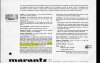
Another example is the power transformer on the Marantz 9 monoblock. Substantially larger than the one inside the 8B, my pair can run for hours and the transformers are barely warm to the touch. Marantz mentions the oversized cool running transformers in their advertising back in the day..

cool transformers.JPG
 
Last edited:
The power transformer in these can get quite warm after 6 hours. As a rule I never run my vintage Marantz tube amps continuously for that long. 4 to 5 hours is more than plenty. The insulation is nearing 60 years already. Get an AC voltage/ current meter such those Chinese eBay ones or hook up the amp to a Kill-a watt. Measure the current draw. My 8b draws around 1.2 amps at idle. If significantly higher than this, find the issue before operating the amplifier further.

I measured 1.4 Amps idle with speakers connected. I think all is OK. I´ll taking acount your comments about not to run a lot of hours continously.
 
I measured 1.4 Amps idle with speakers connected. I think all is OK. I´ll taking acount your comments about not to run a lot of hours continously.

You should be good to go. I built a box with a couple of voltmeters/ammeter units so I can continuously monitor the incoming AC line voltage and current draw for my two Marantz 9's. The current reading is sensitive enough that I can tell if the output tubes' bias needs to be adjusted, for instance. Potential benefits of this: say an EL34 starts drawing more current than it should. The total current draw will increase and can be readily seen on the meter from across the room in my listening position...
 
Last edited:
Back
Top Bottom