


Since1984
New Member
Hi all,
I've got a Marantz Pm400 on my bench, nice amplifier. It works, one channel playing fine, the other has weird noise which almost gets dangerous to speakers - it's something like a cracking/almost a bit like fireworks, sometimes gets lower, then suddenly comes back again, never stops. Still, that channel plays music with normal volume, too. No overheating, it's not a hum or buzz (it's volume independent), it's not the power supply (as said, other channel is fine). Changed most electrolytics in the defective channel, no difference. Decided to start isolating the problem, so I disconnected the power amp section from the pre amp section and grounded it's input. As expected, still the same noise problem in the defective channel, while other good channel now dead silent, as it should be. Grabbed my oscilloscope and started to trace the noise and also compare with the other good channel at some strategical points.
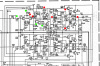
Here I add an excerpt of the schematic of the defective channel (power amp part), where I marked green dots on places where there was no noise present and red dots, where it was present. The noise looks like some random "spikes" around some millivolts, quite intense, of varying frequency and amplitude, it's not white noise or something. It's more a crackling.
From what I understand, after doing some research, this will probably be caused by some transistor in one of the stages of the power amp which is failing and developed this noise, right? If it was a resistor or a capacitor, would be more like white noise and more consistent, lower amplitude, no?
Also, doesn't seem to be a broken solder joint or intermittent "short circuit", as I tapped around that section with a wooden tool quite thoroughly and nothing really changed.
Haven't done the freeze spray trick yet.
Now I'm reaching out to you guys, as I don't understand very well the design of the output stage, it's a little complex, I know the first stage is the diff amp and I know what the last stage does, obviously, but can't identify well the rest (don't know where the VAS is, for example), so not sure if maybe with some help understanding the circuit better, finding the culprit would be easier?
As you can see from the red dots, I'm pretty sure the noise appears somewhere after the stage of Q707 and Q709, as it is not present at the base of Q705 nor Q707, but is present at base of Q713 and Q711. It's also not present at the common point for differential stage (at Zener), but it is present directly at emitter of inverting diff amp transistor and its base, which is where the feedback arrives from the output power transistors (which obviously carries the noise), which is also why it is present at the emitters of QN01 and QN03. Am I thinking correctly here? Or could the noise go the other way round, could it be the output transistors and the feedback connection injects the noise signal in the whole circuit over inverting input of diff amp stage?
What would be best to do next? Please, some opinions on this.
a) Apply freeze spray (I only have a non-invertible compressed air can, I hope it does the job) to the transistors which are suspects, to see if something changes
b) Disconnect R723 and 725 (output transistor resistors), so that no feedback goes to inverting input of diff amp and see if that changes noise? Or would that make the amp instable or other problems during this brief testing?
c) Disconnect R709 (resistor to base of inverting diff amp transistor) Q703, so that feedback doesn't get there and start isolating this way one transistor after the other, working from left to right, interrupting signal temporarily to test?
d) is it possible to measure (in terms of voltage, ohms or current) a transistor which has developed this kind of noise problems? or, as it is still partially working (it stil puts the music through), measurements would all be normal?
e) lastly, should I simply start substituting transistors in pairs, if necessary, starting with Q709 and Q707, then QN01 and 03, then Q703, hoping to eliminate the problem by luck, so not to loose much time in tracing it? this is a paid task, but not per hour, obviously.
Thanks in advance. And sorry for low quality of schematic, it's the only service manual I can find.
I've got a Marantz Pm400 on my bench, nice amplifier. It works, one channel playing fine, the other has weird noise which almost gets dangerous to speakers - it's something like a cracking/almost a bit like fireworks, sometimes gets lower, then suddenly comes back again, never stops. Still, that channel plays music with normal volume, too. No overheating, it's not a hum or buzz (it's volume independent), it's not the power supply (as said, other channel is fine). Changed most electrolytics in the defective channel, no difference. Decided to start isolating the problem, so I disconnected the power amp section from the pre amp section and grounded it's input. As expected, still the same noise problem in the defective channel, while other good channel now dead silent, as it should be. Grabbed my oscilloscope and started to trace the noise and also compare with the other good channel at some strategical points.
Here I add an excerpt of the schematic of the defective channel (power amp part), where I marked green dots on places where there was no noise present and red dots, where it was present. The noise looks like some random "spikes" around some millivolts, quite intense, of varying frequency and amplitude, it's not white noise or something. It's more a crackling.
From what I understand, after doing some research, this will probably be caused by some transistor in one of the stages of the power amp which is failing and developed this noise, right? If it was a resistor or a capacitor, would be more like white noise and more consistent, lower amplitude, no?
Also, doesn't seem to be a broken solder joint or intermittent "short circuit", as I tapped around that section with a wooden tool quite thoroughly and nothing really changed.
Haven't done the freeze spray trick yet.
Now I'm reaching out to you guys, as I don't understand very well the design of the output stage, it's a little complex, I know the first stage is the diff amp and I know what the last stage does, obviously, but can't identify well the rest (don't know where the VAS is, for example), so not sure if maybe with some help understanding the circuit better, finding the culprit would be easier?
As you can see from the red dots, I'm pretty sure the noise appears somewhere after the stage of Q707 and Q709, as it is not present at the base of Q705 nor Q707, but is present at base of Q713 and Q711. It's also not present at the common point for differential stage (at Zener), but it is present directly at emitter of inverting diff amp transistor and its base, which is where the feedback arrives from the output power transistors (which obviously carries the noise), which is also why it is present at the emitters of QN01 and QN03. Am I thinking correctly here? Or could the noise go the other way round, could it be the output transistors and the feedback connection injects the noise signal in the whole circuit over inverting input of diff amp stage?
What would be best to do next? Please, some opinions on this.
a) Apply freeze spray (I only have a non-invertible compressed air can, I hope it does the job) to the transistors which are suspects, to see if something changes
b) Disconnect R723 and 725 (output transistor resistors), so that no feedback goes to inverting input of diff amp and see if that changes noise? Or would that make the amp instable or other problems during this brief testing?
c) Disconnect R709 (resistor to base of inverting diff amp transistor) Q703, so that feedback doesn't get there and start isolating this way one transistor after the other, working from left to right, interrupting signal temporarily to test?
d) is it possible to measure (in terms of voltage, ohms or current) a transistor which has developed this kind of noise problems? or, as it is still partially working (it stil puts the music through), measurements would all be normal?
e) lastly, should I simply start substituting transistors in pairs, if necessary, starting with Q709 and Q707, then QN01 and 03, then Q703, hoping to eliminate the problem by luck, so not to loose much time in tracing it? this is a paid task, but not per hour, obviously.
Thanks in advance. And sorry for low quality of schematic, it's the only service manual I can find.

 ...
...