• The move to the new server is done. There are some software and database maintenance updates in process. This has us passing the hat around to help out. We appreciate any donations. Seriously, even a dollar helps. The payment page may be found here - https://www.audiokarma.org/support.html

Marantz "regular" vs. "B" versions of classic models?

Taketheflame

Super Member
Hey all,

My apologies if this topic has been done a lot, but I couldn't seem to find an old thread with all the answers I'm looking for.

As the title suggests, I'm a little curious how the "B" versions of classic Marantz receiver models compare to their earlier non-B variants? (i.e - 2285 vs 2285b, etc.).

Some reading I came across suggests that the earlier models were built a bit better, but I also haven't read of any complaints about build quality on B-series receivers either. Did the B-series make use any unobtainium parts over their earlier relatives? (such as the use of output ICs over discrete components?).

Perhaps of most importance to my curiosity - is the sonic signature of B models different than that of the previous generation? The only model I've actually heard in person is a 2325...and I found it truly sublime - very musical, with a smooth top end - but not lacking details compared to brighter-sounding gear that I own.

Admittedly, I'm starting to get the "itch" for a Marantz receiver again, despite satisfaction with my current gear and the Marantz tax these days - they definitely have a certain magic to them that I enjoy. I'm just kind of hoping the B-models are worthy of consideration, as it would open up more options for me should I find myself in a position to buy. As a bonus, I also prefer the aesthetics of the B-series over the earlier Marantz styling.
 
Register to hide this ad
Hey all,

My apologies if this topic has been done a lot, but I couldn't seem to find an old thread with all the answers I'm looking for.

As the title suggests, I'm a little curious how the "B" versions of classic Marantz receiver models compare to their earlier non-B variants? (i.e - 2285 vs 2285b, etc.).

Some reading I came across suggests that the earlier models were built a bit better, but I also haven't read of any complaints about build quality on B-series receivers either. Did the B-series make use any unobtainium parts over their earlier relatives? (such as the use of output ICs over discrete components?).

Perhaps of most importance to my curiosity - is the sonic signature of B models different than that of the previous generation? The only model I've actually heard in person is a 2325...and I found it truly sublime - very musical, with a smooth top end - but not lacking details compared to brighter-sounding gear that I own.

Admittedly, I'm starting to get the "itch" for a Marantz receiver again, despite satisfaction with my current gear and the Marantz tax these days - they definitely have a certain magic to them that I enjoy. I'm just kind of hoping the B-models are worthy of consideration, as it would open up more options for me should I find myself in a position to buy. As a bonus, I also prefer the aesthetics of the B-series over the earlier Marantz styling.
The differences were minimal having to do with minor changes such as having a dedicated center tune meter for FM, a panel mounted de-emphasis switch for FM, a four channel adapter button which was basically an additional tape loop, that kind of thing. Basic schematic and sonic signature would be exactly the same. There might be exceptions but as far as I know no major differences in circuitry, generally if you have the schematic of either one you have the schematic for both.
 
The difference between the B and non-B models can be anything depending on the model. Some are just cosmetic, others can be circuit design changes and or construction and layout. An extreme difference is the 1060 and 1060B. There isn't much that is similar at all between them other than the model number.
 
The difference between the B and non-B models can be anything depending on the model. Some are just cosmetic, others can be circuit design changes and or construction and layout. An extreme difference is the 1060 and 1060B. There isn't much that is similar at all between them other than the model number.
In that case...

Is there a big difference between the 2285 and 2285b? Or the 2275/2330 and their B-variants? How about between the 2330/b and the 2325?

Truth be told, I don't really need 125+ WPC for my listening habits/speaker choices, but mainly mention the 2325 as my limited experience with Marantz. The 2265b through 2285/b models would be more appropriate for my needs power-wise (and maybe save a few bucks over the true monsters).
 
I'm not as familiar with the Marantz receivers as I am with the separates.
The 2230 and 2230B are pretty much the same except for the construction of the chassis I believe. There are more differences in the 22xx receivers and the 23xx receivers though since the 23XX receivers came out in the later 70's. There was some cost saving in how some of the B models were made, but they still sounded good and seem to hold up well. If your speakers are efficient enough you really don't need gobs of power. The difference between say a 50wpc receiver and a 100wpc receiver is only a out 3db in loudness. I didn't notice a real difference between a 70wpc amp I have and another amp at 125wpc.
My little 30wpc Marantz 1060 integrated amp pushes a pair of 93db speakers I have pretty loud. So does a 17wpc tube amp I have with the same speakers.
 
It varies by model and the B designation does not automatically mean "not as good". And the B models sometimes are silver face, sometimes not. For example, the 2230 and 2230B are completely different, as are the 1060/1060B and 2220/2220B. In all three cases the former is capacitor coupled and the lB models direct coupled. And the construction is different. I personally like the 2220B but would pass on the 1060B and 2230B.

But many B models are nearly identical to the non-B. 2240/2240B, 2250/2250B and more. In these two examples the soldering method on the boards changed and little else. In the case of the 2235/2235B, the B got a tuning meter that the non-B did not have.

The 2238/2238B models are completely different, as are the 2252/2252B, You see a lot more of the B models of this series. Black face vs silver face, and completely different construction and circuit boards. In these examples the non-B is way easier to work on than the B model.

To answer your questions, the 2285/2285B are completely different, as are the 2325 and 2330B models, with the B models being a PITA to work on (IMHO, of course). In both cases I prefer the non-B. But the B models still rock.

IC's first turned up on the MPX board of the 2325. That is the only early 70's design I can think of with an IC. Some later non-B and nearly all later B models used IC's on the tuner boards. I can't think of a pre 1978 model that used IC's for anything other than tuners.
 
Last edited:
The same question has crossed my mind a few times.

I have the 2238b, bought it new back in the day. When I look at the various Marantz editions ( see link below) the main difference I can see from the photos between the "b" v "non b" models is the change from a balance slider control to a knob control. I believe that the slider type of controls were somewhat trouble prone.

I see a 2238BL on the list. Not sure what was different in the BL model.

Other changes that are not visible or apparent on the outside may include circuit or component changes that I am not aware of, perhaps someone knowledgeable can tell us.

http://www.classic-audio.com/marantz/mindex.html.
 
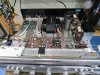
Inside a 2238:
2238 inside front_resize.JPG

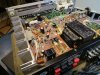
Inside a 2238B:
2238 B inside rear_resize.JPG


Some of the internal changes on the 2238B:
Power supply, protection circuit, main amplifiers, and speaker switches combined on one board
Sheet metal screws used instead of machine screws
Many pieces including the tuner pointer, lamp housings, RCA jacks, heat sink, and more

The 2226B, 2238B, 2252B, 2265B, 2285B, and the 2330B all have these changes from models designed earlier in the decade. These models were introduced in 1977 and all use similar construction. Models first released from 1972 to 1976, and some in 1977, have a lot of pieces in common each other that were changed with this 1977 series.

This 1977 series reflects redesigns that were less expensive to manufacture. I would still describe them as good quality builds. They are just not the over-the-top construction used prior to 1977. They still have big transformers, big filter caps, quality pots and switches, and quality soldering. The service manuals have block diagrams that would've been nice to have with the prior models. And note that not all the models listed in audio-classics as 1977 use the newer construction. It shows the 2330 and 2330B as both first available in 1977.

I've restored several 2252B units and have always been pleased with the sound after they were completed. More discerning listeners would need to chime in here on sonic differences between it and the 2252.
 
The same question has crossed my mind a few times.

I have the 2238b, bought it new back in the day. When I look at the various Marantz editions ( see link below) the main difference I can see from the photos between the "b" v "non b" models is the change from a balance slider control to a knob control. I believe that the slider type of controls were somewhat trouble prone.

I see a 2238BL on the list. Not sure what was different in the BL model.

Other changes that are not visible or apparent on the outside may include circuit or component changes that I am not aware of, perhaps someone knowledgeable can tell us.

http://www.classic-audio.com/marantz/mindex.html.
"BL" has shortwave. The 105 and 105B tuners are Am/FM. The 105BS tuner has shortwave also.
 
"BL" has shortwave. The 105 and 105B tuners are Am/FM. The 105BS tuner has shortwave also.

I never knew that Marantz (or any other receiver) offered a shortwave option in their radio receiver. I assume that it also had some type of SW antenna connection on the back?
 
I would assume so. Other companies had SW tuners as well. I dont think they were for the US market though.
 
All the non-B and B models I’ve seen, many of them, the B is completely different inside than the non-B. For the most part I prefer the non-B when the B is silver face.

I am not a fan of the 2230 but love the 2230B.

The 2330 and 2330B are very different and there I prefer the 2330.

There never was a 2275B.

l was not a fan of the 1060. Never saw a 1060B.
But. A recent recap on a 1060 shows promise. I’ve done them before and let them go. This last one seems better than I remember.

There is nothing much different in the sound of the B versions. They are still great units. The build quality is still there though somehow a tad lighter than the older ones. When the B is silver face.

And many of the smaller units have great sound. I lost track of the 2220 and 2220B. One is very good and the other is fantastic.

For the most part, the non-B were the sturdiest built units. They are solid.
 
I was fascinated by my Uncle's Marantz when visiting his home as a kid, in the 1970's. I recently joined the Marantz owners club, now that I am approacing 60. I went a bit crazy last year and bought four of them on Ebay. Three B models, 2215B, 2220B, 2230B, and a 2325.
I did a little research and the B models were not a compromise in any way. While the circuitry may be different, the build integrity appears robust and shows exceptional construction in every way.

I agree with you on the aesthetics, and also prefer the larger blackout indicator dial-soo cool!
 

Attachments

  • IMG_4298.jpg
    IMG_4298.jpg
    107.6 KB · Views: 47
  • Like
Reactions: Zol
Back with just a few more questions..

The Marantz house sound is often described as "lush" - and I would agree with that based on listening to a 2325. I could listen to one all day.

But some say there are subtle differences in the voicing between models. Of the medium to high powered units, I've read that the 2270 is considered the most warm, followed by the 2325. I couldn't find much consensus on how the 2265, 2275 and 2285 compare to the 2270/2325 (and it's my understanding that the 2275 and 2285 were more or less the predecessors of the 2270?).

Just hoping some Marantz-a-holics on here can offer a simple comparison, or if they more or less all sound close enough?
 
All the non-B and B models I’ve seen, many of them, the B is completely different inside than the non-B. For the most part I prefer the non-B when the B is silver face.

I am not a fan of the 2230 but love the 2230B.

The 2330 and 2330B are very different and there I prefer the 2330.

There never was a 2275B.

l was not a fan of the 1060. Never saw a 1060B.
But. A recent recap on a 1060 shows promise. I’ve done them before and let them go. This last one seems better than I remember.

There is nothing much different in the sound of the B versions. They are still great units. The build quality is still there though somehow a tad lighter than the older ones. When the B is silver face.

And many of the smaller units have great sound. I lost track of the 2220 and 2220B. One is very good and the other is fantastic.

For the most part, the non-B were the sturdiest built units. They are solid.

This. I know you know your stuff based on all of your posts regarding refurbs and repair of these units. Speaking of the smaller units, the 2230 is cap-coupled where the B is not. Same for the 2220. Since you like the 2230B it’s probably the 2220B you prefer which is very well-regarded. I prefer the cap-coupled units (own a 2220) and would agree on the build of the non-Bs - both types can sound great and depends on the listeners preference or visual appeal, i.e., my 2220 uses a balance knob which I prefer instead of the fader on the 2220B. Certain “versions” of the 2220B also use a relay that doesn’t have a modern replacement.

Kudos to anyone who can keep all this knowledge straight, and I always come to AK to double-check myself. All this to say you can’t really go wrong with either non-B or B. :)
 
I have both the 2252 and the later 2252b (all silver face) version and IMO the "b" has a slightly cleaner and more detailed sound without giving up the warm signature Marantz sound,
 
Last edited:
Back
Top Bottom