• The move to the new server is done. There are some software and database maintenance updates in process. This has us passing the hat around to help out. We appreciate any donations. Seriously, even a dollar helps. The payment page may be found here - https://www.audiokarma.org/support.html

Maxell Tape differences

lmfree

Active Member
I'm getting back into R to R decks after 30 years and need to buy tape but I forget the differences. Back in the early 80's I think I was using Maxell UDXLII in the gold boxes. I see Maxell for sale but there is the UD, UDXL, XL1, EE and then there is UDXL1 Black Coated. What does it all mean and does it make a difference in sound quality. If there are other different brands out there I would like to hear about them as well. Thanks
 
Register to hide this ad
UDXLII is a cassette formulation. Maxell's reel tape line up was a bit different. Here it is in a nutshell.

Bottom of the line: Standard
Next up: Low Noise (LN)
Then: Ultra Dynamic (UD & UDB. UDB was just UD with backcoating.)
Top: UDXL & XLI (UDXL was the forerunner of XLI. Pretty much the same thing, just hadn't been fully spliced off into it's own line yet.)

EE (XLII) tape was it's own thing. It is of no use to you if your deck doesn't say EE compatible on it. It will have an EE button on it, or say so in the manual.

Gold and gold & black Maxells are the oldest versions you will typically see for sale. There are older, but those are not often offered for sale. After that series came white & black (UD) and silver & black (XLI). Then grey to the left, black to the right (UD) and silver on left, black on right (XLI). And lastly blue striped on left, black on right (UD) and grey striped left, black on right (XLI).

Maxell last produced reel to reel tape in 2002.

Wanna know more, just ask. I've been researching the entire series for awhile now. Once done i'll post the complete line-up for all to see.

And yes, there are LOTS of different brands out there. TDK was well respected in it's time, as well as Scotch 206/207. If you want to buy NEW tape, the old BASF and AGFA tape formulations are still being made by RMGI. Quantegy is also still making tape.
 
Last edited:
Interesting, thanks for posting that, Numistrek09. :thmbsp: I have a few old Maxell & TDK tapes sorted from a giant pile, that look to be keepers, & one is really old, from Lot No. 02711.5. It has some Mozart & Berlioz on it, if the box is right, might be worth a listen. :music: Oh, it's a UD 35-90, in the gold & black box, & the gold cardboard is textured, kinda classy-looking. :smoke: Do you know much about the TDK tapes? I have a couple Audua ones, L-1800 & LB-1800 (LB is backed), & wondered how they stack up. :scratch2:
 
Thanks, that information was very helpful. I have a chance to buy a few reels of sealed XLI 35-180B but didn't know where it stood on the quality scale. My deck will take EE but it seems hard to find and $$$$$. Is the EE worth the money and search over the XLI?
 
EE is not worth the extra money, even if you have the switch, IMO. XLI is an excellent tape, and I'd take it over XLII.
 
Numistrek09 - would you recommend buying older Scotch / Ampex tapes from yard sales, etc..? I often find them for sale, but don't have any means to evaluate them on the spot so I usually just pass. What I record on RtR I generally want to be of the highest quality and to last the test of time, so old tape just seems too much of a risk. Your thoughts?

Like many folks, I've been buying off the "bay" for Maxell UD tapes when I can, mostly sealed and BarterTown of course. I've yet to try the new stuff out there by Quantegy, but I guess it's about time!

Thanks for your advice and comments.
 
Don't jump to try and sticky this yet, wait till i'm finished with my work! That said, anyone here with early examples of Maxell tape, do please post info and pics. I'm interested in the front/back of the box, info cards inside, reel type, any date info and leader color/patterns. Some of these early Maxell's will say Hitachi/Maxell on them.

On the topic of used yard sale tapes, ehhhh, not really. It depends on your expectations. Since you said you want the highest quality, i'd say pass. Old tape is exactly that. Unless the seller can give you a history of how it was stored and what machine he played it on, you could be getting anything. Being it is a yard sale tape, it has probably spent the last 20 years stored in the attic or garage. And while it may still sound good playing, it won't offer the highest recording reliability anymore. Dropouts could be numerous for instance. But if you are interested in some tape to just play around with, then sure, go for it. For Scotch tapes 203, 206, 207 and 250 are well regarded. I also believe 150 is seen as a good tape, but i can't remember right now. I have some 175 and it has given me no issues, but for others it has. 111 was also considered to be a good tape in it's time, but much of it was made on acetate and is fragile today. I'd pass on it.

The ONLY Ampex labeled tapes that one should consider buying is 631 and 641. All the rest is pretty much unusable today. Especially AVOID 406, 407, 456 & 457. See the sticky on Sticky Shed at the forum's top. It lists pretty much all of the known offending tapes from all makers. Now if you find some cheap tapes on metal reels, i'd say buy them just for the reels. Especially if 10.5". If not bent, scratched or otherwise damaged, they are great for loading new pancakes of tape onto, or resale.

All i can say about examining them is pretty limited to my own standards. I look for the obvious stuff like mold, breaks, twists and dust. I also look at the tape pack, is it nice and even, or all over the place? A few uneven areas can be expected if the pack has shifted. But that usually moves whole sections of tape, not individual layers. I also like to spool out about a foot or so of tape and have a look at the magnetic surface. If you can see lots of heavy lines, it's been played MANY times, or run on a rough transport. Faint lines can be ok. Also look for water stains on the box, or any other stains for that matter.

Spaceman,

The UD box with the textured gold surface is an older version of the series. Dates to around 1973-75. The oldest gold UDs don't say 35-90, but instead 35-7.

I have done some research on the TDK tape series, but they don't have as big a following, so info is limited. It doesn't help that TDK got out of the reel tape biz years before Maxell did. Audua was their top tape line in the mid to late 70s. Pretty good stuff and should stack up nicely to UD and UDXL. I'd keep it! Best as i've been able to find, the line up is as follows...

S and SD were the basic types in the early 70s. Then SD was replaced with Audua. It came in non-backcoated and backcoated. Then around 1981 The S and Audua series were dropped and replaced with LX and GX. So anyone here with TDK GX reels, you have the top of their line! TDK also made some EE tape and it was labeled as SA. (Just like their TY2 cassettes.)

Anyone with reels of TDK tape also feel free to post info on them.

 
Scotch & TDK R2R tape

For Scotch tapes 203, 206, 207 and 250 are well regarded. I also believe 150 is seen as a good tape, but i can't remember right now. I have some 175 and it has given me no issues, but for others it has. 111 was also considered to be a good tape in it's time, but much of it was made on acetate and is fragile today. I'd pass on it.
Anyone with reels of TDK tape also feel free to post info on them.

Scotch 203 was an excellent higher biased Dynarange tape which was recommended for Teac A-series decks (silicone lubricated 1.0m mil polyester backing, labeled as "professional.") Scotch 206, 207, 211, 212, 213, & 214 were (I believe) the successors to 203. Scotch 150 was very good general purpose tape (lower bias than 203), which did not have the extended frequency range of 203. Scotch 150 tape also had a poorer S/N ratio. But still a good tape.

I have an unopened TDK LX 35/90 R2R tape, labeled as "for professional use." Box says: "Low-Noise, High-Output, Low-Distortion; for use in hi-fidility master recording applications."
 
I've found that you can tell a lot about a tape just by looking at the color. The darker it is, the more potential it has. Also look for a back coating; manufacturers generally didn't back-coat their cheap crap tapes.

At a yard sale you can't tell what's on that Maxell reel, could be anything.

Maxell did use leader ID's back in the day, so that's one way to tell for sure (unless it's been spliced, but that will be obvious).
 
Maxell tape E35-7

I have 3 sealed boxes of Maxell Low Noise "E35-7" reel to reel tape. I think I got them at a yard sale last year. It does say For Professional Use on the front, as well as Hi-output, Wide dynamic range. How does this compare to the UD series? I am using an Akai dbx747 deck and wonder if I should use these in addition to the Maxell UD tapes that I have. Thanks for any info. Bob
 
TDK question

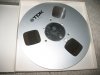
Any idea what this TDK reel has on it? There's nothing on the box to indicate what it might be, and the leader only says 150.

Whatever it is, the Pioneer likes it a lot.
 

Attachments

  • IMG_7944.JPG
    IMG_7944.JPG
    105.3 KB · Views: 77
  • IMG_7945.JPG
    IMG_7945.JPG
    81.2 KB · Views: 68
  • IMG_7946.JPG
    IMG_7946.JPG
    55.7 KB · Views: 74
What do the numbers mean (eg., 35-90, etc.)? I can see how the 90, 180 and so on might mean minutes at a certain speed but what about 35? Anyone got the low-down?
 
I have 3 sealed boxes of Maxell Low Noise "E35-7" reel to reel tape. I think I got them at a yard sale last year. It does say For Professional Use on the front, as well as Hi-output, Wide dynamic range. How does this compare to the UD series? I am using an Akai dbx747 deck and wonder if I should use these in addition to the Maxell UD tapes that I have. Thanks for any info. Bob
UD tape was a "High" bias tape back in the day. The Low Noise is a brown oxide tape, comparable to Scotch 211? Now that I'm looking, there was a grade below that, called Standard. If your deck has adjustable bias, it should accommodate it, otherwise, it might be overbiased. Hey, try one, and see.
 
maxell tape

Here is a more complete guide to the numbers for Maxell tapes.

18-180: 7" reel. 0.5 mil thickness, 3600'. 96 minutes playing time each way @ 7½ ips speed.

25-120: 7" reel. 0.75 mil thickness. 2400'. 66 minutes playing time each way @ 7½ ips speed.

50-60: 7" reel. 1.5 mil thickness. 1200'. 33 minutes playing time each way @ 7½ ips speed.

35-90: 7" reel. 1.0 mil thickness. 1800' 48 minutes playing time each way @ 7½ ips speed.

50-120: 10" reel. 1.5 mil thickness. 2400'. 66 minutes playing time each way @ 7½ ips speed.

35-180: 10" reel. 1.0 mil thickness. 3600'. 96 minutes playing time each way @ 7½ ips speed.

Credit for the above should be given to Des-Lab who posted this info on another forum.
 
Maxell tape

A little more info from same contributor:

REEL STYLES

Type 1: Three-hole flange cutouts with tape end slot. Large label attached to reel.

Type 2: Three hole flange cutouts without tape end slot. Maxell logo stamped on reel. No label unless user affixed.

Type 3: Two hole flange cutouts. Maxell "Double M" stamped on each side of reel symetrically opposed to the cutouts. No label unless user affixed.

Type 3A: Same as Type 3, but for XLII "EE" tapes only. Only one "Double M" emblem stamped on reel. Opposite side has "XLII EE" stamped in lieu of second "M".
 
Last edited:
I knew i should have checked in sooner, loads of questions waiting to be answered! Lets get started.

BEATDRUM:

Your Maxell Low Noise E35-7 tapes date to the early 70's. They were pretty good quality tapes and were between Standard and UD in the line-up. UD has a higher MOL level and higher output levels as well, plus slightly better frequency response. But overall the two are fairly close. (Least so their comparative literature says.) As suggested earlier you will need to adjust your recording bias to get similar performance. Putting your DBX on may help as well. I'd say go for it, but don't put your best material on them.

And yes, 35-whatever does mean it's 1 mil tape. The reel styles you listed only applies to the 10.5" reel series. The 5 and 7" types all used various types of plastic reels.

OLD BUSTED H:

Your Pioneer likes your TDK so much because it is a first generation Audua tape. Early to mid 70's.

NITROUS:

TDK LX was their answer to Maxell's UD line. TDK GX was their answer to Maxell XLI. TDK SA and Maxell XLII EE were also roughly equal.
 
So, nice to know the 35, 50, etc. numbers are consistent and refer to the thickness but is it still some arbirtary numbering scheme or does, for example, "35" equate somehow to 1 mil in metric?
 
Back
Top Bottom