• The move to the new server is done. There are some software and database maintenance updates in process. This has us passing the hat around to help out. We appreciate any donations. Seriously, even a dollar helps. The payment page may be found here - https://www.audiokarma.org/support.html

MC1502 opinions

jibup

New Member
Hi I'm in the process of renewing my whole system and am upto the last stage which is power amp or amps. Will be feeding with c22mkv and the speakers are MA pl500ii. It's proving to be the most difficult step as possibility of local auditions are limited. Have toyed with the dream of owning a mc1502 as a only live once way of thinking but have no means of trying before buying.
It's big money for me and wanted to make sure. My main question is does it produce enough current to drive the 8 woofers of the monitor audios. Currently vertically byamping 2 mc7200 and happy but they are old and needed something new to see out my days. I don't listen to loud stuff anymore just jazz, vocal and some classical.
 
Register to hide this ad
Not an easy Answer to your Q. If you are worried about driving your woofers, go with the largest Output transformers you can get. OPTs are the key to deep bass. Have not heard the 1502 but have heard most of the other MAC tube amps. Your speakers seem to be 91db efficient. You may want to see if you can locate the whole impedance curve of the speaker and see if there are any wild swings in impedance. Perhaps the manufacturer can help you find this info.
May also want to contact McIntosh and ask them about the ability of the 1502 to drive your speakers.

Probably not an answer you want to hear but if I was looking at spending that level of cash I would be looking at a used VAC Phi 300 or or a pair of Phi 200s or similar.
 
Even though it's on the low end of Monitor Audio's recommended amplifier power for the pl500ii speakers, the MC1502 should have no trouble driving them to satisfying levels. Attached is an Absolute Sound review of those speakers where a 36Wpc tube amp was used to power them.

 
The MC 7200 can be bridged to mono and becomes a 600 wpc monobloc.

Keep the 7200’s and biamp with a MC 1502 for the mid/highs.

If this is a path you might consider I will check the gains for you to see if they are the same.

Tom
 
With the OP's preamp, I'd consider using it with the solid state MC462 if I had any doubts about having enough power. It would erase all doubt and also save some cash.
 
The MC 7200 can be bridged to mono and becomes a 600 wpc monobloc.

Keep the 7200’s and biamp with a MC 1502 for the mid/highs.

If this is a path you might consider I will check the gains for you to see if they are the same.

Tom
Hi Tom.
I've tried bridging but it somehow degrades the sound but yes if I go for it will be keeping the 7200s
Joe
 
Not an easy Answer to your Q. If you are worried about driving your woofers, go with the largest Output transformers you can get. OPTs are the key to deep bass. Have not heard the 1502 but have heard most of the other MAC tube amps. Your speakers seem to be 91db efficient. You may want to see if you can locate the whole impedance curve of the speaker and see if there are any wild swings in impedance. Perhaps the manufacturer can help you find this info.
May also want to contact McIntosh and ask them about the ability of the 1502 to drive your speakers.

Probably not an answer you want to hear but if I was looking at spending that level of cash I would be looking at a used VAC Phi 300 or or a pair of Phi 200s or similar.
Hi John
Have not found a impedance curve though MA specs say nominal 4 and minimum 4.2 at 120hz
 
Hi John
Have not found a impedance curve though MA specs say nominal 4 and minimum 4.2 at 120hz
you are probably pretty safe then. some speakers have an impedance curve that drops into 2 or 3 ohms at the low frequencies. Much tougher speaker to drive.
 
Passive biamplification with a tube amplifier is not recommended. I would check with McIntosh before going this route.
 
I think it would be very nice, but likely the 7200s have more noise, especially after 30 years, and the process of biamping properly is not a simple one.

Caddy mentioned not passively biamping a tube amplifier, which is a concern of amplifiers with output transformers as the transformers can develop oscillations that are essentially un-terminated / un-damped, not sure it’s a concern with the level of NFB that McIntosh employs nor with their bifilar windings, but I agree with 62caddy that McIntosh should be consulted on that.

I’m not a big believer in tube amplification after about 1960, and feel like you could buy and be happier with an MC352, MC462 (or used MC452), but if it’s tubes you want that won’t get you there. The 352 would replace the old 7200s and the 1502 in your proposed system. JMO.
 
I think it would be very nice, but likely the 7200s have more noise, especially after 30 years, and the process of biamping properly is not a simple one.

Caddy mentioned not passively biamping a tube amplifier, which is a concern of amplifiers with output transformers as the transformers can develop oscillations that are essentially un-terminated / un-damped, not sure it’s a concern with the level of NFB that McIntosh employs nor with their bifilar windings, but I agree with 62caddy that McIntosh should be consulted on that.

I’m not a big believer in tube amplification after about 1960, and feel like you could buy and be happier with an MC352, MC462 (or used MC452), but if it’s tubes you want that won’t get you there. The 352 would replace the old 7200s and the 1502 in your proposed system. JMO.
So it's not as easy as preout 1 of the c22v to a 1502 for m/h and the preout 2 to whichever other amp for lows
 
So it's not as easy as preout 1 of the c22v to a 1502 for m/h and the preout 2 to whichever other amp for lows

Tube amps are designed to work into a specific impedance (load) and should not run unloaded; the bass frequencies aren't removed electronically in passive bi-amping, so the tube amp sees them as an open circuit, which can damage output transformers and tubes. To biamp properly, an outboard (active) crossover is used and the crossovers built into the loudspeakers are bypassed which means gutting the original wiring which will pretty much kill the value of them. In any case, the bass frequencies are removed from the amplifier inputs, therefore the open circuit problem and the potential for damage is eliminated.

Frankly, you'd be better off running the MC7200s in bridged mode (single wiring to speakers) which will provide an extra ~ 3 dB to headroom. With the passive biamp arrangement you have, roughly half of the amplifier power is largely unused since the mid/high drivers require a fraction of the energy required for the LF drivers.

Single wiring ensures the maximum amount of valuable power to be used when it's most needed, where it's most needed.
 
Last edited:
So it's not as easy as preout 1 of the c22v to a 1502 for m/h and the preout 2 to whichever other amp for lows
Yes, and no.

Provided it is sanctioned by McIntosh, which might run afoul of people not willing to “stick their (collective) necks out” to approve it, this I have found to have its advantages and improve SQ in systems I had before I had line-level crossover options (DSP etc.). However the amplifiers I used for this were Solid State / direct-output and had no oscillations etc. from the frequency range of the music not having a significant load to draw it down and prevent this oscillation.

Modern McIntosh, perhaps all McIntosh since the ‘60s, in my experience has a robust enough design that this is not a problem. However my experience/opinion is NOT an endorsement as I have not owned any modern McIntosh tube gear (a choice), nor have I studied the design/schematic of any modern McIntosh tube gear. There are a few people on this forum who post regarding tube circuits who I feel are qualified to make this determination as they spend a lot of time in tube gear theory and design, I do not.

So what’s all the fuss? I’ll put in my words what this is about:

When your amplifier, as it is currently used full range into a full range speaker system puts out all of that music, it is divided into two (or sometimes more) loads, a high-pass filter allows the HF to go to the HF driver(s) and doesn’t pass the LF music to these drivers, essentially looking like an open circuit for the LF frequencies. There is a low-pass filter that passes the LF music from the amplifier to the LF driver(s), so there’s somewhere for all of that LF energy to go.

All of the energy potential from the amplifier has a “path to ground”, a way to be dissipated from an amplifier attached to a full-range speaker. The impedance match that @62caddy mentioned above.

In a biamplified system this is not the case. In a “passive biamplified” arrangement, you are sending full-range music to each amplifier, and the portion of the music that is not driving the speaker, does not have a load and in theory, can create oscillation and other trouble in the amplifier’s output transformer.

In a simple transformer I can certainly see this to be true.

However, McIntosh’s bifilar winding and autoformer design is intended to prevent lots of bad stuff, on top of that there is a significant amount of NFB. Negative FeedBack is in simple terms the distortion in the output as compared to the audio input, inverted and fed back in to cancel the distortion. In theory, since this is wideband NFB, any oscillations or other bad stuff that are in the output of the transformer (and therefore are not part of the music) will be cancelled by this NFB scheme and therefore not a concern. In theory and according to me, based on knowledge of general McIntosh design principles, not specifically the MC1502.

Passive biamping is not preferred nor considered best practice, and McIntosh should be able to tell you if this amplifier can be used in this way. If you’re looking at buying from Audio Classics (a well-regarded McIntosh dealer here) they also should be able to give you an informed opinion on this.

Best of luck

Still, I’m not a tube fan, and since anything tubes can do, SS can do better (ex: The Bob Carver Challenge) so I’d still say skip the maintenance and go right to the MC352/MC452/MC402/MC462 and you will have enough to keep your speakers happy at all reasonable levels with excellent-accurate power, and even the lighting on these (except possibly the 402) is LED so maintenance is not necessary for the foreseeable future.

 
Tube amps are designed to work into a specific impedance (load) and should not run unloaded; the bass frequencies aren't removed electronically in passive bi-amping, so the tube amp sees them as an open circuit, which can damage output transformers and tubes. To biamp properly, an outboard (active) crossover is used and the crossovers built into the loudspeakers are bypassed which means gutting the original wiring which will pretty much kill the value of them. In any case, the bass frequencies are removed from the amplifier inputs, therefore the open circuit problem and the potential for damage is eliminated.

Frankly, you'd be better off running the MC7200s in bridged mode (single wiring to speakers) which will provide an extra ~ 3 dB to headroom. With the passive biamp arrangement you have, roughly half of the amplifier power is largely unused since the mid/high drivers require a fraction of the energy required for the LF drivers.

Single wiring ensures the maximum amount of valuable power to be used when it's most needed, where it's most needed.
Thanks caddy. I'm going to give the single wired bridged method another go for now although the 7200s are 35 year old units so thinking cap still on
 

Attachments

  • IMG_20251013_082213_112114.jpg
    IMG_20251013_082213_112114.jpg
    88.2 KB · Views: 9
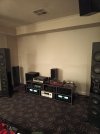
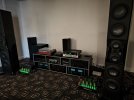
Thanks guys. Dealer talked me into 2 for the price of 1. Said they'd be more power on tap too. Never had sound like this before at home. Couldn't be happier.
Ha! I was just about to post suggesting that! (I have 2 MC275s bridged myself). Bonus: easier to move two 70 lb units rather than one 140 lb unit (I also have a 140 lb MC2500 ). And if you ever want to downsize, you can sell one MC275... Not to mention that the classic look of the MC275 is iconic.
 
Do you think he was right about there being more power available. Now volume levels on the c22 seem to be set same as with the 7200s
 
Back
Top Bottom