• The move to the new server is done. There are some software and database maintenance updates in process. This has us passing the hat around to help out. We appreciate any donations. Seriously, even a dollar helps. The payment page may be found here - https://www.audiokarma.org/support.html

MC225 Bumble Bee Replacements - How to choose?

Wow, lots of good advice!

I'm still on the fence with the input caps (C1 & C2) and the four bumble bee coupling caps (C8, C9, C18, C19). Any additional input with regards to the input & coupling caps? My desire is to keep the stock sound, but am not opposed to making it a tad brighter since my ears are not as young as they used to be (too many years of running live sound for a large party band with horns :music:.

Here's the plan so far:

MC225 Markup.jpg
 
I finished a fairly extensive refresh on my MC225 a couple of years ago.

I did the ever popular power supply rebuild/upgrade using the Authenticaps, and replaced the selenium rectifier with an IN4007.
I used Atom electrolytics in the bias supply.
I kept the original RCA Diodes i the high voltage section, since they rarely seem to be a problem.

I kept the original Brown "dog bone" caps, and replaced all the "Bumble Bees", using Ruskie K42's in place of the .047uf coupling caps.
The K42 caps were the 1600 Volt version, which at the time, were quite a bit less expensive than the lower voltage versions.
I used 716 Orange Drops in place of the other Bumble Bees.

I replaced all of the signal path 1/2 Watt resistors with Takman carbon films except for a few, where the circuit voltage might have been greater than 350V.
I used original type carbon comp's at those locations.
I changed out the 1 and 2 watt power dropping resistors with metal film or metal oxide resistors.
I noticed that just about all of 1 and 2 watt resistors showed signs of heat distress or had drifted from their original values.

I'm running strong testing tubes, same brands as the originals.

I acquired the amp around 1990 and, as they say, it had been ridden hard and put up wet.
I did a few stop gap repairs to keep the amp running until about 10 years before I did the refresh, when I retired it until I got around to planning, collecting parts,. and spending the time going thru it, doing what I felt was a complete job.

I'm really happy with way it sounds, but I really can't say if it sounds different than it did originally, as there was a time lapse since I used it last, it wasn't in that great a shape to begin with, and I'm significantly older that I was in 1990.
 
it's a plan! shipping charges may also help to whittle down choices- if you care. can't go wrong with nichicon and orange drops/ sprague. haven't tried the pio's; k40y-9's. i'd go with whatever other AKers here have done, though...should be plenty of threads on similar Mc tube amps.

I finished a fairly extensive refresh on my MC225 a couple of years ago.

I did the ever popular power supply rebuild/upgrade using the Authenticaps, and replaced the selenium rectifier with an IN4007.
I used Atom electrolytics in the bias supply.
I kept the original RCA Diodes i the high voltage section, since they rarely seem to be a problem.

I kept the original Brown "dog bone" caps, and replaced all the "Bumble Bees", using Ruskie K42's in place of the .047uf coupling caps.
The K42 caps were the 1600 Volt version, which at the time, were quite a bit less expensive than the lower voltage versions.
I used 716 Orange Drops in place of the other Bumble Bees.

I replaced all of the signal path 1/2 Watt resistors with Takman carbon films except for a few, where the circuit voltage might have been greater than 350V.
I used original type carbon comp's at those locations.
I changed out the 1 and 2 watt power dropping resistors with metal film or metal oxide resistors.
I noticed that just about all of 1 and 2 watt resistors showed signs of heat distress or had drifted from their original values.

I'm running strong testing tubes, same brands as the originals.

I acquired the amp around 1990 and, as they say, it had been ridden hard and put up wet.
I did a few stop gap repairs to keep the amp running until about 10 years before I did the refresh, when I retired it until I got around to planning, collecting parts,. and spending the time going thru it, doing what I felt was a complete job.

I'm really happy with way it sounds, but I really can't say if it sounds different than it did originally, as there was a time lapse since I used it last, it wasn't in that great a shape to begin with, and I'm significantly older that I was in 1990.

excellent...been waiting for this. great write-up/recollection/execution. :rockon:
 
Seems like a lot of folks are happy with them, so I'm going to give the K40's a try for the coupling caps and the two input caps. :thumbsup:
 
The input caps to my understanding are there to block dc from the preamp. I have totally rebuilt my preamp so i left the bumble bee input caps in place in my 225. It sounds great.
 
The 6ps orange drop caps are very similar construction and sound to Bumblebee caps you have in there. They are polyester film and foil. Yes, there are better caps like the 716 series polypropylene etc. they will brighten up the sound and be more detailed. The Brown caps appear to be Polyester film and foil and could very well be fine , just test them.
If you want to high grade the amps sound , then you will find many opinions on what is the “Best” cap to use, like “Jupitor” “teflon”, “oil” etc

personally , My taste would be along the lines of “Vitamin Q” type caps and Polystyrene. But, they don’t sound like what you have now.
F&T are some of the current best Electrolytic caps for vintage tube amps. Spragues are excellent as well. There are others of course.
I am only addressing the rebuild of vintage tube amps.


Agree with @billyz , if you put too many polypropylene caps in you can wreck the sound of MAC gear. Will get lean sounding and lose much of the midrange warmth. Have done that twice only to find the natural sound returned once the polyprop caps were removed.
 
Wow, lots of good advice!

I'm still on the fence with the input caps (C1 & C2) and the four bumble bee coupling caps (C8, C9, C18, C19). Any additional input with regards to the input & coupling caps? My desire is to keep the stock sound, but am not opposed to making it a tad brighter since my ears are not as young as they used to be (too many years of running live sound for a large party band with horns :music:.

Here's the plan so far:

View attachment 2644457


C1 and C2 are DC blocking caps for the input. there is very little voltage there, so even if the bumble bees are leaky, probably not much at half a volt. I would leave them in place. Or if you are pretty sure your preamp does not put out any DC, an experiment you can try it bypass C1 and C2 with a soldered in jumper wire, effectively taking that cap out of the circuit.
 
Agree with @billyz , if you put too many polypropylene caps in you can wreck the sound of MAC gear. Will get lean sounding and lose much of the midrange warmth. Have done that twice only to find the natural sound returned once the polyprop caps were removed.

I ended up ordering K40’s to replace the coupling capacitors and the two input capacitors. From what I’ve read, the K40’s will sound much like the original bumblebees. Is that correct?
 
C1 and C2 are DC blocking caps for the input. there is very little voltage there, so even if the bumble bees are leaky, probably not much at half a volt. I would leave them in place. Or if you are pretty sure your preamp does not put out any DC, an experiment you can try it bypass C1 and C2 with a soldered in jumper wire, effectively taking that cap out of the circuit.

Good to know. I was wondering about that.

With regards to preamps, I found a really nice MX-110Z that will be here in a week or so. It had a complete going over 3 years ago, and has had few hours put on it since. I’m really excited and can’t wait to hear it. :music:
 
I don't think the founders intent was to produce a line of euphonic sound filter amps, instead laboratory reference grade standards in their power classes by unique design engineering with good grade contemporary passive parts.
 
C1 and C2 are DC blocking caps for the input. there is very little voltage there, so even if the bumble bees are leaky, probably not much at half a volt. I would leave them in place. Or if you are pretty sure your preamp does not put out any DC, an experiment you can try it bypass C1 and C2 with a soldered in jumper wire, effectively taking that cap out of the circuit.

I have found this to be true of many vintage and even modern amplifiers. My guess is they are covering all the potential input sources that they could imagine. Many ( Most ) preamps have output caps to block DC from the outputs. So it is redundant to have them on both pieces of gear. I have also found it makes a huge improvement in the audio quality to eliminate or Bypass them. But you should measure for DC voltage on the source component output. If there is none then go ahead and bypass the input Caps. No Cap is the Best sounding .

By the way, I bypassed the output coupling caps on my Marantz CD player and it was the single largest audio improvement that I made to it and I made many upgrades and mods to it.
 
I haven't pulled down a schematic for the MX-110Z yet, but I'll have a look and see if there are any caps at the outputs.
 
There must be, the topology demands it.

I'll take your word for it. I'll double check the outputs for DC and maybe try bypassing the input caps on the MC225 if all is good.

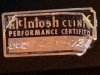
By the way, I was doing a little reading on McIntosh's Dave O'Brien and it looks like he worked on my amp at some point (!). How cool is that?
MC225 Clinic Sticker DOB.jpg
 
Iirc, the '110 used ceramic disc couplers in the audio preamp that seldom fail or go leaky. Panasonic metalized Polyprops would be an upgrade.
 
The mx110z uses a 1uf electrolytic on each channel after the last tube. It is worth replacing those. They are on the bulk head behind the tone circuits, and space is limited. I could barely shoehorn in some Jansen superior caps. I believe Terry D used Nichicon film caps (qxp?).
 
Thank you for that info! I’ll check those caps after the MX110 arrives.

The plan is to work on the MC225 this weekend. Hopefully, all of the parts will arrive by the weekend so I can complete the rebuild. :D
 
The mx110z uses a 1uf electrolytic on each channel after the last tube. It is worth replacing those. They are on the bulk head behind the tone circuits, and space is limited. I could barely shoehorn in some Jansen superior caps. I believe Terry D used Nichicon film caps (qxp?).
Yes, very tight quarters there. I used some white colored 1uf @ 200volt polyprop Spragues in there myself. There are a couple resistors in the way so it was pretty tedious replacing the electrolytics so be careful.
 
Back
Top Bottom