Hi, My MC2255 stops during the power on start up due to a long beep with sequence “5” (- Reg Low) in the display. It started to be an intermittent issue yesterday but it consistently encounter the issue today and I can’t proceed to listen to music due to an issue on this unique self test feature on this amp. I can’t find any reference in the manual what does “-Reg Low” or sequence 5 is? Appreciate if anyone here in this forum can provide guidance what’s the issue. Thanks.


You are using an out of date browser. It may not display this or other websites correctly.
You should upgrade or use an alternative browser.
You should upgrade or use an alternative browser.
MC2255 Power Guard start up stop at sequence 5 with a long beep.
- Thread starter jervz
- Start date
Register to hide this ad

MACKIE1975
Super Member
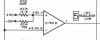
Thanks, I’ll be bringing this to a local tech but can you advise what does this (5) -15v regulator low means and whether this has something related or connected to the main caps not within specs?
The amp has been recap recently except for the main cap. I think the main caps right now are 28,000+ and 29,000+ uf right now.
MACKIE1975
Super Member
Check Q703

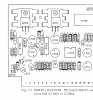

If someone "recapped" it, they could have put C705 or C710 (or both) in backwards, which could have then shorted thereby pulling down the -15V supply. You can check to see if it's blown its top, and that the positive terminal is oriented correctly.

captouch
Addicted Member
If someone "recapped" it, they could have put C705 or C710 (or both) in backwards, which could have then shorted thereby pulling down the -15V supply. You can check to see if it's blown its top, and that the positive terminal is oriented correctly.
I just recapped a friend’s 2255 so some of this is fresh in my mind.
These are good points above and what I want to point out is there are up to 3 different versions of boards depending on your serial #. So be sure to note your serial number if relying on the schematics.
The board pic shown by MACKIE1975 showing the polarities of C703, C705, C709, and C710 are for serial #’s up to CT2552. For serial #’s CT2553 and after, the polarities of C703 and C709 switch so they have positive pointing in the same direction as C705 and C710.
There may also be discrepancies between what’s actually implemented on the board and what’s in the schematic. For example, C513 is listed as 47uF/16V, but it should actually be a higher voltage cap - I used 47uF/80V, but it may have been a 63V in there originally. There may be other cases similar, but that was one I specifically remember and corrected the schematic.
So just be sure not to blindly trust the schematic and board diagrams with regards to cap value/voltage and polarity. The documentation is usually 95%+ correct, but the few discrepancies there might be can really cause problems.
MACKIE1975
Super Member
Most of the schematic errors are polarity and value.
If the board is OEM then stick with the layout.
If the board is OEM then stick with the layout.
If there was a mistake on the recap or polarity, shouldn't the issue will manifest immediately rather than days a week later? The amps was working probably for a week or two before it fully unusable before the power guard seq 5 issue.I just recapped a friend’s 2255 so some of this is fresh in my mind.
These are good points above and what I want to point out is there are up to 3 different versions of boards depending on your serial #. So be sure to note your serial number if relying on the schematics.
The board pic shown by MACKIE1975 showing the polarities of C703, C705, C709, and C710 are for serial #’s up to CT2552. For serial #’s CT2553 and after, the polarities of C703 and C709 switch so they have positive pointing in the same direction as C705 and C710.
There may also be discrepancies between what’s actually implemented on the board and what’s in the schematic. For example, C513 is listed as 47uF/16V, but it should actually be a higher voltage cap - I used 47uF/80V, but it may have been a 63V in there originally. There may be other cases similar, but that was one I specifically remember and corrected the schematic.
So just be sure not to blindly trust the schematic and board diagrams with regards to cap value/voltage and polarity. The documentation is usually 95%+ correct, but the few discrepancies there might be can really cause problems.
captouch
Addicted Member
If there was a mistake on the recap or polarity, shouldn't the issue will manifest immediately rather than days a week later? The amps was working probably for a week or two before it fully unusable before the power guard seq 5 issue.
I would say it really depends on which cap was reversed and the role it plays in the circuit. A reversed cap in a power supply with high voltages usually pop/explode right away. So that would be an extreme example that fails right away.
But I can speak from personal experience when I bought a just-recapped Mac preamp. For the seller, it operated fine, but I don’t think it was really used after recap, just briefly checked. After I first received it, it played fine at first too.
But within the first couple/few days, it started slowly muting itself after being on for a bit. Took a lot of troubleshooting, but finally traced it to a reversed cap in the muting circuit.
I replaced the cap with a new one in the correct polarity/orientation and never had the problem again.
In the case of your power on self-check circuit, it’s verifying that voltages in certain parts of the circuit are in the expected/proper range. If a cap is in the wrong way, it could be “fighting” what the circuit is trying to do, dragging a voltage up/down from where it’s supposed to be. Whether the wrong polarity cap slowly degrades from being reverse-biased and eventually has different characteristics or fails and no longer has the same effect as it did when first implemented- that seems possible to me.
So yes, I think it’s possible you’re still dealing with a reversed polarity cap somewhere in the circuit. Not to say it’s 100% the case, but it’s worth checking to avoid chasing your tail over a possible issue that can easily be solved.
Due to warranty, I'm unable to open and check the internal components for a year. The local technician fixed it and I asked what was the issue and he said it was just a loose PC board that he needs to re-plug in.I would say it really depends on which cap was reversed and the role it plays in the circuit. A reversed cap in a power supply with high voltages usually pop/explode right away. So that would be an extreme example that fails right away.
But I can speak from personal experience when I bought a just-recapped Mac preamp. For the seller, it operated fine, but I don’t think it was really used after recap, just briefly checked. After I first received it, it played fine at first too.
But within the first couple/few days, it started slowly muting itself after being on for a bit. Took a lot of troubleshooting, but finally traced it to a reversed cap in the muting circuit.
I replaced the cap with a new one in the correct polarity/orientation and never had the problem again.
In the case of your power on self-check circuit, it’s verifying that voltages in certain parts of the circuit are in the expected/proper range. If a cap is in the wrong way, it could be “fighting” what the circuit is trying to do, dragging a voltage up/down from where it’s supposed to be. Whether the wrong polarity cap slowly degrades from being reverse-biased and eventually has different characteristics or fails and no longer has the same effect as it did when first implemented- that seems possible to me.
So yes, I think it’s possible you’re still dealing with a reversed polarity cap somewhere in the circuit. Not to say it’s 100% the case, but it’s worth checking to avoid chasing your tail over a possible issue that can easily be solved.
@captouch, I don't have a service manual for the MC2255 and would like to know the original specs (voltage, dimensions) of the two big main filter capacitors at the back of the amp.
I wanted to change those capacitors since capacitance is no longer at specs and purchase the proper capacitor in online (mouser). I thinking of using Mallory (Ryan of AC suggested this) or Kemet brand.
I wanted to change those capacitors since capacitance is no longer at specs and purchase the proper capacitor in online (mouser). I thinking of using Mallory (Ryan of AC suggested this) or Kemet brand.
captouch
Addicted Member
Due to warranty, I'm unable to open and check the internal components for a year. The local technician fixed it and I asked what was the issue and he said it was just a loose PC board that he needs to re-plug in.
But it’s not working now, so what does the warranty cover? You have to let it sit not working for a year?
captouch
Addicted Member
@captouch, I don't have a service manual for the MC2255 and would like to know the original specs (voltage, dimensions) of the two big main filter capacitors at the back of the amp.
I wanted to change those capacitors since capacitance is no longer at specs and purchase the proper capacitor in online (mouser). I thinking of using Mallory (Ryan of AC suggested this) or Kemet brand.
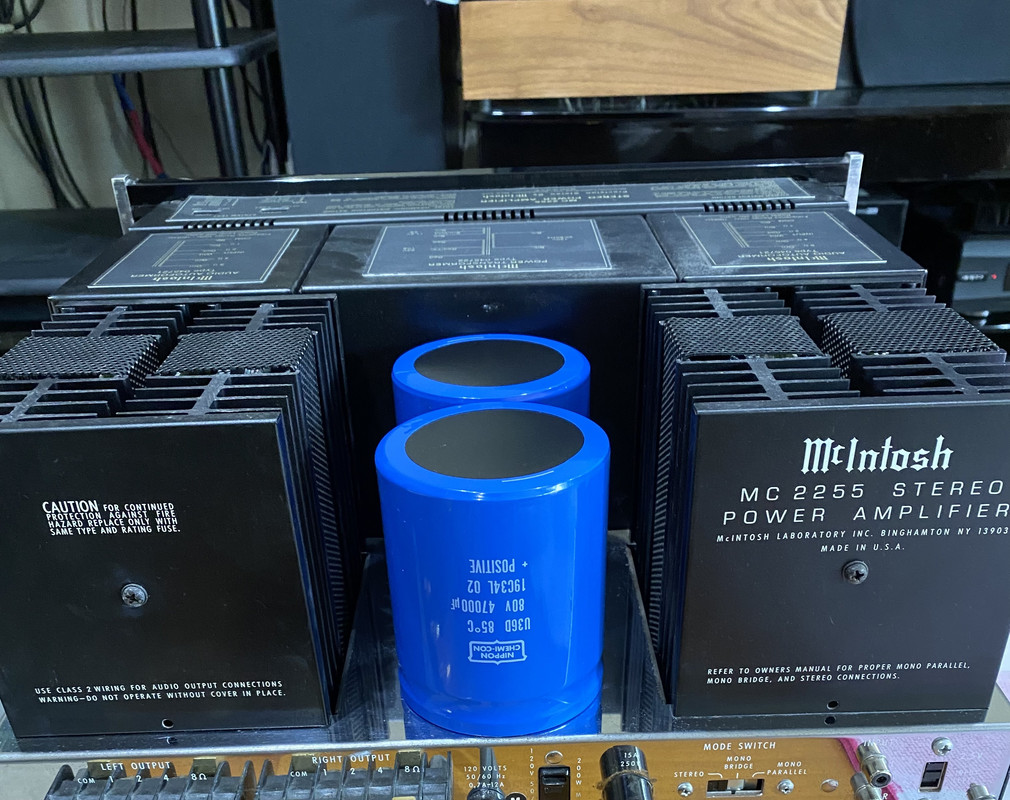
I sent you the Mouser part # in email on 5/15. The part# is E36D800HPN473ME92U
Diameter is 3”, height is 3.625” (which is shorter than original, which is about 4”), 38,000uF value. Besides the height, which is just cosmetic, it’s an exact replacement/fit.
Looks like this after replacement:
He fixed it now and I'm considering also replacing the two main filter cap.But it’s not working now, so what does the warranty cover? You have to let it sit not working for a year?
Thanks, is the original voltage of the capacitor 80v or lower?I sent you the Mouser part # in email on 5/15. The part# is E36D800HPN473ME92U
Diameter is 3”, height is 3.625” (which is shorter than original, which is about 4”), 38,000uF value. Besides the height, which is just cosmetic, it’s an exact replacement/fit.
Looks like this after replacement:
captouch
Addicted Member
He fixed it now and I'm considering also replacing the two main filter cap.
Oh, got it. Great, glad to hear it was resolved. The power on self-test board is indeed a PC-type interface board that I can see might not be seated properly. Maybe that was it.
captouch
Addicted Member
Thanks, is the original voltage of the capacitor 80v or lower?
The original spec is 60V. So 80V exceeds original spec, but that's not a problem. If you were to put in a 47,000uF/60V cap (if you could find one), it would likely be smaller diameter or shorter, which would look worse. So I'd just go with the one recommended if possible.