I recently sent my beloved McIntosh MC2105 and C30 for a long overdue overhaul at a “authorized McIntosh service depot”. When the gear came back 7 months later the first thing I noticed was the tape loop button on the C30 no longer worked. I was told by the servicer that those buttons are no longer manufactured so it can’t be fixed. they also did something to the CD input so that’s broken now too. Strike 1! After a short period of time I started to notice that the MC2105 would spike on the right meter and a loud popping noise was audible through the speaker. This problem persisted a second time so I contacted the servicer. First he said I am maybe not switching my gear on in the proper sequence and that’s causing the issue. He also wanted me to show him a picture of the interconnects between the preamp and power amp. Both these things were non-issues. He said it sounded like an issue with the power in my house. I have 220 amp service at my house and the panel was upgraded about 5 years ago. I contacted our power company and they checked from the pole to the house. Everything is fine. I called my electrician and he went through the panel to make sure our HVAC system wasn’t bleeding over into the panel. It was fine. He asked me to switch on the amp while he was checking at the panel. Sure enough it spiked and I heard him go “WOW”! He said he measured 11.5 amps at the panel when the amp spiked. Clearly it’s an issue with gear he said. I contacted the servicer and after much arguing and sending them a video of my amp doing the same thing in a different building with nothing hooked up, they finally took the amp back to repair it. Strike 2! They said the board looked like it was lose and they would repair it and send it back. 4 months later I finally get my amp back. we are now over a year. It worked great until about two days ago when. You guessed it! The right channel is spiking and popping again. I changed interconnects, speaker wire and even speakers but the issue persists. Strike 3! I have no idea what to do now. I spend thousands having this equipment rebuilt by a supposed “”McIntosh servicer”. Does anyone have any suggestions or thoughts on what might be causing this? I am definitely not sending this back a third time. I plan on contacting McIntosh to see what they think. I am not sure how they are with legacy products. Any help or suggestions would be greatly appreciated!


You are using an out of date browser. It may not display this or other websites correctly.
You should upgrade or use an alternative browser.
You should upgrade or use an alternative browser.
McIntosh MC2105 and C30 power issues
- Thread starter dylanfan
- Start date
Register to hide this ad
To my best knowledge a authorized service agency is any agency that can establish a account.
Back in the day all dealers were expected to be service agents as it was a part of the dealer agreement. Could not be a dealer without a in house device department.
They had skin in the game.....independents......not so much.
The push button switches are available from Mouser or digikey, you just have to take them out of the gang and swap new for old.
On the back of the amp what position is the input switch? It should be in normal which puts a DC blocking cap in circuit to keep DC out of the amp.
The question now is the spike being caused by something up stream from the amp or within the amp itself.
You do not want to use your speakers as the test vehicle. You do not say where you are but a treck to a different repair shop, one with skin in the game, whether Mac authorised or not, is in order.
Back in the day all dealers were expected to be service agents as it was a part of the dealer agreement. Could not be a dealer without a in house device department.
They had skin in the game.....independents......not so much.
The push button switches are available from Mouser or digikey, you just have to take them out of the gang and swap new for old.
On the back of the amp what position is the input switch? It should be in normal which puts a DC blocking cap in circuit to keep DC out of the amp.
The question now is the spike being caused by something up stream from the amp or within the amp itself.
You do not want to use your speakers as the test vehicle. You do not say where you are but a treck to a different repair shop, one with skin in the game, whether Mac authorised or not, is in order.
Last edited:

What c_dk said.
It sounds like the amp needs proper repairs and hasn't received them. You would be wise to not use it until it is taken to a proper Technician, and as c_dk said (I agree) it is more important to find someone familiar with servicing the vintage 2105 (and similar) than necessarily a currently authorized service center.
It sounds like the amp needs proper repairs and hasn't received them. You would be wise to not use it until it is taken to a proper Technician, and as c_dk said (I agree) it is more important to find someone familiar with servicing the vintage 2105 (and similar) than necessarily a currently authorized service center.
Thank you so much for the great advice. I am in Atlantic Canada and the nearest McIntosh dealer is in Quebec. I contacted a local high end stereo shop and they do have an in-house technician. I made an appointment to have the gear dropped off. I checked online and there service department has great reviews. The switch on the back of the MC2105 and it was set to direct. I flicked it to normal unplugged the speakers and powered it up. Same thing right channel pins then drops down. It did it intermittently. Is it possible the issue is with the C30 maybe it somehow sending the amp DC voltage? I also contacted my electrician to get a quote on running a home run from the wall inlet back to the panel. It may be best to keep my audio on an isolated circuit.

Sorry to hear the problems you're having. I'd suggest sending the equipment to Audio Classics. The quality of their service work is second to none.
FYI - the C30 has a delay circuit designed to prevent output "thumps" when powered on/off. There should be no need to use a special sequence when powering on the preamp/power amplifier with a correctly functioning C30.
Also, the switched A/C outlets of the C30 are triggered by an internal relay rather than through the C30's power switch as had been done in earlier preamplifiers. The maximum power consumption of the C30's outlets are also rated for ~ 1,800 watts IIRC which is far higher than the maximum power consumption (~ 400W) of the MC2105 and have plenty left over any other source equipment.
I would have no compunction about using one of the C30's switched outlets to power the MC2105.
FYI - the C30 has a delay circuit designed to prevent output "thumps" when powered on/off. There should be no need to use a special sequence when powering on the preamp/power amplifier with a correctly functioning C30.
Also, the switched A/C outlets of the C30 are triggered by an internal relay rather than through the C30's power switch as had been done in earlier preamplifiers. The maximum power consumption of the C30's outlets are also rated for ~ 1,800 watts IIRC which is far higher than the maximum power consumption (~ 400W) of the MC2105 and have plenty left over any other source equipment.
I would have no compunction about using one of the C30's switched outlets to power the MC2105.
If one meter is pegging, it is likely a problem with that channel's audio section. The driver boards are notorious and there is a Factory Service Bulletin (FSB) that should be done when any service is carried out on this amp, as well as changing the multi-cap under the deck. Also the 2105 has gotten to an age where there are output transistor failures and driver board failures, it should be completely serviced by a qualified McIntosh experienced Technician.
62Caddy is correct that Audio Classics is an excellent source of service for these, but of course they're pretty far from you, ... worth it if you can.
If you're pegging a power meter, you're hitting it with a pretty big hammer and you might be one hit away from letting the smoke out, at which point there is a lot more to repair/replace. I do not recommend powering it up again until it is properly serviced. If you had a current limiting (aka: DBT) device you could try swapping left & right driver boards to see if the problem changes channels with it. Same with your input device / preamp, ... if you switch left and right and the pegging meter is still on the same channel, ... it's in the amp not the input device.
Last, these were built in a day when the power supply wasn't that clean, ... there is no reason to pull a separate circuit unless you feel that you can hear the difference. It has its own filtered power supply that can take reasonable variations in power and I can think of no power anomoly that would cause this symptom. If the symptom affects one channel it is unlikely to be power related.
62Caddy is correct that Audio Classics is an excellent source of service for these, but of course they're pretty far from you, ... worth it if you can.
If you're pegging a power meter, you're hitting it with a pretty big hammer and you might be one hit away from letting the smoke out, at which point there is a lot more to repair/replace. I do not recommend powering it up again until it is properly serviced. If you had a current limiting (aka: DBT) device you could try swapping left & right driver boards to see if the problem changes channels with it. Same with your input device / preamp, ... if you switch left and right and the pegging meter is still on the same channel, ... it's in the amp not the input device.
Last, these were built in a day when the power supply wasn't that clean, ... there is no reason to pull a separate circuit unless you feel that you can hear the difference. It has its own filtered power supply that can take reasonable variations in power and I can think of no power anomoly that would cause this symptom. If the symptom affects one channel it is unlikely to be power related.
I dropped off at a local high end hi-fi shop with a good reputation for service. I am still awaiting their diagnosis. Thanks for the good advice on this. I also started digging into this on my own because I can't let things go. Is it possible to have a faulty output autoformer? Could the autoformer cause the erratic issues described in my original post? I looked at the block diagram and it appears there are two of these. If the one on the right side failed would it cause the meter to spike and a crackle pop in the right speaker?
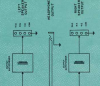
Let's hope it is not the very unlikely issue with a autoformer. They are not repairable.
A proper bench test will revel if there is a output issue and if not a proper diagnosis will check for issues in the stages before the output.
The meters are driven by a amp circuit dedicated to them....it is possible for a meter issue to be caused by these circuits.
Be patient give your local tech the time to diagnosis and then post the findings.
A proper bench test will revel if there is a output issue and if not a proper diagnosis will check for issues in the stages before the output.
The meters are driven by a amp circuit dedicated to them....it is possible for a meter issue to be caused by these circuits.
Be patient give your local tech the time to diagnosis and then post the findings.
The Tech has been working on this now for the last three weeks but can't find an issue. Here is some correspondence.
The amp is still test running and still no right channel problem.
All electrolytic capacitors have been replaced in the amplifier,
the 2 large filter capacitors in the middle must have been very
expensive. I've tried moving the contacts of the boards and tapped
them to vibrate everything and nothing happened.
It really looks like a small or mid-power transistor is the most
likely cause but sometimes a resistor will go intermittent or noisy
as well. Unfortunately there isn't really a way to know where the
problem is unless the problem can occur and give me a hint of
where to look. There are about a dozen transistors involved that
could be the problem,
This was followed most recently with this.
I took the power amp apart and extensively checked the right amp module and the preamplifier board.
I wasn't able to find anything wrong. I have run it extensively since then.
I still have it apart in case something happens, but I checked all transistors and new capacitors
for heat and cold sensitivity and tried turning the unit off and on many times.
I could look into replacing all the small signal transistors and maybe the driver transistors, would likely be $200-
$300 but it would be going on an educated guess but it would be only a guess at this point.
That's the update for now, I wish the power amp problem would have occurred by now, but I'll keep running it,
it might take awhile to occur.
I'm not sure the best option here. It seems the amp is showing no issues. I have a video of the amp acting up but can't attach it. Any advice would be greatly appreciated!
The amp is still test running and still no right channel problem.
All electrolytic capacitors have been replaced in the amplifier,
the 2 large filter capacitors in the middle must have been very
expensive. I've tried moving the contacts of the boards and tapped
them to vibrate everything and nothing happened.
It really looks like a small or mid-power transistor is the most
likely cause but sometimes a resistor will go intermittent or noisy
as well. Unfortunately there isn't really a way to know where the
problem is unless the problem can occur and give me a hint of
where to look. There are about a dozen transistors involved that
could be the problem,
This was followed most recently with this.
I took the power amp apart and extensively checked the right amp module and the preamplifier board.
I wasn't able to find anything wrong. I have run it extensively since then.
I still have it apart in case something happens, but I checked all transistors and new capacitors
for heat and cold sensitivity and tried turning the unit off and on many times.
I could look into replacing all the small signal transistors and maybe the driver transistors, would likely be $200-
$300 but it would be going on an educated guess but it would be only a guess at this point.
That's the update for now, I wish the power amp problem would have occurred by now, but I'll keep running it,
it might take awhile to occur.
I'm not sure the best option here. It seems the amp is showing no issues. I have a video of the amp acting up but can't attach it. Any advice would be greatly appreciated!
It might, but I wouldn’t count on it.
If you swap the left and right driver board and the problem channel changes then I’d say yes.
If you swap the left and right driver board and the problem channel changes then I’d say yes.
After 5 weeks the tech still can’t find any issues. He said the right meter pinned one time on start up for a couple of seconds. He’s been through it several times and can’t get the issue to come out. I asked if he can swap the driver boards. I guess that way we can see if the problem moves to the left. Any other suggestions of things he can check while it’s on his bench would be greatly appreciated!
It is very difficult to fix a intermittant, especially when as a good tech your presence will scare the demons out of the offending unit!
I have talked to a number of good techs over the years and they have reported that they do not need a special chant or even a magic wand, just turning on their soldering iron or setting down their coffee mug nearby will scare the gremlins away.
That aside their were a few things DOB would have us do when ever one of these amps came in for a amp clinic as well as a few new things we have learned over the last 20 years.
Spritz cleaner into all the controls and switches.
Pull the driver cards and with a eraser burnish the driver board contacts before spritzing the socket with Cramilon(D5 today) and insert and reinsert a few times.
Loosen a turn and then resnug up the main filter cap screws.
When we had the driver boards out we would examine for any possible cold solder joints and reflow any suspect ones.
The amp would then go back on the bench for a official test.
Seldom would DOB authorise a driver board rebuild unless it was for a MC2300 (which was mandantory) unless I could talk him into it........
These amps were pretty bulletproof and still are but a few new things have been showing up.
The bias resistors have been drifting up in value, leading to some notch distortion and some stability issues. I have seen a 2 or 3 ohm drift cause a noticeable notch forming on my scope as well as raising the distortion.
Differential pair as the route into the cicuit for negative feedback often work extra hard as they add feedback to correct even minor issues in the amp.
A trick judgement question for your tech: what low noise high HFE to92 transistors does he keep on hand for replacement devices? If he keeps 1845 and 992s in stock that is good, a special stash of 2240 and 970s really good and if he relies on just NTEs not so good.
I have pondered over the simulated constant current source feeds from the multicap and considered if it would benefit the amp to tweek them beyond just replacing the multicap. It would effect both channels however so most likely not relevant to your amp.
I would have him look really carefully at the waveform upon turn on to see if any notch is present and surely lift a leg and check the resistor value. Replacing the diff pair just because should be a minor cost.
I have talked to a number of good techs over the years and they have reported that they do not need a special chant or even a magic wand, just turning on their soldering iron or setting down their coffee mug nearby will scare the gremlins away.
That aside their were a few things DOB would have us do when ever one of these amps came in for a amp clinic as well as a few new things we have learned over the last 20 years.
Spritz cleaner into all the controls and switches.
Pull the driver cards and with a eraser burnish the driver board contacts before spritzing the socket with Cramilon(D5 today) and insert and reinsert a few times.
Loosen a turn and then resnug up the main filter cap screws.
When we had the driver boards out we would examine for any possible cold solder joints and reflow any suspect ones.
The amp would then go back on the bench for a official test.
Seldom would DOB authorise a driver board rebuild unless it was for a MC2300 (which was mandantory) unless I could talk him into it........
These amps were pretty bulletproof and still are but a few new things have been showing up.
The bias resistors have been drifting up in value, leading to some notch distortion and some stability issues. I have seen a 2 or 3 ohm drift cause a noticeable notch forming on my scope as well as raising the distortion.
Differential pair as the route into the cicuit for negative feedback often work extra hard as they add feedback to correct even minor issues in the amp.
A trick judgement question for your tech: what low noise high HFE to92 transistors does he keep on hand for replacement devices? If he keeps 1845 and 992s in stock that is good, a special stash of 2240 and 970s really good and if he relies on just NTEs not so good.
I have pondered over the simulated constant current source feeds from the multicap and considered if it would benefit the amp to tweek them beyond just replacing the multicap. It would effect both channels however so most likely not relevant to your amp.
I would have him look really carefully at the waveform upon turn on to see if any notch is present and surely lift a leg and check the resistor value. Replacing the diff pair just because should be a minor cost.
Last edited:
Good news! The tech swapped boards and the problem moved to the left side. He said he is going to go over the board tomorrow and hopefully find the problem. Any suggestions of where he might check first? I don’t want to step on his toes but the suggestions on this thread got us this far. Thanks!
That is good news.
If it were mine I'd rebuild the trouble driver board first, run it a while on the original channel to ensure all is good, then I'd rebuilt the other driver board to match. After that, burn-in and ensure all is good.
My next step would be to complete the restoration, but when you're paying a tech I understand that this is more of a financial decision.
Best of luck and I'm glad you have found the likely culprit.
If it were mine I'd rebuild the trouble driver board first, run it a while on the original channel to ensure all is good, then I'd rebuilt the other driver board to match. After that, burn-in and ensure all is good.
My next step would be to complete the restoration, but when you're paying a tech I understand that this is more of a financial decision.
Best of luck and I'm glad you have found the likely culprit.
So here we go again. Tech swapped boards which moved the problem to left side. He swapped transistors from left to to right vice versa to see if the problem would move back to the right channel. The amp ran beautifully over the holidays. I forgot how much I loved that sound! So this morning I power up for listening session and pop. Meter spikes on the left side! The tech said he thought he had it licked but said there was a chance the problem may resurface. He offed to replace the transistors on both boards with new ones. The boards have been recapped already. Any suggestions I can pass on to the tech when I bring the amp back on Monday would greatly appreciated. Can he use any good spec matching high quality transistors when rebuilding the boards or do they need to be McIntosh specific? Should he replace anything else? Thanks in advance for any advice.
Last edited: