
• The move to the new server is done. There are some software and database maintenance updates in process. This has us passing the hat around to help out. We appreciate any donations. Seriously, even a dollar helps. The payment page may be found here - https://www.audiokarma.org/support.html

MDF vs. 5 ply furniture grade plywood

DLStryker

Active Member
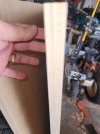
Is 3/4 MDF superior to 5 ply furniture grade plywood for a Forte size cabinet? I picked up this plywood from a local furniture shop for $40 a sheet. I am going to build two Forte test cabinets. One with the passive radiator in the front and one with the passive radiator in the rear. See which one sounds best to me with the speakers that will be sitting in the center of a room.

I could buy a couple more sheets of the plywood for the "final" build, but was not sure if MDF is better.
 

Attachments
  • 20250219_131129.jpg
    20250219_131129.jpg
    74.3 KB · Views: 63
  • 20250219_131137.jpg
    20250219_131137.jpg
    59.4 KB · Views: 57
  • 20250219_131141.jpg
    20250219_131141.jpg
    96.6 KB · Views: 60
Last edited:
Register to hide this ad
All MDF is not created equal. The last P-E flatpack speaker cabinet kit I bought was made from poor quality MDF. Much softer than any MDF I've used before. Same is most likely true for 5 layer plywood.
 
Use 11 layer Baltic birch, make sure it’s the Scandinavian version, not the cheaper Chinese variety. I would not use MDF for structural purposes, although I would consider MDF faced cabinet grade plywood if Baltic birch wasn’t available.
 
Manufacturers will tell you MDF is so much better but me not so sure. Plywood was good enough for PWK. MDF is good enough for sure but measurable better, not so sure myself. My thought bean counter decision. Cheaper than good plywood.

The decision to use polyester caps in their crossovers is another example of a bean counter decision. I see people on this site claiming the polyester cap will bring their crossovers back to original specifications. PWK used motor run caps with are for the most part are polypropylene. My understanding is that many years ago there were some motor run caps that were paper in oil but for the most part polypropylene. Electronic engineers and geeks know a polypropylene capacitor is better, the numbers in the data sheets prove so, but the bean counters save a few cents with polyester capacitors. I do agree that a polyester capacitor is good enough for the application but that does not mean a polypropylene is not a better cap. If I wanted to recap my crossovers I would definitely choose a good polypropylene over a polyester. The only thing better about a polyester is the size. They are typically smaller.
 
Last edited:
MDF is good for speaker cabinets because it’s dense, uniform, and well damped. It has no grain or internal voids, has a very consistent thickness, machines accurately, and doesn’t resonate as easily as plywood. The result is a cabinet that adds less of its own sound.

That said, I really like working with Baltic birch. It’s a high-quality plywood that is strong, stiff, and much more durable than MDF, and it certainly has its place in speaker construction. I typically prefer MDF for home speaker cabinets, but Baltic birch is an excellent alternative. Lower-grade softwood plywood, on the other hand, is generally less desirable because of its inconsistent layers, internal voids, and tendency to resonate.
 
I was reading this morning about the Daedalus Audio's Muse Studio Loudspeakers which are made out of solid wood. He is claiming solid wood is better than MDF. Solid wood is much harder to work with than MDF or plywood in a speaker build because real wood is always moving. I notice he is using dovetails for joinery. If I were to build a speaker I would probably use MDF. That is if I were younger, that stuff is heavy. Much cheaper than either solid wood or any kind of plywood. I believe we are splitting hairs because if built correctly any of the 3 would be more than adequate. Someone with extraordinary hearing might claim to hear a difference. At my age I am skeptical of any speaker reviewer. I've never heard a problem with my plywood built 86 LaScala's bass bins even when my hearing was better. Never found a need to brace the cabinets. I can remember when younger hearing the master tape hiss starting before the music on a LP.
 
That was wonderful to watch

A Cornwall size box might be more worthwhile to test. That box was so small and stiff it probably minimized any differences
 
I doubt most will not hear any difference between MDF, plywood or solid wood if braced and built correctly. Splitting frog hairs IMHO.
 
@wdecho The motor runs, even the small box motor runs found on the AK/AL series of networks are polyester film and foil. They were paper in oil in the 50’s and 60’s. The only speaker I know about that used polypropylene (Bennic), was the 60th Anniversary Klipschorn.
 
I doubt most will not hear any difference between MDF, plywood or solid wood if braced and built correctly. Splitting frog hairs IMHO.

I'd suggest the more apples to apples comparison of materials, to the point of the OP's question, would be as the speaker was originally designed/built, not in an optimized configuration of bracing.
 
@wdecho The motor runs, even the small box motor runs found on the AK/AL series of networks are polyester film and foil. They were paper in oil in the 50’s and 60’s. The only speaker I know about that used polypropylene (Bennic), was the 60th Anniversary Klipschorn.
Not what the electronic engineers I listen to have to say. Perhaps you know more than them.
 
It looks like I might know more than them about vintage Klipsch product.
 
Last edited:
Really. Makes no difference to me whether polyester or propylene in old motor run caps. I have no idea myself, just repeating what I have read on technical forums from really smart people with degrees. I have never cut one open myself and even if I did I would not know what I as looking at.

The engineers at Klipsch say polyester caps are more than adequate for their crossover networks these days and I am not going to argue with them knowing polypropylene have better numbers on the data sheets. Either good enough for something as simple as a crossover network.
 
I have zero engineering or build experience with this question. However, I had a set of Snell E II cabinets made out of Baltic Birch. I also had the crossovers rebuilt and the drivers replaced with Audio Note drivers.
I’ll put them up against anything in the 5,000 dollar range.
Even without the driver or crossover upgrades I think there would have been an improvement over stock MDF.
Just my experience
I wish you well.
 
God forbid your speaker ever gets wet but MDF would not fare anywhere near as well as plywood. MDF doesn't shrug off accidental whacks very well either.
 
Back
Top Bottom