

You are using an out of date browser. It may not display this or other websites correctly.
You should upgrade or use an alternative browser.
You should upgrade or use an alternative browser.
Measuring Speaker Resistance - help please
- Thread starter Kasanay
- Start date
-
- Tags
- bozak impeadance spearkers
Register to hide this ad

hifijohn
Active Member
thats seems a bit high ,when you measure the resistance(not impedance)youre measuring the resistance of the woofer voice coil and the series inductor to the woofer. the mids and tweeters dont count because they have a cap in series with them., Im guessing the cabinet have more than on woofer.and they are in series.but that stills seems bit high.Hey, this may be a dumb question but:
I have a set of Bozak speakers. The boxes containg woofers, midranges, tweeters, supertweeter and crossovers networks. When I put a meter on the connector I'm reading 20 ohms. Is this normal?

Speaker impedance is generally not measured without a signal and just a meter. DC resistance of the voice coil in an individual driver can be measured that way, but it doesn't equate to the speaker's "impedance". Speaker impedance is frequency dependent so you need to be running a signal at a specific frequency through the speaker to measure impedance at that frequency. I'm sure someone here can chime in on exactly how that might be done with a signal generator and VOM? I use an AudioSonde Audio Toolbox that can run a sweep and display the impedance as a graph with impedance on the vertical axis and frequency on the horizontal axis. Impedance generally varies over the frequency spectrum. 20 ohms sounds high, but I don't think that measurement necessarily equates to the "impedance" of the speaker.

klipschorn
Klipschorn
thats seems a bit high ,when you measure the resistance(not impedance)youre measuring the resistance of the woofer voice coil and the series inductor to the woofer. the mids and tweeters dont count because they have a cap in series with them., Im guessing the cabinet have more than on woofer.and they are in series.but that stills seems bit high.
I can show you how to measure speaker impedance if you have a VOM or a VTVM or a DMM, a signal generator and a 10 ohm resistor, preferably 1% but 5% will do; a 1/2 watt rating will suffice. The meters should be capable of reading at least as low as 0.040 vac (40 mV).
Note: 20 ohms isn't a high reading for speaker impedance, usually regarding a woofer of 8 inches or larger. The impedance if these drivers can easily reach several times or higher than their nominal impedance at resonance. the nominal impedance of a typical 8 ohms woofer is usually around 6 to 7 ohms in the passband of 300hz to 400hz., below and above which it will rise. Below, it peaks at resonance and above, it gradually rises continuously. Around 1khz, it can be as high as twice the nominal, around 12 ohms, which always baffled (no pun intended) me as to why "DIY" crossover designers will assume 8 ohms as the upper bound of the woofer. In the example listed, this will cause an approximate 25% negative shift in the upper crossover frequency of the woofer with a resultant possible dip in the response in that region.

whoaru99
Epic Member
What's the nominal rated impedance of the speaker?
Usually, the DCR measures a bit lower than the nominal impedance rating.
For example, an "8 ohm" speaker often measures 5-6 ohms DC resistance (that which is shown on the mulitmeter). A 4 ohm speaker often shows 3-3.5 ohms DC resistance.
Of course, there may be exceptions but these are commonly observed values.
Usually, the DCR measures a bit lower than the nominal impedance rating.
For example, an "8 ohm" speaker often measures 5-6 ohms DC resistance (that which is shown on the mulitmeter). A 4 ohm speaker often shows 3-3.5 ohms DC resistance.
Of course, there may be exceptions but these are commonly observed values.

Kasanay
Active Member
The nominal rating is not displayed on the units. However, with the help of some very knowledgeable folks like Ken Seger, I have been able to figure out how (and why) these boxes were configured:What's the nominal rated impedance of the speaker?
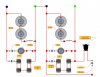
The builder utilized a combination of 8 ohm and 16 ohm drivers and cleverly configured them to produce a nominal load of 32 ohms.
32 ohms was desired because these were intended to be driven by an OTL (output transformer less) amplifier.
To measure speakers you need LCR meter. Speaker impedance is frequncy dependent. Most decent LCR meters allow you to select frequency from some range- like 100, 1000 and 10K Hz. They also report phase angle, which is important when you assess amplifier ability to drive these speakers.Hey, this may be a dumb question but:
I have a set of Bozak speakers. The boxes containg woofers, midranges, tweeters, supertweeter and crossovers networks. When I put a meter on the connector I'm reading 20 ohms. Is this normal?