I've recently started using MC12 mostly as a learning aid. Created about 20 circuits mostly power amp stages eg, Yamaha CA-800/1000/1010
Luxman L-430, L-80V, SQ-505X, Marantz 2500, 1030, NAD 7120, Pioneer SX-828...
Was wondering if these simulations would be useful to others, the idea that users could load the simulations then test according to their needs.
OK, agree that there are 1000's of amps and the techs don't need them and the average AK user doesn't even bother googling AK when they have a protection issue, so circuit simulation wont happen....
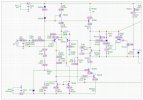
I mostly use the DC analysis, see example below (CA-1010) showing node voltages, certainly a lot to learn in the AC analysis.
Part of the motive for this post is that while MC12 has a large definitions database, some of the common vintage audio transistors are missing, creating these definition files is beyond my pay grade, maybe others???
Luxman L-430, L-80V, SQ-505X, Marantz 2500, 1030, NAD 7120, Pioneer SX-828...
Was wondering if these simulations would be useful to others, the idea that users could load the simulations then test according to their needs.
OK, agree that there are 1000's of amps and the techs don't need them and the average AK user doesn't even bother googling AK when they have a protection issue, so circuit simulation wont happen....
I mostly use the DC analysis, see example below (CA-1010) showing node voltages, certainly a lot to learn in the AC analysis.
Part of the motive for this post is that while MC12 has a large definitions database, some of the common vintage audio transistors are missing, creating these definition files is beyond my pay grade, maybe others???