Midland Tube Amp help

Ahhh, yes, andother of the gold-tone amplifiers, all birthed in the same Japanese factory during the Eisenhower administration.

Your unit is identical to the Calrad SA-2B, which is itself identical to units from Olson, Armaco, and a host of other mail-order companies.

While I do not have any documentation on this particular model, as I do for other Calrad units, having studied many of the similar amplifiers (mostly push-pull 6BQ5 and 6BM8) created in that nameless factory and then sold by these catalog companies I can tell you that the circuits are not only nothing fancy, but all have been extensively Muntzed. As a result, the circuits require some simple modifications for stability, reliability, and performance. I therefore suggest you use a decent worked out 6BM8 design as a basis for a rebuild.

The design, in summary, uses the triode portion as a gain stage and the pentode portion as a low-power SEP stage. You should be aware that many of these designs push the power capability of the pentode portion to or beyond its limits, dramatically shortening the lifespan of both the tube and the output transformer.

The original specifications for many of these amplifiers are just delusional if one knows the limits of the tube. I just picked up a Japanese push-pull 6BQ5 amplifier of the same era which used fanciful ratings; 20 WPC (ha!) for a pair of tubes rated for about 16 WPC maximum. The unit shows obvious damage, as the chassis has scorch marks around the tubes, one output transformer is burnt up with scorch marks on the paper, and the other output transformer has obvious heat damage. Tubes and output transformers therefore require replacement, and I will modify it to limit the gain to a more reasonable 16 WPC max.

The Japanese single-ended designs of that time are even more prone to being overdriven because of the low efficiency.

These units do make excellent headphone amplifiers, where power requirements are low, so your plan is perfect. As for driving speakers, well, you'll likely be happier with something of greater power.

Because of the cost-cutting aspects of these designs I suggest you do a few things for stability and lifespan. Off the top of my head:
All of the Japanese electrolytic capacitors used for AC interstage coupling are bad and will consequently place a DC voltage (from the triode gain-stage stage's plate) on the grid of the 6BM8's pentode stage, blowing up the tube. These capacitors must be replaced if you want a stable amplifier. None can be saved. I suggest using PP film capacitors for coupling, or PTFE if you want to spend a few dollars more.

Add add individual bias potentiometers to the output stage, and possibly investigate Dave's EFB, to better match the outputs. I also suggest a 10 Ω resistor to allow you to accurately measure the current.

Add grid and screen stopper resistors for anti-arcing and anti-oscillation.

Add a Zobel to the input stage to ensure RF cannot get into the amplifier and cause oscillation.

Replace the screen supply, which is a dropping resistor, with a voltage regulator of some sort. A string of lower-voltage Zeners will reduce the noise of a Zener and improve stability. Do not exceed the published screen limits.

Replace all of the carbon composite resistors, which will have drifted, with 1% metal film.

Replace all of the ceramic capacitors, which are microphonic, hygroscopic, and have other defects such as capacitance varying with DC bias, with PP film.

Replace the sockets.

The 6X4 (like the 6X5) is a bad, bad, tube. It tends to fail as a short which rapidly burns out the power transformer. (A fuse won't help as it takes too long to blow, and the power transformers used in these units are not very robust.) This problem is infamous in the tube radio world. Many circuits overdrive the 6X4 by exceeding the maximum current ratings. (In brief, larger capacitors shorten the conduction angle, i.e. the time in which the filter capacitor charges. The 6X4 cathode can only handle about 40 uF, and even that is pushing it.) I would switch to solid-state with a delay, but another rectifier tube would be fine. Some research on the 6X4 will confirm the widespread problems of blown power transformers.
These changes will give you a nice headphone amplifier which is stable and reliable.

Sounds above my expertise. :(:(
 
What is above your expertise? I would start by just replacing the capacitors first then you can easily replace any out of spec resistors. The tubes can be left alone for now.
Very much a beginner caps and resistors I can do. It's the other stuff I don't know about adding zener etc... Is this worth messing with? I just dig it plan on repainting the gold etc.
 
Ok. I looked up some numbers for you.

A Sylvania 6X4 is rated for 70 mA driving 10 uF. If the first filter capacitor is significantly larger than this it will shorten the tube's lifespan. According to your information, the capacitor is 10 uF which is the maximum.

A 6BM8 has a maximum plate current of 40 mA. If the tubes are being run at full power, that's 80 mA and the tube dies. If the tubes are run at, say 30 mA, that's 60 mA and life is likely ok. Class A has a constant draw of maximum current. So it's not a peak situation, it is a continual situation.

The 6X4 is routinely overdriven in both small amplifiers like this and radios because the tube's maximum rating in the datasheets is higher, but that's peak not steady state. When the 6X4 fails it fails as a short. So the power transformer is shorted and burns out. This is difficult to source and expensive.

I do not know how much current is being pulled from the 6X4, but it may be too much. A lot of these amplifiers did that.

Many do not trust the 6x4 as a rectifier. Not sayin', just sayin'.

If the screen voltage is too high the tube's lifespan is shortened. A lot of amplifiers pushed the screen voltage (and plate voltage) to gain power output at the expense of tube lifespan. A Zener diode becomes noisier as the breakdown voltage increases, so a (say) 150 V Zener is considerably noisier than (3) 50 V Zeners in series, or (4) 25 V Zeners in series. The other problem is that a dropping resistor requires a constant load to maintain the voltage drop and the screen voltage can climb under some circumstances.

I would suggest rewiring it using a standard Class A 6BM8 circuit which has been worked out on diyAudio or similar forum.
 
Rebelfan, The sky isn't falling. Your amp will be fine with some minor updating.

Ahhh, my stalker once again shows up to deprecate what I've written, yet he never actually explains with any facts where I am incorrect, just proffers empty reassurances to denigrate my writings. Go away stalker boy and find someone else to bully, because it won't work on me. You might consider learning some basic electrical engineering and something about tube amplifiers. Your community college likely offers courses suitable for you, as self-study seems to not be working out.

I never said the sky was falling; that strawman was set up to denigrate me. What I correctly and accurately pointed out is a well-known risk from the 6X4. This is easily confirmed by simple research.

I again point out that the 6X4 is well known as a problematic tube, and one which is routinely overloaded in commercial circuits of the day because of cost savings. If the 6X4 is overloaded—as seems likely, show by way of my prior explanation and calculations, an expected situation for this inexpensive (when sold as a new product) Class A amplifier (which must drive the tubes hotter to obtain higher power output)—the rectifier will eventually short and destroy the power transformer because it can't drive a dead short.

Failures from 6X4 shorting, including a blown power transformer, is a common problem in radios and low-cost (again, when sold as new) amplifiers, and this can be easily verified with a simple google search for terms like "tube 6x4 failure".

The failure mode, again, is that the rectifier shorts and destroys the power transformer.
 
Last edited:
Unfortunately making those modifications is going to be too advanced for the original purchaser. Would you recommend he recap and use it as is, or just get rid of it?
 
Amcreblefan, since you are not very well versed in this amplifier, as mentioned earlier, I personally would also go with just replacing the capacitors for now. Even though the 6X4 might be known to be a problematic tube in certain circuits, it should be ok for this little amplifier. Unless this amp was or is blowing fuses or creating a miniature lightning storm inside the 6X4, it should be ok in this amp until you can get it up and running and then do some extensive troubleshooting. This little amp is so simple that it probably won't present too many problems for you. :bigok:
 
Amcreblefan, since you are not very well versed in this amplifier, as mentioned earlier, I personally would also go with just replacing the capacitors for now. Even though the 6X4 might be known to be a problematic tube in certain circuits, it should be ok for this little amplifier. Unless this amp was or is blowing fuses or creating a miniature lightning storm inside the 6X4, it should be ok in this amp until you can get it up and running and then do some extensive troubleshooting. This little amp is so simple that it probably won't present too many problems for you. :bigok:

Uh, no.

You don't have any idea of the current draw on the 6X4 in this configuration. This can be calculated from the components. I don't have a schematic for this particular unit, but my experience with the other gold-tone Japanese amplifiers (I have two which need to be rebuilt) is that the 6X4 is significantly pushed out of its safe range.

If the fuse blows the power transformer would have been destroyed. That's how a rectifier short works. It is not a recoverable situation. Making cutsey comments about "creating a miniature lightning storm" is not going to help; by the time arcing was visible inside the tube it likely would have melted.

The fact that the amp is "simple" does not mean that it does not violate the design limits of the 6X4 or of the output tubes, for that matter. If the 6BM8 is being run close to maximum plate current to maximize the Class A power output—Class A is inefficient so the output tubes in these amplifiers are run much harder—the rectifier is overloaded. I just picked up a gold-paint push-pull which has a burned-out output transformer and scorches on the chassis because the 6BQ5 (a lower-power output tube) were run (by design) beyond the maximum plate limits and failed, taking out the output transformer. It will make a nice headphone amplifier once I've replaced the output transformers and rejiggered the circuit to not be prone to chernobyling.
 
Um, yes! The OP has no idea what you are talking about. With this particular amplifier, just trying to make it simple before going in down, dirty, and deep!
 
Unfortunately making those modifications is going to be too advanced for the original purchaser. Would you recommend he recap and use it as is, or just get rid of it?

It's a good point. I'd suggest he (a) replace the capacitors and resistors (which will have drifted) and (b) turn down the current for the 6BM8 to move well back into the safe operating limit for the 6X4. The risk of premature tube failure from early B+ from a solid-state rectifier without a delay (again, beyond OP's skillset) is likely easier to deal with (new output tubes) than finding a new power transformer.

The 6X4 is notorious for shorting when overloaded. And most designs using it did just that.
 
Um, yes! The OP has no idea what you are talking about. With this particular amplifier, just trying to make it simple before going in down, dirty, and deep!

The power draw needs to be computed and likely adjusted. Someone can help him figure that out. Backing out of excessive current is not difficult, just resistors to shift the line.
 
A conventional fuse (on the power transformer primary) likely won't work fast enough, but it is better than nothing. High-voltage fuses would be required for the secondary.
 
Another solution occurred to me.

In the 1930s and early 1940s Zenith had an unacceptably high failure rate of 6X4 tubes in its radios which were burning out power transformers. The solution was placing a lightbulb in the B+ circuit at the plate. The thin filament of the bulb serves as a fuse, but one which will not arc. (Remember, high-voltage B+ will arc across a burned out fuse, which is why standard AC line fuses cannot be used for high-voltage.)

This is slightly edited from another posting I made on AK.

The bulb, according to Zenith's Wartime Service Hints No. 1 published in April of 1943, is equivalent to a 250 mA or 125 mA fuse. That is more than the transformer can continuously deliver for a long period of time, but for the brief time required to blow that fuse (bulb) it won't cause any damage.

I managed to find my copy of that service bulletin, which is very low resolution. I am sorry but this is the best I have.

index.php

I keypunched the relevant text (right column about 2/3 of the way towards the bottom) for clarity (italics in original, underlining added):
The burning out of the power transformer in the sets using the 6X5 tubes has been kept at a minimum by wiring in a dial light in each plate lead of the secondary of the transformer. These should be of the 1/4 amp. or .15 amp. sire depending on the drain of the set. They glow very slightly under normal conditions but will bum out immediately upon the short-drafting of either of the rectifier tubes. Some servicemen located in the rural districts have even put in sockets for these panel bulbs making it possible to replace them without removing the chassis and enabling the owner to replace both the rectifier tubes and the bulbs in case of trouble. We have found that these panel bulbs work much better than fuses either in the primary or high-voltage circuit as they stand temporary overloads without burning out and yet will open the circuit when aborted out. To the best of my knowledge, we have never lost a transformer the second time when these bulbs have been put in when the transformer was changed.
Now, a bulb poses a problem for fidelity because varying current loads cause the filament to heat and cool, creating resistance changes, and thus varying voltage drops which affect fidelity. (The bulb is a PTC device, and rather non-linear.) That would not matter in an AM radio, of course, as the fidelity is not great to start.

But this application is a Class A, so constant current!

So a bulb rated, as set froth above, 150 mA or 250 mA would be far outside the 6X4 design limit so if the tube shorted the current would exceed any reasonable value for the amplifier, and the bulb would protect the circuit. The power transformer could likely tolerate that temporary overload without damage. I suggest using a bulb with a far lower rating, say 70 mA as this is right at the design limit of the 6X4 so it would not blow in normal operation.

Disclaimer: I have not done this. I do, however, think it would provide the necessary protection when (not if) the overloaded 6X4 shorts. That will keep the power transformer from going to Valhalla with it.
 
Thats a 6X5 that Zenith was using, an octal based rectifier. The 6X4 is a newer 7 pin tube. I don't believe the newer tube has the same troubled history as the older 6X5 did. For whatever its worth, I've got several things with a 6X4, none have ever failed, and none show any evidence of having failed in the past.
 
Another suggestion which occurred to me.

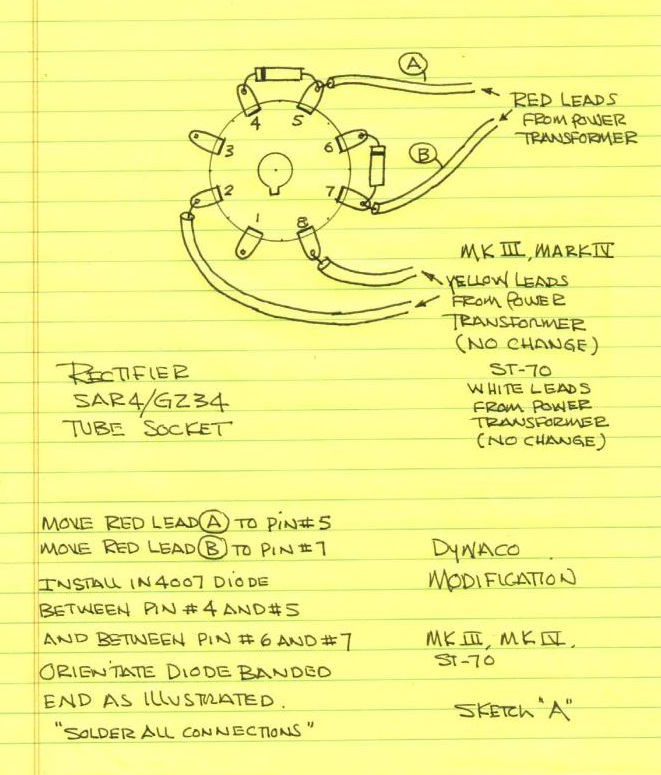
Add solid-state diodes to the 6X4. That will remove the PIV stress on the tube, which is considerable, and use the 6X4 mostly as a B+ delay. It is a trick commonly used with high-current rectifier tubes only available as NOS at outrageous prices. Provided the tube shorts cathode to plate, and not cathode to heater, the tube turns into a wire so the solid-state diodes will rectify. The B+ delay is lost, but that's less harmful (only damages the output tubes) than having the power transformer (expensive and hard to source as an exact replacement) frying.

Search for diodes and the Dynaco ST-70 and you'll find a discussion of how to implement that. He's an example:

TubeRectifier-DiodeMod.jpg
 
Thats a 6X5 that Zenith was using, an octal based rectifier. The 6X4 is a newer 7 pin tube. I don't believe the newer tube has the same troubled history as the older 6X5 did. For whatever its worth, I've got several things with a 6X4, none have ever failed, and none show any evidence of having failed in the past.

The 6X4 and 6X5 are the same tube, just in different envelopes.

The plate design is often identical. A pile of 6X4 designs exist with different plate configurations. A military version exists, as well. But all have the same low current rating of 70 mA maximum.

Which brings up the question: does your gear exceed the rated current? Preamplifiers generally don't do this, as the circuit is inherently low current. Amplifiers, however, use a lot more current.

Many lower-cost designs pull too much current from the tube. I have a few of those gold-paint amplifiers which run the tube at what could only be considered to be delusional ratings. About 100 mA, as I recall, for a tube rated 70 mA continuous maximum current. While the tube is rated for about 200 mA peak, the exact duration of that peak is unspecified, and I think it is a conduction angle issue so not relevant to normal operation.

Like I said, I have one which cooked the output tubes and at least one output transformer. Some designers treat a tube's maximum limits, particularly screen voltage, as suggested starting points. Guitar amplifiers are known for blown 6X4 tubes which eat the power transformer.
 
70mA is shown as typical usage, not maximum. 45mA/plate is shown as max. = 90mA.

The rule with tubes, particularly rectifier tubes, is the greater the current the shorter the lifespan. The "typical usage" rating in the datasheet is what the tube is expected to tolerate for the rated lifespan. Running tubes at the maximum plate current is known to be a poor design practice with poor results.
 
Quoting maximum ratings is understood to be manufacturer design ratings, poor choice or not. 70mA is still a typical load not a max. load.

Typical load is the suggested load. That's how the datasheet is to be interpreted, not as starting points. Anything above typical shortens lifespan and stresses the tube.
 
Back
Top Bottom