• The move to the new server is done. There are some software and database maintenance updates in process. This has us passing the hat around to help out. We appreciate any donations. Seriously, even a dollar helps. The payment page may be found here - https://www.audiokarma.org/support.html

ML-2C PROJECT COMPLETED: Custom mid-tweeter arrangement

I should note though that I used a replacement dome and super tweeter, removed the crossover parts RR added to the crossover to affect the midome and tweeter response curves. I also moved the 8 inch and dome crossover -3dB down point up 1000 Hz, if I remember correctly.

By increasing the level of these drivers I could add acoustic absorbing material around the drivers to minimize the effects caused by the cabinet and large grill woodwork.

The goal was to spend less than a Franklin per pair and improve their high frequency response to a more modern row 10-12 curve instead of their old timey 25 row curve.
 
OK here we go. Sitting in my listening position. (This is a maybe 12 x 16 foot room with 10 foot ceiling?) Background noise present but not loud (fan on elsewhere in house, occasional car driving by outside w/ window open).

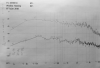
I ran a frequency sweep video on YouTube, and set my app to hold. That's the yellow line.

This is with the MQ-102 on position 1 on both channels.

oYgsGg8.jpg

What are the two traces again? Yellow trace is a reference or `baseline´? Are they L & R channels? What exactly is the White trace? Did I not read the post well enough?

I'll compare your swept data to my stepped CW tests and swept (spectrum analyzer) snapshots. These Mc speakers are heavy in the upper bass region, at least my XR6s are.


-Greg
 
Last edited:
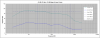
Got around to picking some values off your Spectrum Analyzer plot.

JL_data_sheet_256.png

What are the descriptions for the Upper and Lower traces? How much power fed to the speaker(s)? How far was mic from the speaker(s)? Can you send test data in ASCII text or CSV file?

Here's the raw data plotted in Excel:

JL_SA_FFT_data.png
JL_SA_FFT_data.png

Will need more info to scale traces referenced to their rated sensitivity.

Is that FFT plot displaying voltage? I have it plotted on a speaker SPL (power) scale.


-Greg
 
Last edited:
The issue above has been bothering me. See bottom of y-axis on FFT plot is dbFS (dBFS).

Wiki definition: https://en.wikipedia.org/wiki/DBFS

"dBFS (or dB FS) is a unit of measurement for amplitude levels in digital systems, such as PCM, which have a defined maximum peak level."

"The level of 0 dBFS is assigned to the maximum possible digital level. For example, a signal that reaches 50% of the maximum level has a level of −6 dBFS, which is 6 dB below full scale."


Minus 6 dB which is 50% of Max is a voltage ratio, yes / no? How can the data be referenced to SPL at 1 watt and 1 meter?


-Greg
 
Last edited:
Oh WOW you are awesome for plotting that out! The app I used is Advanced Spectrum Analyzer PRO: https://advanced-spectrum-analyzer-pro.soft112.com/

I think it simply plots the sound level seen at the microphone vs. frequency. Perhaps the 0 dbFS is in reference to the peak voltage that the microphone in the cell phone can output?

On the measurements, I took them while sitting in my chair with the intention of discovering any room acoustics, like bass resonance. I wasn't trying to create a 1 watt @ 1 meter response curve. That's why the power supplied was arbitrary, for the specific task of trying to figure out room acoustics in the abstract. I suppose the next step would be an anechoic speaker measurement, and then a comparison of the two plots, whereby the difference would be the effect of the room acoustics?
 
Hello I know that I am jumping in very late in this process but I have a pair of ML-2C s that I have blown the tweeters in and also 3 of the 4 upper mids. I have a pair of XR5s that I wrestled with for quite a while before giving up and updating the drivers. You are really fortunate to have found replacements for your mids but I am wondering if you reached a conclusion of what you would have done if you were forced to update? Do you know what driver you would select?
 
Hello I know that I am jumping in very late in this process but I have a pair of ML-2C s that I have blown the tweeters in and also 3 of the 4 upper mids. I have a pair of XR5s that I wrestled with for quite a while before giving up and updating the drivers. You are really fortunate to have found replacements for your mids but I am wondering if you reached a conclusion of what you would have done if you were forced to update? Do you know what driver you would select?

I am not sure how much I can help. I set out from the start to find original mids, and got lucky when I did. But because that was my goal, I never spent much time researching suitable updates.

The only thing I did find about updates, was about Roger Russell's suggested updated drivers - although I can't find it now. I'm sure it's out there (maybe someone can help).
 
Interesting, I bought a pair of XR6s some years back, maybe 8 or 10 years ago, and one upper-mid was blown. Sent the L&R UM drivers to Mc for a rebuild and when they came back, the speakers sounded TERRIBLE. Doing some midrange frequency tests, the UMs were down by 6 or 7 dB (will have to dig up the numbers). Called Mc back complaining about distortion and low mid output, and shipped the UMs to them again. When the drivers came back a second time, all they did was pull out the fiberglass pads over the domes. Now they REALLY sounded terrible and the pads were gone. So that was a waste of 400 bucks. Have about 1200 into them and won't spend any more, and hate to mod the cabinet because they're in `museum quality´ good shape. Still listen to them nearly every day, but with the whole upper frequency range cut. They are `thumpers´ now, good tool for noisy neighbors with MQ104. :naughty:
 
Interesting, I bought a pair of XR6s some years back, maybe 8 or 10 years ago, and one upper-mid was blown. Sent the L&R UM drivers to Mc for a rebuild and when they came back, the speakers sounded TERRIBLE. Doing some midrange frequency tests, the UMs were down by 6 or 7 dB (will have to dig up the numbers). Called Mc back complaining about distortion and low mid output, and shipped the UMs to them again. When the drivers came back a second time, all they did was pull out the fiberglass pads over the domes. Now they REALLY sounded terrible and the pads were gone. So that was a waste of 400 bucks. Have about 1200 into them and won't spend any more, and hate to mod the cabinet because they're in `museum quality´ good shape. Still listen to them nearly every day, but with the whole upper frequency range cut. They are `thumpers´ now, good tool for noisy neighbors with MQ104. :naughty:

If it helps anyone I used a HiVi DMB-A 2 inch fabric dome mid and Dayton Audio AMT air motion transformer tweeters 8ohm all from parts express in myXR5 rebuild and am very happy with the result especially the tweeters. It was very cost effective
 
I still have two NOS 036-035 mid domes as used in the XR series of spekers as well as 1 036-055 mid dome replacement for the ML series.

If there is a professional speaker repair company out there willing to take on the rebuilding of these Mac drivers I'll be happy to work out something to loan them these OEM drivers to use as benchmark references for proper repair.
 
T
I still have two NOS 036-035 mid domes as used in the XR series of spekers as well as 1 036-055 mid dome replacement for the ML series.

If there is a professional speaker repair company out there willing to take on the rebuilding of these Mac drivers I'll be happy to work out something to loan them these OEM drivers to use as benchmark references for proper repair.

This might be sacrilege but I really wonder if it wouldn’t be better to ask for new technology replacements for the tweeters and upper mids. I have to confess to supplementing my bass with a high end sub even though I have the equalizer. At 150 lbs each I think that those ML-2C cabinets are the real magic. Roger R where are you? We need you.
 
Roger did come up with a rather expensive ML1 update with Morel modern drivers and a revised add on crossover board.

We installed one kit in a nice pair of ML cabinets and the one was under whelming.

They showed the typical for their design a 3 dB boost at 100 hz, 0 at 1000 and were 8 dB down at 10k and 12 dB down a 15k......maybe acceptable in 1972 but not for the modern expectations.

He did include instructions to undo the extreme high frequency roll off by clipping out some dropping resistors and removing those bumped up the 10k and 15k output by 3 dB.

The owner was happy, I thought they were the typical dull sound I remembered from back in the day.

When I choose to experiment with a 100 buck upgrade I used much cheaper drivers, reworked the crossover and adjusted the response curve to a more modern + 3, 0 -3 curve. Say row 14 of a traditional classical music venue instead of row 22.
 
Back
Top Bottom