• The move to the new server is done. There are some software and database maintenance updates in process. This has us passing the hat around to help out. We appreciate any donations. Seriously, even a dollar helps. The payment page may be found here - https://www.audiokarma.org/support.html

Modern day high elliptical tracking forces concern..

cafe latte

Addicted Member
After seeing an elliptical retip recommendation on a thread for a cart that tracks at 2.5g and seeing some of the really very high modern carts with elliptical stylus tracking at 2g and avove I felt to speak out and though it was discussion worth.
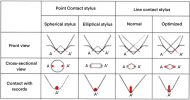
Back in the old days of vinyl conical was king and they tracked 4g plus which is not as heavy as it sounds. When elliptical was invented it drove the push for high compliance cartridges as the heavy 2.5-4g tracking forces were just too heavy for an elliptical so 1-1.5g became the norm. An elliptical in its simplest form is a conical with the front and rear cut off this results in a much smaller footprint on the groove walls. Put simply more pressure per given are as the contact patch is smaller.
I have some pics somewhere showing a 0.2x0.7 tracking at 1.5g and then pics of the groove after one play, the groove is marked and after 20 plays there is a groove cut in the croove wall (not cut really but ploughed into the wall by deformation). Then 20 plays with a conical at 2.5g and no damage at all is visable.
Now we have more exotic cuts like Shibata and Micro ridge which have huge narrow contact patches which not only track better, but the large area speads the load further so reducing both stylus and groove wear. These cuts tracking at 2.5g plus is not a problem as it was not a problem for conical and exotic cuts have a larger contact area with the groove resulting in even less wear, but the understanding that elliptical can not be used tracking at 2g plus seems to have been lost in time as more and more we see ellipticals tracking at crazy tracking forces resulting in accelerated stylus and groove wear, the latter being the most concering.
The VE stylus wear study 2 showed significant wear at 190 hours on an elliptical tracking at 2g, if the stylus is wearing so quickly I can only imagine what it is doing to the groove walls.
When we look at the cost of say a ATvm95e and the Micro ridge version ml in Aus the e version is 80 Aus dollars and the ml is 265 so 185 more. Looking at the stylus wear study groove wear aside you will use 5 elliptical so in the long run you will spend more buying elliptical stylus over the time you have the micro line then we consider groove wear and sound quality all of a sudden the elliptical starts to look very unatractive indeed.
Chris
 
Register to hide this ad
I know there are some elliptical DJ carts in the 2-5 gram range. Stanton 680.V3E is one.
 
I am curious what the heaviest tracking force elliptical cartridge is?

Currently quite likely Orotofon's elliptical SPU variants, I'd guess - like the Classic NE, the Classic GE MkII, Meister Silver G MkII and the #1 E - all medium-sharp ones (8 µm/0.3 mil) with 4 g suggested (range: 3 to 5 g).

Among the sharp ones with 5 µm/0.2 mil AT's old ATP-6 used to be pretty high up with its 2 to 4 g.

Greetings from Munich!

Manfred / lini
Wow that is nuts for an elliptical! Can't imagine the grooves had a happy time.
Chris
 
Yup - certainly not, what I'd recommend or use myself.

Greetings from Munich!

Manfred / lini
I guess when elliptical first came out they just used them on what existed cart wise already, it would have taken a bit of time for cartridges to become higher compliance.
It nuts though that elliptical 1.5g equates to conical 3.5g ish so 3g elliptical is like 7g conical so even more scary 4.5g elliptical we are talking 10.5g conical!!!! Holy vinyl dust!!
Chris
 
I've been using AT OC9 variants for 30 years. The original OC9 was a nude elliptical and then the ML version came out (I have both). Both tracked beautifully at 1.5 g.
The new variant of these cartridges is the OC9XML is quite a bit more compliant than the OC9/OC9ML (16x10-6cm/dyne @100Hz vs: 9x10) yet recommended VTF is 2 g.
What's going on?
 
My own experience (OK, today I use a lot better tips) confirms what is written by Richard Brice in his Stereo Lab article:


Excerpt:

"Furthermore, it compounds the damage in subsequent plays, eventually causing significant damage to the groove walls so that the PVC material is pushed from the peaks and deposited on the downhill slopes. The elliptical stylus - even tracking at 15mN (1.5g) - is the wrong side of the micro-hardness threshold.The old-fashioned, conical (spherical) stylus isn't.

Woodward argues² that the damage due to the elliptical tip is acceptable on the basis that it is not enough to preclude the better performance of this type over the spherical tip. The extra electrical distortion caused by the physical groove-damage, outweighs the extra distortion due to the conical type.4"


In short - today it is possible to correctly reproduce with line contact stylus even last tracks of old records, weared by spherical stylus (if they are played properly before), but those weared by elliptical stylus sometimes can be reproduced only with ELP laser player. And not always - if tracking force was too less, stylus jumped and perforated sides of the groove up to top edges, so there is no more virgin groove left even at top. This is a result of people playing records with less tracking force than recommended by particular cartridge manufacturer because they believed they save record with less tracking force.

There are a lot of useful articles:

 
Last edited:
My own experience (OK, today I use a lot better tips) confirms what is written by Richard Brice in his Stereo Lab article:


Excerpt:

"Furthermore, it compounds the damage in subsequent plays, eventually causing significant damage to the groove walls so that the PVC material is pushed from the peaks and deposited on the downhill slopes. The elliptical stylus - even tracking at 15mN (1.5g) - is the wrong side of the micro-hardness threshold.The old-fashioned, conical (spherical) stylus isn't.

Woodward argues² that the damage due to the elliptical tip is acceptable on the basis that it is not enough to preclude the better performance of this type over the spherical tip. The extra electrical distortion caused by the physical groove-damage, outweighs the extra distortion due to the conical type.4"


In short - today it is possible to correctly reproduce with line contact stylus even last tracks of old records, weared by spherical stylus (if they are played properly before), but those weared by elliptical stylus sometimes can be reproduced only with ELP laser player. And not always - if tracking force was too less, stylus jumped and perforated sides of the groove up to top edges, so there is no more virgin groove left even at top. This is a result of people playing records with less tracking force than recommended by particular cartridge manufacturer because they believed they save record with less tracking force.

There are a lot of useful articles:

At the time elliptical came out it was felt that the better performance of the elliptical was worth the damage they cause. Today we have micro ridge to name one tip that lasts 5 times longer and does not cause damage due to the large contact area and due to its longevity it is no more expensive so why use something that causes groove damage when there is an alternative?
Chris
 
Cafe, what do you think of the line contact by namiki, is it close in shape to an elliptical? going to have a 103 redone and was thinking of the line contact.
Thanks
 
Cafe, what do you think of the line contact by namiki, is it close in shape to an elliptical? going to have a 103 redone and was thinking of the line contact.
Thanks
My 2c is if you are going to get it redone get a Micro ridge. Micro ridge due to the ridge dont change throught the life of the stylus. Other cuts the minor radius grows gradually and the sound slowly gets worse, but with Micro Ridge the stylus will sound the same as it did when it was new just before the ridge finally wears out which will be over 1000 hours.
Chris
 
At the time elliptical came out it was felt that the better performance of the elliptical was worth the damage they cause. Today we have micro ridge to name one tip that lasts 5 times longer and does not cause damage due to the large contact area and due to its longevity it is no more expensive so why use something that causes groove damage when there is an alternative?
Chris

Good question. I wonder too why elliptical tips are used on many good (otherwise) and expensive MC cartridges. Perhaps maybe because of cartridge design what they do not want to change? For example, when Ortofon designed their SPU Royal N with Replicant r/R 5µ/100µ (because of larger radius of 100µ sometimes works better on weared records than my Ortofon MC5000 retipped by VDH with 2µ/85µ tip) they modified SPU damping system too to reduce VTF to 3grams recommended VTF (2,5-3,5g range). Who knows. However there are many "vinyl lovers" who know nothing but they "hear" :). I have seen discussions about what cartridge "sound better" and there are opinions those with elliptical and even spherical tips are "the best sounding". So maybe they are still produced until there still is market for them (like Ortofon still manufacture classic SPU with spherical and elliptical tips).
 
Good question. I wonder too why elliptical tips are used on many good (otherwise) and expensive MC cartridges. Perhaps maybe because of cartridge design what they do not want to change? For example, when Ortofon designed their SPU Royal N with Replicant r/R 5µ/100µ (because of larger radius of 100µ sometimes works better on weared records than my Ortofon MC5000 retipped by VDH with 2µ/85µ tip) they modified SPU damping system too to reduce VTF to 3grams recommended VTF (2,5-3,5g range). Who knows. However there are many "vinyl lovers" who know nothing but they "hear" :). I have seen discussions about what cartridge "sound better" and there are opinions those with elliptical and even spherical tips are "the best sounding". So maybe they are still produced until there still is market for them (like Ortofon still manufacture classic SPU with spherical and elliptical tips).
Yes you can buy a new SPU elliptical which tracks at 5g which is bonkers. If a 0.3x0.7 elliptical is done as in thr stylus wear study in 190 hours record wear aside then as wear is not linear with tracking force increase it is exponential so at more than double the tracking force the wear is far more than 1.5x more so the stylus is only going to last maybe 50 hours which is crazy. Then we look at vinyl wear which will be horrible.
Chris
 
Wouldn't running at lighter VTF and a cartridge with more compliant suspension also be beneficial for sound quality in general?
I mean using less grove-energy to move the suspension around would mean more energy left for producing music?

... this coming from a guy who enjoys running an ADC ZLM at 1g or less.
 
Wouldn't running at lighter VTF and a cartridge with more compliant suspension also be beneficial for sound quality in general?
Welcome to 1975 when high compliance and ultra low mass arms were the hot new thing :)

Give it some time, someone will come along and promote this grand new idea from 50 years ago and all those Infinity Black Widow arms will come back out of boxes because cartridges will once again exist that can make use of them, and the 1960s chunky broadcast arms that run all this low compliance stuff will be hidden away as a terrible idea, never to be discussed again until they make a resurgence.

the cyclical nature of fads is very interesting to me.
 
Not all elliptical styli are the same, though. .2 x .7 is the worst and should only be seen on very high compliance cartridges, like Shure or Micro Acoustics. .3 x .7 has become general purpose. .4 x .7 was common at one time, but seldom seen anymore. Historically, there were many more sizes like .5 x .8 and .5 x .9. Even now some cartridges spec .3 x .8 like the Sumiko Pearl. These are all elliptical shapes that are formed by placing facets front and rear of a standard spherical stylus.

The Ogura Vital “elliptical,” however should be separated from this bunch. Most, perhaps all, Vital styli are hyperelliptical following the Puleston patent including the Vital 8/18 (17.6 x 17.8) micron stylus found on the old Dynavector 10 X 5 elliptical before the switch to the MKII as standard, the Denon DL-110, later models of the Supex SD900 Super (marked “Vital”) and the Rega Exact 2 (probably) among others. This elliptical diamond wears by forming classic cat eye flats rather than the large circles that a standard elliptical produces. It appears that the 17.6 bearing radius would actually be made like a super short line contact rather than just a contact dot.

Different charts present different images. Compare the “common biradial” side view to the “point contact” side view below it. The “common biradial” as illustrated appears to show the difference in elliptical types that I am trying to describe.

Top chart shows a “hyperelliptical” which may add a dimensional difference. But if the elliptical such as a “true ellipsoid” as characterized by ADC is manufactured like a hyperelliptical, it seems to me the bearing edge would be more like the biradial shown in the top chart and not the “point contact” as in the lower chart. Visually, there appears to be significantly more contact area with the “biradial,” that would significantly increase wear life and reduce wear pressure.

IMG_2800.jpeg
IMG_2799.png

Interesting topic, too, because I recently read an old review about the Fidelity Research FR-1MK3F in which the reviewers were fretting quite a bit about the combination of an elliptical diamond and a 2g tracking force. But they didn’t have anything better to say about line contact.

“We are also a little dubious about the FR-1 Mk.3F's required 2-gram tracking force. This is nothing to worry about with a spherical-tipped cartridge, but with a biradial stylus, even a line-contact one such as this, contact pressure at 2 grams will be high enough to cause some groove wear with repeated playings. (With a spherical, disc and stylus wear virtually cease at tracking forces of below 1½ grams—assuming, that is, that the cartridge can track cleanly below that force.)”


If anything is clear from the article, at the time it was written the Shure V15 was the gold standard.
 
Last edited:
Back
Top Bottom