
• The move to the new server is done. There are some software and database maintenance updates in process. This has us passing the hat around to help out. We appreciate any donations. Seriously, even a dollar helps. The payment page may be found here - https://www.audiokarma.org/support.html

More Conn mono 6L6 amps

terryblulite

RIP 1954-2019
Any suggestions for a reputable shop to work these over for hifi? I'm in Eastern Kansas. I've noticed a few of these amps are on the forum,so figured some of you might have some leads on specs,schematics,and the like.These photos are "just off my truck",one is still on the dolly.They look untouched,with Conn tubes,and consecutive #'s.The tone cabinets have been textured with a tough white coating and were in a local church.Conn model # 129 on a brass tag in each one.A 15", a 10",and a chrome small X-over can in each one.I have no use for the cabs and drivers,they gotta go! I also left the organ there,but it's available.I didn't even look it over.I paid about the price of 4 cheap 6L6's for both amps and tone cabinets.
From what I've seen and read,I'm hoping for an honest 30W apiece.My Ampeg bass amp is rated at 50W, I'm thinking these are hefty enough that I can come close to that.I've got enough projects going that I'd rather have a shop with some knowledge of these to do it.
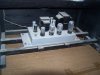
 

Attachments

  • connamp1.jpg
    connamp1.jpg
    38.6 KB · Views: 260
  • connamp2.jpg
    connamp2.jpg
    39 KB · Views: 377
Register to hide this ad
You are about 90 miles from AK member jaymanaa.

He does excellent work. PM him to see if he's interested.

Great looking iron!:thmbsp:
 
These amps have a good power supply, but organ applications generally favor the bottom end of the spectrum over the top, so the output transformers are often not very fast. My Allen 75s generally fell apart much above 16KHz. Maybe that's not an issue, but if it is then it may be adviseable to find some output transformers geard to hi-fi use. I'll admit that despite the upper end limitation my Allens sounded great, and I had no issues with the clarity and definition; they were very clean-sounding.

From what I've read of his posts jaymanaa likely knows his stuff. At that distance away, IMHO, you should make a day trip of it and shake hands rather than entrust those amps to the simian handlers at UPS.
 
I will be watching the progression of this thread. I have a pair of those also just waiting to "be somebody".

I'm excited about mine but not sure where I want to go with them yet.

RC
 
The transformers are excellent, I'd love to see some bandwidth specs for them, but I'd bet they don't give up a thing to ST-70 OPTs.

They sound decent as is, but they have somewhat odd schematics. Very common group of tubes, though with a 6J5 driver, 6SN7 splitter and PP 6L6 for power.

I would expect somewhere around 15-20w, not 30 out of them, however.

BTW, the organ itself probably has anywhere from 40-100 or so 12AU7 (most often RCA made clear tops).
 
Thanks for all the remarks and leads!I think I can live with a limited top end response,if that's how things work out.When I was looking them over before I bought them,I had to use a flashlight.From seeing the 6L6's and pretty hefty iron in the dark- I thought I was seeing a good 30W potential.Well,maybe not! Time will tell,and any info on these is welcome.
I'm still in that "what to do?" planning stage....Like I need another project!!!
 
Dynaco ST70 iron has the same footprint and will add a UL tap to allow you to get more power out of it. :)
 
If that Conn has 12AU7s tone generator tubes that would be sweet, given that most Conn sections utilize 6X8s. The flip side is many, if not most, 6X8 units come with 32 WPC stereo amps utilizing 7868s. The perfect storm would be finding the 12AU7s with the 7868 Amps.
 
Hi, I have a Conn organ amp and agree that it is really good on bottom end, this is just an observation from playing heavy action DVD's. Its interesting that thy put out 25 watts per channel for 7868, my estimation, maybe cause mine have much smaller output transformers. The one person mentioned 32 wpc in this column and the seller I bought it from says 35 watts. Anyways it sounds good, but selling it, need more power for my larger Forte II's. These are really nice amps and yours looks like a winner with the mono blocks.
 
Hi, I have a Conn organ amp and agree that it is really good on bottom end, this is just an observation from playing heavy action DVD's. Its interesting that thy put out 25 watts per channel for 7868, my estimation, maybe cause mine have much smaller output transformers. The one person mentioned 32 wpc in this column and the seller I bought it from says 35 watts. Anyways it sounds good, but selling it, need more power for my larger Forte II's. These are really nice amps and yours looks like a winner with the mono blocks.

The monos are each about the same size as your stereo amp, significantly heavier duty.
 
The transformers are excellent, I'd love to see some bandwidth specs for them, but I'd bet they don't give up a thing to ST-70 OPTs. ..
Wow! That's serious testimony, as Dyna usually had some pretty nice output iron.

....
BTW, the organ itself probably has anywhere from 40-100 or so 12AU7 (most often RCA made clear tops).

You ain't kiddin' there! And when I went on a service call to one of these behemoths I'd bring along a caddy of 'AU7s to replace dead ones I was sure to find. Then the tuning.... :yikes: :D
 
hey-Hey!!!,
Cooler still would be a Baldwin with a 6SN7 generator and a 4x 6L6 amplifier section...:banana: ( love that dancin' bananna! ).

IIRC there were a sack of Conn early black plate 12AU7 in one find, as well as 7591A and GZ34's to go along with PP EL84 amps. They seem to love multiple small amps, instead of one big one.
cheers,
Douglas
 
hey-Hey!!!,
Cooler still would be a Baldwin with a 6SN7 generator and a 4x 6L6 amplifier section....


Oh my aching knees! :yikes:

I remember a few times kneeling for several hours while replacing a gross of capacitors in those things--often in an unheated church.
 
The church aspect may be the difference between in the tube compliments. I've normally seen Conn home organs rather than the larger church or theater models. These have thirty something 6X8 tone generator tubes (one tube for each two notes), and the 7868 stereo amps. Its probably because these units cut costs, and so had only one amp to power both the regular compliment of speakers and the internal tremelo unit (a Leslie without the Leslie name).

The church organs tended to have discrete mono amps for each speaker compartment or array, and often individual tubes linked to each tone generated. This could mean sixty-something 12AU7s. But this is also a reason why the amps had huge iron and less wattage, more of the primary transformer's power was used simply to light up all those tubes.

That's the issue--more is the pity for the audiophile looking in the graveyards for audio tripe from exotic animals to throw in the aural stewpot at home on the stove. But there is also the fact that they draw quite a lot of B+ current in service as well. A different output transformer with a much lower plate-to-plate impedance primary, and a lot of ouchputs oriented in PPP would perhaps harvest more audio output from that power supply...:scratch2:
 
hey-Hey!!!,
I don't consider power efficiency, except humourously...:) My directly heated transmitting tube amps run in Class A. I put as much into one filament as they deliver to the speakers or there abouts. The 4E27 needs near 40W for one cathode, 813's need 50W each. Good thing I don't have to sell these at break-even, let alone profit to pay for some part of labour...:)
cheers,
Douglas
 
Back
Top Bottom