• The move to the new server is done. There are some software and database maintenance updates in process. This has us passing the hat around to help out. We appreciate any donations. Seriously, even a dollar helps. The payment page may be found here - https://www.audiokarma.org/support.html

Most noticeable DAC upgrade over a Chromecast Audio

I don't have to defend my methods. If you don't like my opinion and what I found, that is fine, it is my opinion/findings but I am sticking to it. I don't have to justify anything to anyone.

Are you Audio Science Review? If not, then my post had nothing to do with your opinion/findings; especially since you call them opinion/findings rather than scientific facts.

If someone puts science in their name and touts their results as scientific then I believe they should be willing to discuss and defend their methods used to reach those results.
And I think the items being tested should be run within their designed range. Otherwise it is like a car magazine saying that a car was junk because its engine blew up after being run at 8000 RPM for 10 minutes when it redlines at 7000; with the argument that 'any good car should be able to do that'. But if you have a tilt against cars that don't rev really high then that is a great way to "prove" that they are a bad choice.
 
Quick question I'm pondering as I await the arrival of my $20 worth of stuff. Digital clocking- should the Chromecast be the clocking source or the DAC internal clock (in this case the M-Audio interface)? If internal would the sample rate on the DAC be set at 96Hz? (M-Audio goes to 192kHz but I think the CCA tops out at 96kHz...)

I'm kinda thinking either way would work, so for max flexibility I should just have the M-Audio look to the Chromecast for clocking?
 
Short version: don't overthink it, just connect them and it'll work.

Longer version: there's the sampling rate and there's the clocking. The CCA will determine the sampling rate based on the format it plays (44.1, 48, 96kHz), you can't really set it on the DAC (but you can on ADC). The clocking depends on the DAC, with SPDIF it may use DACs internal clock if the DAC has ASRC or it will be clocked by the CCA if not, but you usually have no control over clocking anyway. Some DACs allow to turn the ASRC on and off though.
 
^ yup... don't overthink :)

Don't get too caught up in numbers either... ASR is getting way too much press these days... while numbers are fine to look at the implementation of the dac chip is what counts... that's what you hear. Too many people don't do their homework and turn to places like that as gospel and they end up scratching their heads when things don't work out. "The specs said" is not always the best route... 35 years of being in the electronics field and I can say that.
 
^ yup... don't overthink :)

What!? Isn't overthinking what this forum is all about?

I kid- I get it. As a longtime musician I've picked way more amps and guitars based on sound and feel than over specs. I like to learn enough to get myself in the wheelhouse, and understand enough to satisfy my audio-geek factor.

Mostly the issue is I can't stop thinking about this stuff while I'm waiting for my cables and adapters to arrive so I can try it!
 
Perfect... then you know... as a musician tone and timbre are important!!

We all have the geek factor which is why I chose this as a career... for me the audio side was a pleasant bonus :)
 
OK- so. I had the receiver on my bench for awhile replacing some transistors that were going bad. If you're bored, here's the thread on that.

With transistors replaced, I got out all the cables and wires and what not and set everything up using the M-Audio Profire 610 as a DAC.

Test tracks were Smashing Pumpkins 'Cherub Rock', and 'Dire Wolf' from Reckoning by the Grateful Dead. Listened both analog out from the CCA on both Spotify, then FLAC (CD-rips) over Plex. I could hear the difference- both sounded pretty good to me- FLAC was better.

Then I ran the CCA optical out to the SPDIF converter, SPDIF converter into the Profire SPDIF In, Profire analog out to the Marantz 2235 Aux input.

A bigger incremental increase. To the point where I finally am starting to 'get it' with all the terms like "soundstage" and what not. Holy smokes.

It almost sounded like everything was EQ'd and mastered totally differently for the better.

From where it started with Spotify over CCA analogue, to the digital with external DAC it is a noticeable improvement. Mostly in clarity, soundstage(yes!), and detail. The new transistors may also have had an impact but I tried to start from scratch with the test tracks after the replacement.

Thanks for the help- I'm sure at some point I'll progress to a better DAC and run it through a receiver with less THD, etc. But it sounds so good to me right now I going to stop and enjoy it for awhile. I could go on and on about the detail I'm now able to hear in the music. But I won't. You folks already know.

Suffice it to say that when I closed my eyes and listened to the Grateful Dead playing live, for a moment there I could swear I smelled armpits and patchouli oil.
 
  • Like
Reactions: gvl
Glad you like it. The audio interfaces are usually pretty good DACs as well because they are made for music production, so they must meet certain levels of performance to be transparent. I think I also hear some improvement when I use a separate DAC with a CCA, but it's relatively small, the DAC sounds a bit cleaner but I'm not sure if I could pick the difference without knowing which is playing.
 
Glad you like it. The audio interfaces are usually pretty good DACs as well because they are made for music production, so they must meet certain levels of performance to be transparent. I think I also hear some improvement when I use a separate DAC with a CCA, but it's relatively small, the DAC sounds a bit cleaner but I'm not sure if I could pick the difference without knowing which is playing.
Yeah- this wasn't really the most controlled A/B experiment. So many things changed at the same time. New transistors in the receiver, moving from compressed audio to lossless, switching to the external DAC. I'll have to do some more targeted (I won't say 'scientific'- I know how that goes on this forum!) A/B-ing at some point, but first I need to organize this mess...

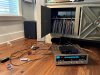
IMG_7069_2016x1512.jpg
 
Brief additional observation after some time and back and forth with the system, in the event it might help others. I can't tell the difference between the onboard Onkyo TX-NR808 DAC (set to pure audio) vs. the M-Audio Profire 610 into the Marantz 2235 at the same volume. The Profire works great with the Marantz, though. They both sound good.

I'd probably consider just sticking with the Onkyo primarily, except there is a noticeable difference between the phono stage/preamp. The Marantz 2235 sounds quite a bit better to my ear vs. the Onkyo phono stage. Onkyo sounds a bit muffled/muddy by comparison, (Using an Ortofon 2M Red FWIW). The Marantz has more clarity and is smoother as well. The Onkyo seems to get muddy in the midrange and shaves off the treble a bit too much by comparison.

The Onkyo doesn't sound bad though, it just is (to me) outclassed by the 2235.
 
Back
Top Bottom