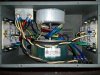
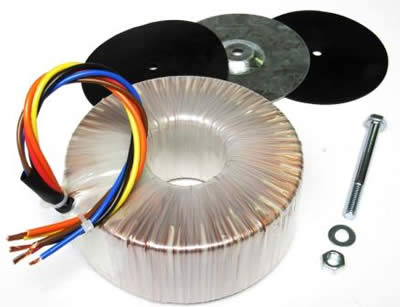
I picked up a 400VA toroidal PT for my current project and after doing a few experiments with it last evening, will almost certainly be using it instead of the silly voltage quadrupler scheme I was using before.
So now the fun part -- how to mount it. Toroidal transformers are "easy" to mount because of the single center bolt... except it's not quite that easy. The turns of a toroidal transformer loop through the donut hole, just like the bolt does, so if the bolt attaches to something conductive, you have the chance of a shorted turn (which can really ruin your day).
The particular transformer I have includes a shielding layer that's brought out on a purple wire to be grounded. That's an instant shorted turn right there if the mounting bolt is not isolated from the chassis.
It gets better... even if I don't connect the shield to ground, I will have a perforated cage over the top of the chassis. That also has the potential to create unwanted currents (although probably not a catastrophic as with the shield). It's only one turn, mind you, so there's probably no shock hazard... but if it doesn't melt the transformer or blow the fuse, it's at the very least going to waste energy as heat.
I think my best bet is going to be to ensure that the mounting bolt is electrically isolated from the chassis ... drill a larger hole, fill it with a rubber grommet, run the bolt through that and use nylon washers on the other side...
Curious to know what other precautions others have taken when using toroidal transformers in their own projects?
So now the fun part -- how to mount it. Toroidal transformers are "easy" to mount because of the single center bolt... except it's not quite that easy. The turns of a toroidal transformer loop through the donut hole, just like the bolt does, so if the bolt attaches to something conductive, you have the chance of a shorted turn (which can really ruin your day).
The particular transformer I have includes a shielding layer that's brought out on a purple wire to be grounded. That's an instant shorted turn right there if the mounting bolt is not isolated from the chassis.
It gets better... even if I don't connect the shield to ground, I will have a perforated cage over the top of the chassis. That also has the potential to create unwanted currents (although probably not a catastrophic as with the shield). It's only one turn, mind you, so there's probably no shock hazard... but if it doesn't melt the transformer or blow the fuse, it's at the very least going to waste energy as heat.
I think my best bet is going to be to ensure that the mounting bolt is electrically isolated from the chassis ... drill a larger hole, fill it with a rubber grommet, run the bolt through that and use nylon washers on the other side...
Curious to know what other precautions others have taken when using toroidal transformers in their own projects?