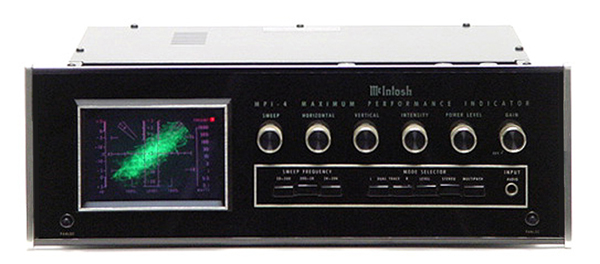
...................................................................................................................Credit to Audio Classics
Over the years I’ve heard many ask what good the MPI 4 is/was.
When the McIntosh MPI 4 was introduced in 1973, I knew I had to have one. At the time I was living in Alaska and was undoubtedly the first kid on my block to have one (probably in the whole state).
I worked with a nun who had a great singing voice (prior to entering the convent she was a singer in a rock-and-roll band). I would hook up a microphone to my system and she would sing notes while observing the single-trace display. When she saw a perfect sine-wave, she knew she had perfect pitch for that note. A sort of bio-feedback learning.
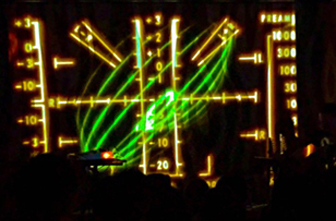
About the time the MPI 4 was introduced, my son was born. He grew up with the MPI 4 and was always fascinated with the display shapes for various music. For instance, Mike Oldfield’s Tubular Bells has a section where the MPI-4 stereo display shows a parallelogram that turns on itself.
Along the way I acquired a second MPI 4 from Audio Classics. I have one in my home theater setup and one in my “play” room.
My son, Ty, graduated from college with a degree in music and then pursued a career in computer science. He is now part of a team that manages the world-wide corporate firewall for a large, well-known anti-virus company. He also has a complete studio with a number of synthesizers and computer-related gear. He has produced a number of albums. Ty's website
Knowing his love for my MPI 4, this year when I paid my annual visit to McIntosh and Audio Classics, I talked to Steve about another MPI 4. He found me a nice minty unit and I bought and gifted it to my son.
Now music is pretty much one-dimensional – it uses our sense of hearing. If you attend a concert or crank up the system, you also feel the music – adding a second dimension. The MPI 4 gives you a visual of the music, adding yet another sense to the mix.
Ty was very happy to have his own MPI 4 and went about figuring out how his favorite music produced the various “designs” on the MPI 4 stereo display. From that, he learned how he could manipulate the music to produce interesting patterns of his own design.
One of his favorite groups is The Legendary Pink Dots – an Anglo-Dutch “synth-pop” band. When they announced a tour of the US this year (in progress) they invited his group (Armchair Migraine Journey) to open for them on the West Coast part of the tour.
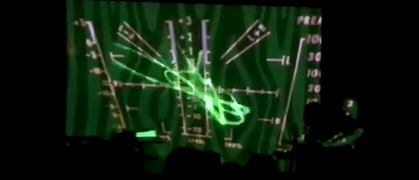
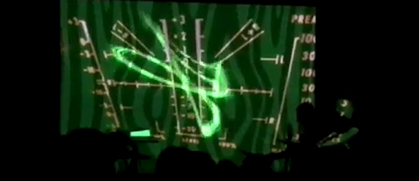
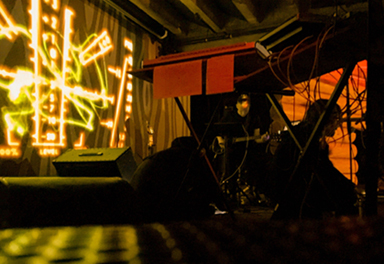
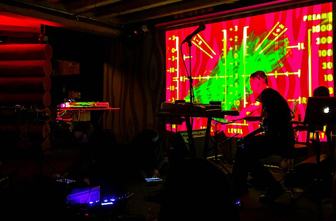
Back to the MPI 4… My son wanted to incorporate the display of the MPI 4 into his showmanship. Now toting around a delicate instrument like the MPI 4 on a band tour is out of the question. So he video-taped the display during a set. Then during the actual concert, he runs that video through a video projector, displaying the MPI 4 stereo trace on the band and wall behind them. Everyone loves it!
And here are some fan-supplied photos of the MPI 4 trace on the wall behind the band:
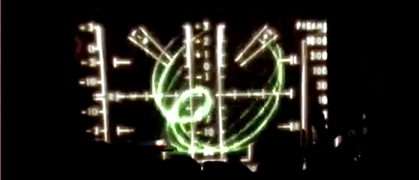
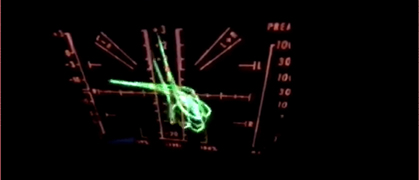
Here are some videos of his projected display: ....Link .... Link ..... Link
And, then Ty on stage:
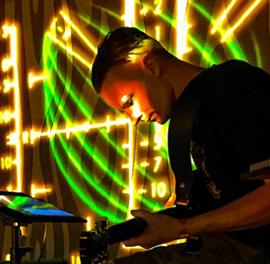


The first section of this Link is a video of the display in action during the concert.
So, there you have it. 43 years after the MPI 4 was brought to market, it is still proven to be useful and is still entertaining those who love music!
Vintage Mac
.