


I have been trying to understand the difference between using an MQ-101 or the bass control on my C-26 to get flat response down to 20 Hz out of my ML-1C speakers.
I have looked at Roger Russell's site and can not find all the details of the action of the EQ's. The specs on the site are lister as follows:
The MQ-101 has bass eq from 0db to +17db at 20 Hz
The C-26 has bass eq from -20db to +16db at 20 Hz
The only reason I can imagine that the 101 would be better or different from using the C-26 control is that perhaps the Q (or slope) is different. I could not find any specific info on this.
Roger included an explanation that seems to support this thought on his equalizers page:
"There are equalizers and equalizers. They aren't all the same. There are speaker equalizers that work with a speaker system to achieve a specific acoustic output. There are equalizers that compensate for different speaker locations in a room. There are equalizers that compensate for response peaks and dips due to room resonances. There are also program equalizers (tone controls) that adjust the frequency balance of program material. Each kind of equalizer is tailored to accomplish a specific task. Each covers a specific frequency range with a certain shape and amplitude. A bass control, for example, does not make a good speaker equalizer. It’s too broad and while it may correct one frequency range, it can also exaggerate another, resulting in different bass that still doesn't sound good."

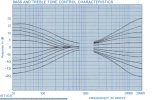
While writing the post I found these graphs - the yellow is the 101 and the blue is the C-26. This also supports my thought that the main difference between the two is the Q.
I may have answered my own question just by writing the post - LOL - I have typed too much to just delete the post and perhaps some of you will have further insights on the topic.
Is it obvious that I am needing to justify the dumping of some more money into the McIntosh void? I should buy an MQ-101, Right? - It's Necessary! Roger Russell says so!
Am I thinking about this correctly?
I have looked at Roger Russell's site and can not find all the details of the action of the EQ's. The specs on the site are lister as follows:
The MQ-101 has bass eq from 0db to +17db at 20 Hz
The C-26 has bass eq from -20db to +16db at 20 Hz
The only reason I can imagine that the 101 would be better or different from using the C-26 control is that perhaps the Q (or slope) is different. I could not find any specific info on this.
Roger included an explanation that seems to support this thought on his equalizers page:
"There are equalizers and equalizers. They aren't all the same. There are speaker equalizers that work with a speaker system to achieve a specific acoustic output. There are equalizers that compensate for different speaker locations in a room. There are equalizers that compensate for response peaks and dips due to room resonances. There are also program equalizers (tone controls) that adjust the frequency balance of program material. Each kind of equalizer is tailored to accomplish a specific task. Each covers a specific frequency range with a certain shape and amplitude. A bass control, for example, does not make a good speaker equalizer. It’s too broad and while it may correct one frequency range, it can also exaggerate another, resulting in different bass that still doesn't sound good."
While writing the post I found these graphs - the yellow is the 101 and the blue is the C-26. This also supports my thought that the main difference between the two is the Q.
I may have answered my own question just by writing the post - LOL - I have typed too much to just delete the post and perhaps some of you will have further insights on the topic.
Is it obvious that I am needing to justify the dumping of some more money into the McIntosh void? I should buy an MQ-101, Right? - It's Necessary! Roger Russell says so!
Am I thinking about this correctly?


