• The move to the new server is done. There are some software and database maintenance updates in process. This has us passing the hat around to help out. We appreciate any donations. Seriously, even a dollar helps. The payment page may be found here - https://www.audiokarma.org/support.html

Muffled sound on 70's Sony with tape from 90's Pioneer

jdelange

Member
Recently I acquired a Pioneer CT-S810S 3 head cassette deck. After replacing the belts I made a recording on a TDK-SA90 with auto BLE without any Dolby. I must admit that I am quite impressed with the sound quality. There are more highs in the recording than I ever had on a cassette. Difference between source and recording is difficult to determine.

Then I put this tape in my Sony TC-229SD which is part of my 70's series Sony setup (TA-5650, ST-4950), and gone where the highs. It sounded muffled as I have grown accustomed to cassettes sounding. Now my question is: is this due to the old tech? Did old cassette decks just don't produce these highs? Or should this be fixable?

Before I took the Sony in operation I cleaned and demagnetized the heads.

Assuming this should be fixable or at least be improvable I was thinking of the following approach:
1. Perform checks and adjustments as per the service manual
2. Create an azimuth tape on the Pioneer (I will settle for that sound quality any day) using my Leader LAG-27 tone generator creating 6 kHz, 10 kHz and 15 kHz tones of 5 minutes at - 20dB.
3. Run the azimuth tape in the Sony TC-229SD and check the phases using my Tektronix 475 in normal and XY mode and see if the azimuth of the Sony can be improved (to match the Pioneer). Background: most of my tape collection is from the 70's-90's. Its pretty worn, both in quality and content. I plan to create new recordings on the 3-head Pioneer which I then would like to play on the Sony (and other cassette players). So the Pioneer is the starting point and reference.
4. So far, actions are easy. Next steps would be improve / repair the electronics of the Sony. Yet I do not know if something is wrong. It's playing, so what to look for and how?
Recapping comes to mind, but I doubt if that's going to improve the highs? It's good to note that the highs are lost in the playback part as I did not record on it and Dolby is off.

So what are your experiences with high frequencies on 2-head 70's decks and did you have any luck in improving dull, muffled decks?

As a side note: it is interesting to see that there are many video's of people adjusting the azimuth of their recorders, but I have yet to see a video where the before and after results are demonstrated. I am guessing something like that could be done with REW whereby a test tape is recorded (on the Pioneer) and then played back on the Sony and checked with REW. I haven't checked this out yet.
 
Register to hide this ad
I suspect you’re on the right track with azimuth. However head wear can reduce highs too. Does the Sony have good highs on tapes you record and play back on it? If so azimuth adjustment to the Pioneer should work.
Rather than REW, look into Audiotester 3.0 and NAK T100 software. Being able to test and see what’s happening in frequency response is very helpful.
 
It sounds like you have a lot of experience, much more than me but the first thing that stands out on that deck is the amount of switches and knobs. I'd give them all a good DeOxit Cleaning, some members may be sick of hearing this from me but outside of belts, this is the other issue that effects sonics the most for me and my deck stash.

These get stuck in the same position for years and the corrosion sits in. My daily driver radio is a Pioneer SK-61 right now, a huge beautiful boombox from 1978, it had very limited sonics when I got it last year but after cleaning and using all the switches and knobs it now sounds pretty good. It has LOUDNESS, TIMER, FUNCTION and radio BAND, they were all messing with channel seperation and the sound.

Great looking deck, that is pretty impressive for 1976.
 
There are at least three potential reasons for your observations:
1) azimuth mismatch, obviously
2) head wear: the Sony has ferrite heads. Popular lore has it that these are indestructable. Reality is that they do wear, but in a different way than permalloy and sendust heads.
3) before roughly 1985 many manufacturers had a loose interpretation of the cassette playback standard, making use of tolerances to implement a treble-drooping playback response. This gave them a few dB extra signal-to-noise ration in the spec sheet. For free. Well, not really ...
 
Update: checked the azimuth alignment. Phases are clearly off. Unfortunately the head adjustment screw is so tight that it cannot be unscrewed. I need to see if I can free it up with acetone and / or heat. This means that I have to remove the drive system (again...) to make it accessible.

I also did a test recording to see if that would improve high frequency. I had to boost the left channel by quite a margin to get equal recording levels using mono input. Yet during playback that same left channel is way lower than the right channel. Not sure if this can be attributed to azimuth also. Otherwise there may be an electronic issue to solve also.

I will take picks when I have the drive free from the case.

Ferrite head wear: I don't think that's very likely. I have had this unit for quite some time, but only now am I picking up cassettes again. There was a reason that the whole drive train was locked up due to hardened grease (a typical Sony problem that I have encountered also on record players and portable cassette players): years of stand still.
 
I had to boost the left channel by quite a margin to get equal recording levels using mono input. Yet during playback that same left channel is way lower than the right channel. Not sure if this can be attributed to azimuth also.

It can not.

Otherwise there may be an electronic issue to solve also.

Or head wear.

Ferrite head wear: I don't think that's very likely.

It is not unlikely. Use has nothing to do with it. Age and environmental issues corrode the gap edges, which then scatter. This is unvisible, except under a good microscope. The result is treble loss.

If what you describe above is a pure wide-band level loss then I would check if both channels get equal/similar bias currents. You might have a fault in the bias generator, perhaps simply due to defective tape type switching. Happens often.
 
tape machines need to be calibrated to the tape you are using. Each manufactures tape and different type of tapes have different prameters. So you calibrate the machine to one type of tape and stick with it. I used Maxell over the years. Most other tapes except for TDK were inferior for sure. If your machine is set up for metal tapes then unless it has the ability to switch to conventional Iron oxide tapes you are going to have issues for sure. Good luck!
 
Found some time to pick up work on the SONY TC-229SD.

Before I started I set the main voltage at 24V using RV501 as per the manual to ensure that voltages measured can be compared with the reference values in the manual.

1. Input level difference.
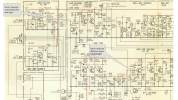
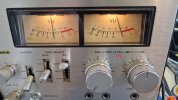
As mentioned when the level input pots are set equally, the right channel is louder than the left channel (image attached), so I need to boost the left channel to get equal input levels (image attached). I measured after the input pots RV301/302 upstream of C102/202 and found the same levels -> the pots are fine. Then I measured (viewing on a scope and measuring using a multi meter) at the input of the line amp upstream of C120/C220 and found a drop in the level -> the filter amps between the pots and the line amps apparently have a different amplification. I measured the voltage rail where C101/201 and R102/202 are connected, left 9.04V, right 8.87V (2% difference) reference value 8.7V.

I would think these values are all within margin so I do not know if this explains the difference between left and right. Also it doesn't explain what causes it. I would think that the right channel pulls more current causing a higher voltage drop over R107/207. Small difference, but quite a difference in the input pots (see image).

I am open for suggestions...

Note that the deck is in record mode to pass the signal from input to output. Hence S1-5 passes the signal from the filter amp to the line amp.

2. Frequency response

Even though the input level difference is a pain, the main issue with the deck is the loss of high tones in play back mode.

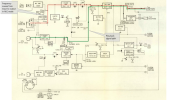
Since azimuth alignment is a sort of last resort, I first want to make sure that the electronics are working as they should. As noted I am using a tape recorded on a modern CTS-810S Panasonic deck as that level of quality is perfectly fine for me. So the main thing I have to bother with are the circuits involved in playback and I am leaving out Dolby to begin with also. So the signal passes through: 1) play back amp and 2) line amp (the green line in the block diagram below).

With the tape in record mode, an input signal passes from line in via the filter amp and the line amp to the line out. So if I take a frequency response from input to output, I have the line amp included. (red line below), unfortunately not the play-back amp.

So used REW to take sweep from input to output, first left, then right channel at -12 dB. I followed the guidelines in this YouTube video in settings things up. I have a Behringer U-PHORIA UMC202HD audio interface.

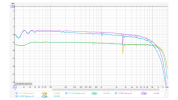
From the charts it is clear that the frequency response of the filter amp and the line amp is as good as flat (upper lines at 0 dB). So this part of the signal path is not a cause for loss of high frequencies. Whats "interesting" however is that the louder right channel has a higher distortion and also the shape is different. The distortion is almost constant over the full frequency range, quite different from the left channel and quite odd (at least for me).

I am open for suggestions ....

3. Visualizing the high frequency loss

I am reluctant to inject an audio signal upstream of the playback amp (i.e. at the record head) as these voltages are so small that I am afraid of damaging something here. So instead I have created a test tape with REW (as explained here, and here) and the Panasonic deck and loaded the recorded sweep into the Sony and the Panasonic for comparison. I used a no-brand standard Ferro tape that must be over 30 years old so this is not the best reference for what the decks are capable of, but for general fault finding this should be fine.

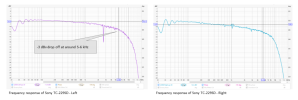
Shown are: 1) frequency response of the Panasonic left and right. -3dBv drop off around 13-14 kHz, 2) frequency response of the Sony left and right. -3 dBv drop off as low as 5-6 kHz, 3) frequency curves of the Panasonic and Sony combined. Level differences are due to the difference in output levels of the deck. I forgot to set these to match.

Sony 229SD - freq response Panasonic.png
Sony 229SD - freq response Sony.png
Sony 229SD - freq Panasonic and Sony.png

4. First conclusions

Given that the frequency response of the line amp is linear and assuming that the playback amp will be lineair too (both channels show similar response, it's unlikely that both playback amps are defect), the loss of high frequencies must be located in the (play-back) head. Orientation / azimuth, tape alignment / path or head wear. I have ruled out dirt and magnetization as I have cleaned and demagnetized the heads prior.

One step I could take before azimuth adjustment is create myself a mirror cassette.

Open for suggestions...
 

Attachments

  • Input levels.png
    Input levels.png
    563 KB · Views: 1
  • Input-output path.png
    Input-output path.png
    371.6 KB · Views: 1
  • Sony 229SD - frequency response in-out.png
    Sony 229SD - frequency response in-out.png
    149.5 KB · Views: 1
  • Level pots.jpg
    Level pots.jpg
    58.5 KB · Views: 1
  • VU meter input level difference.jpg
    VU meter input level difference.jpg
    81.9 KB · Views: 1
I didn’t read everything here but:
Frequency response should be done at-20 dB not any higher.
Use the best tape you can. An old ferric tape probably can’t go higher. If you can use a Metal tape or a decent type II.
Record/ photo all the pots positions before you mess with them. It’s far easier to screw things up than to improve them.
Is the head demagnetized?
 
Back
Top Bottom